
To Find Other Earths, We Need to Understand Other Suns
Overview
NASA’s planet-hunting efforts reflect the fascination of humanity with life on other worlds. The prime goal of the Kepler, K2, and ongoing Transiting Exoplanet Survey Satellite (TESS) missions is the detection of Earth-like worlds around other stars, but concluding that a planet orbiting another star might be habitable is not a trivial matter. Those missions detect extra-solar planets via the transit method, in which changes in the brightness of the observed star are used to infer the presence of something passing between the star and us, the observers. However, light from stars can vary for reasons other than a planetary transit, such as activity on the surface similar to the sunspots on the Sun, changes to the overall surface brightness, and spectral-line changes due to turbulence in the star. Furthermore, the signal from planetary transits is quite weak compared to the noise in the detecting sensors, so eliminating non-planetary signals from the data helps the detection process. Understanding and eliminating stellar “noise” in the data is vital to the planet detection process
Project Details
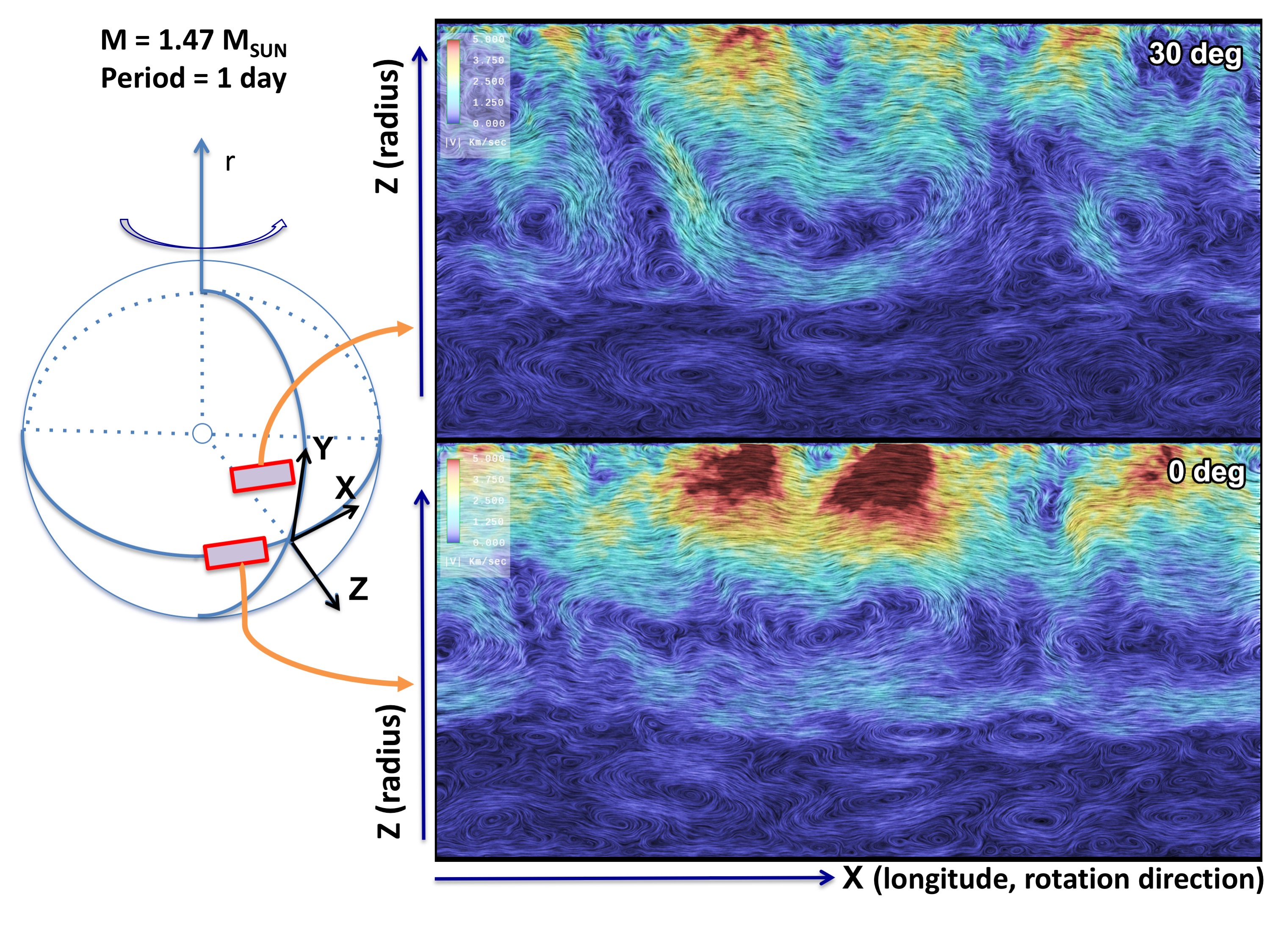
The goal of our work is to understand the nature and magnitudes of the various stellar noise sources that can confuse planet detection and characterization, so as to make planet-hunting a more efficient and robust process. Standard astronomical methods are first used to measure the star’s spectral type, age, metallicity (amount of matter heavier than helium), rate of spin, and gross variability and activity level. Then, simulations are executed on the Pleiades supercomputer at the NASA Advanced Supercomputing (NAS) facility to quantify the various noise sources relevant to planet detection and characterization.
Results and Impact
The iconic solar phenomenon of “granulation” describes the granules of moving plasma at the solar surface that form in the same way as the convecting streams seen in a pot of near-boiling water. We have found through simulations that granulation can have very different structures on stars with masses only slightly different than the Sun, and the surface brightness variation caused by granulation forms background noise in planetary detection using the transit method. Additionally, many stars are known to exhibit highly energetic activity that can negatively impact habitability conditions on their planets, and computer simulations provide details, such as intensity and frequency, about such activity.
Why HPC Matters
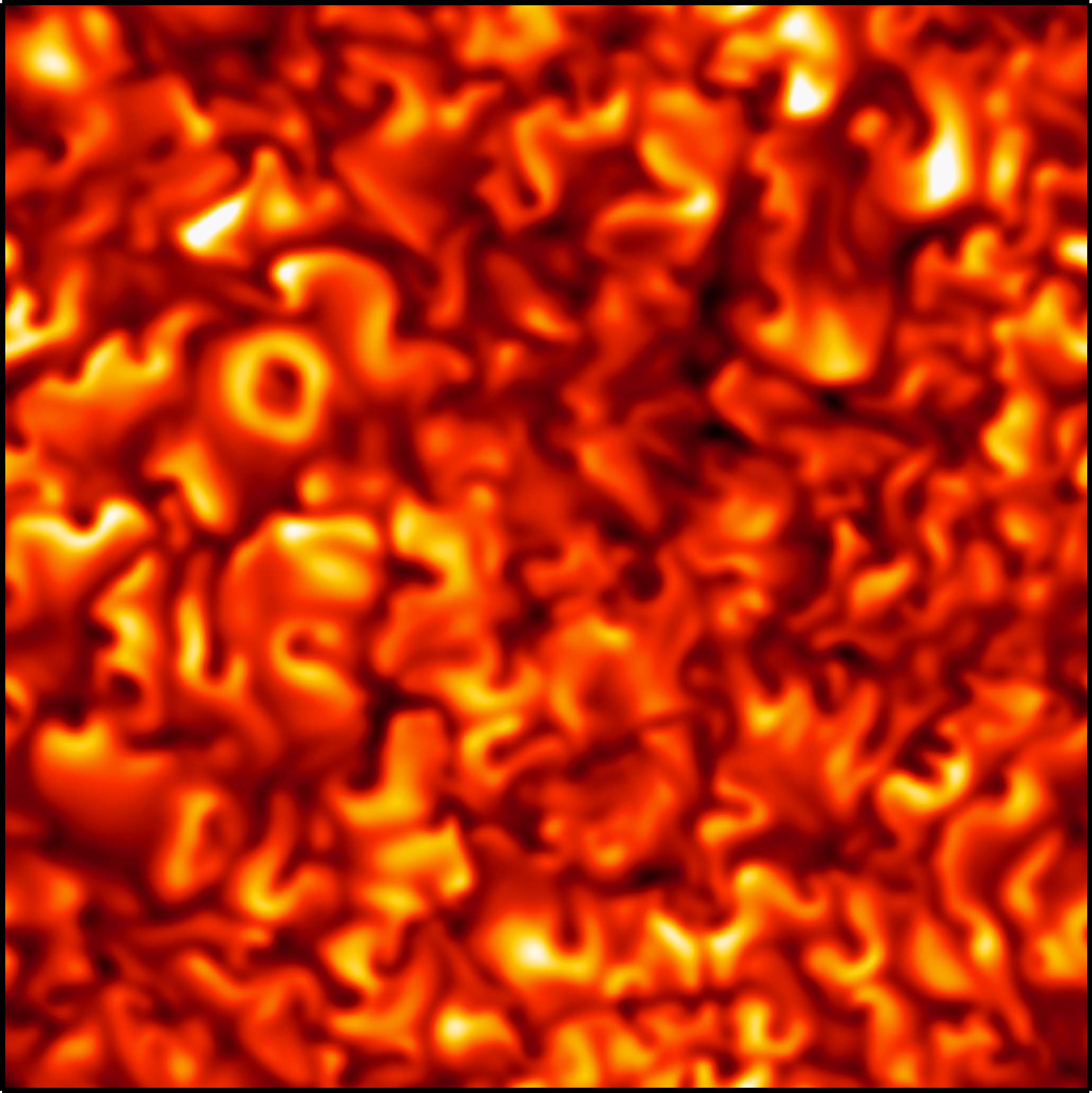
High-performance computing is crucial to the goals of this project, since only through access to resources such as Pleiades could the very great computational needs of the project be met. We often use thousands of processors at a time and many hundreds of runtime hours per case. In addition, system availability, storage for the very large datasets from the most detailed runs, and services—especially data visualization—are equally important and are critical for understanding the massive 4D datasets our research produces.
What's Next
Future elaboration of our work will involve more detailed and accurate simulations by including better models of the relevant physics and simulation of larger regions of the stars at higher spatial and time resolution.
More Information
- See the poster for this demonstration (PDF, 1.8MB). As shown in the NASA booth at SC18.
alan.a.wray@nasa.gov Irina Kitiashvili, NASA Ames Research Center
irina.n.kitiashvili@nasa.gov