
Shields Up! Towards Forecasting Solar Particle Threats Through Simulation
Overview
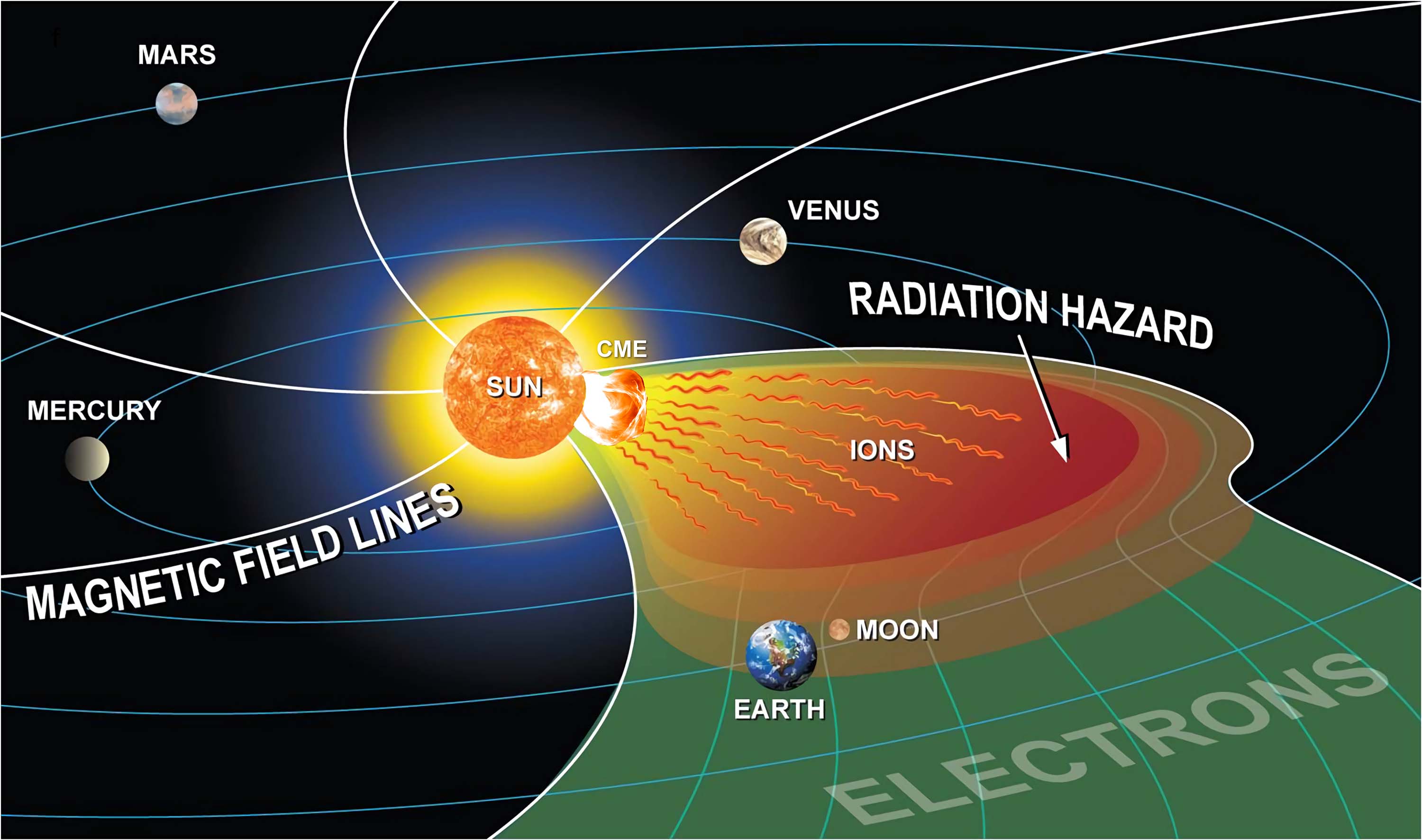
Solar storms, in the form of coronal mass ejections (CMEs) and solar flares, can produce large solar particle events (SPEs), which pose a significant technological hazard to aircraft avionics, communications, and navigation, and a possible health risk for airline crews and passengers. In space, SMEs can be hazardous for crews of spacecraft in low-Earth orbit, the International Space Station, and future interplanetary missions.
The SPE Threat Assessment Tool (STAT) is designed to assess the intensity and extent of SPEs for CME-generated events. Given a magnetohydrodynamic (MHD) simulation of a CME, STAT can compute energetic particle fluxes throughout the heliosphere. These fluxes can be used to identify dangerous regions of space during the event, and determine radiation levels and dose rates. Eventually, STAT could be used to predict the possible range of SPE fluxes in response to the appearance of a threatening active region on the solar surface.
Project Details
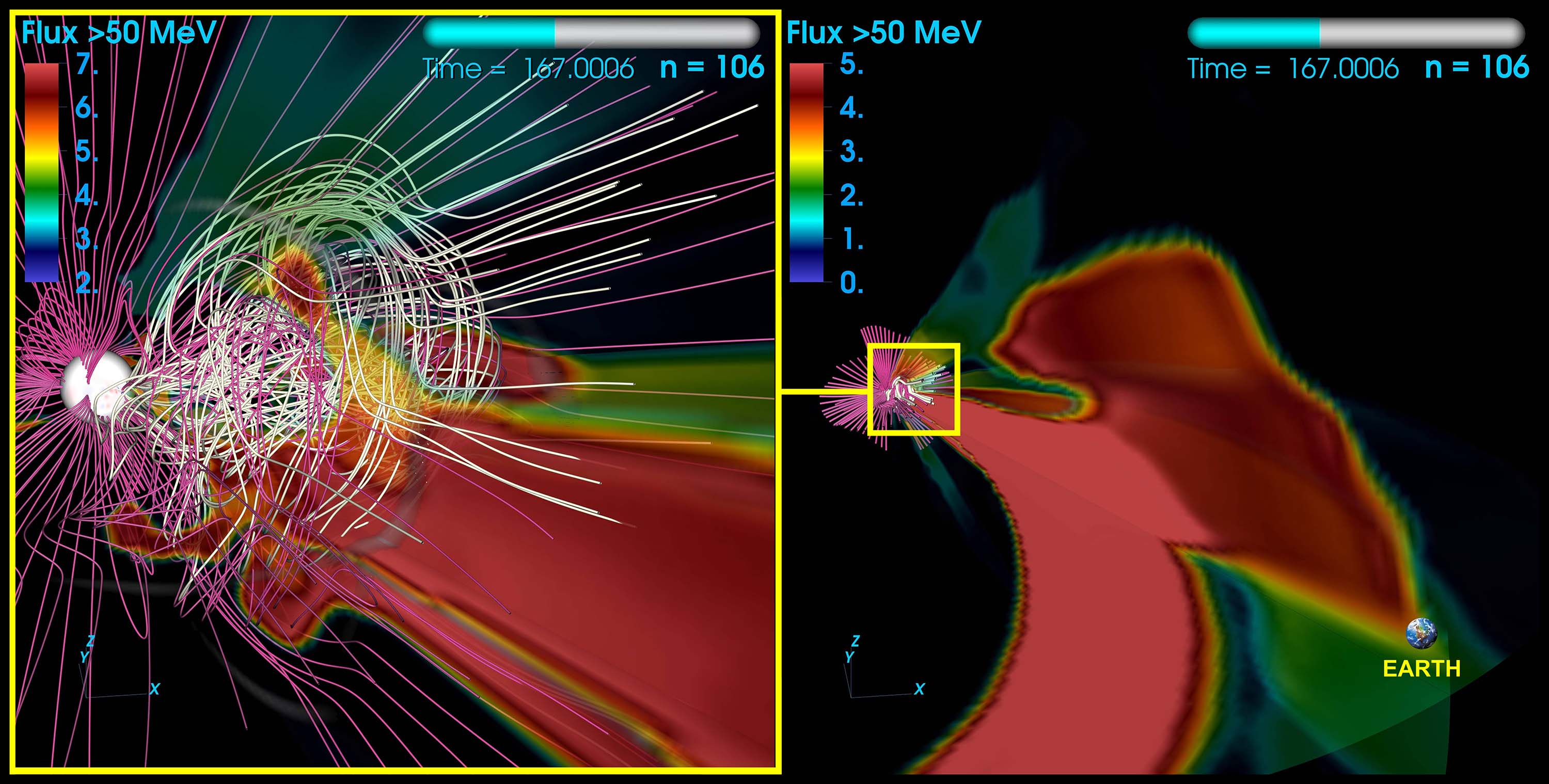
STAT combines the results of state-of-the-art MHD simulations of CMEs generated with the Magnetohydrodynamic Algorithm outside a Sphere (MAS) code, with a cutting-edge constrained transport model, the Energetic Particle Radiation Environment Module (EPREM). The MHD simulation is performed first, followed by the EPREM particle simulations. STAT allows many instances of EPREM to be run for each MHD CME event in order to explore spatio-temporal variations in particle fluxes based on model parameters. Due to their complexity, results of constrained transport particle simulations are traditionally shown for single observer points, or along one-dimensional magnetic field lines. In order to study the sources of particle acceleration from the coupled simulations, and to show dangerous regions throughout the heliosphere, we needed a new way to visualize and analyze the results. By using novel interpolation schemes and post-processing, we are able to show a fully three-dimensional time-dependent picture of the evolution of the particle fluxes.
Results and Impact
The first version of STAT will soon be hosted at NASA’s Community Coordinated Modeling Center, a groundbreaking step that will allow users to run SPE simulations for CME events modeled with the MAS code. STAT is packaged into a user-friendly web-based interface that will allow researchers and operation staff to quickly generate and run SPE simulations, and receive clearly summarized visualizations and data results. The ability to run multiple SPE simulations of these events and compare the results with in-situ observations will greatly advance our knowledge about such events and their behavior. Proper model parameters and physics options will also be established, which is a critical step towards achieving predictive capabilities.
Why HPC Matters
Simulating large CME events requires large HPC resources. These computations can take over 48 hours each using thousands of processor cores. For this project, we ran several CME eruption simulations using the MAS code on NASA’s Pleiades supercomputer. The energetic particle simulations performed using the EPREM code also require large compute resources. Constrained transport codes like EPREM generate massive amounts of data that must be stored and post-processed. Access to the large Lustre filesystems on Pleiades was critical for downsizing the results for visualization and summary reports.
What's Next
Currently, STAT only computes the heliospheric particle fluxes generated by the onset and propagation of a CME eruption in the Sun’s lower corona. Future development will allow the particle simulations to follow the CME as it travels out to Earth and beyond. Advancements in real-time CME simulations will be leveraged to eventually transition STAT into an operational forecasting tool for SPE hazards.
More Information
- Sun-to-Earth MHD Simulation of the 14 July 2000 “Bastille Day” Eruption
- Earth‐Moon‐Mars Radiation Environment Module Framework
- See the poster for this demonstration (PDF, 1.8MB). As shown in the NASA booth at SC18.
caplanr@predsci.com Jon Linker, Predictive Science Inc.
linkerj@predsci.com