
The Tempestuous Global Ocean Circulation
Overview
Researchers from the Estimating the Circulation and Climate of the Ocean (ECCO) consortium are running simulations on NASA's Pleiades supercomputer to create global, time-evolving maps of Earth's ocean and sea-ice system at an unprecedented resolution—about 1 kilometer (km) horizontal grid spacing. The simulations are carried out using the Massachusetts Institute of Technology general circulation model (MITgcm). Our global ocean model includes tidal forcing, which results in well-resolved internal tides and realistic, basin-wide wave trains and interference patterns. The 1-km horizontal grid spacing fully resolves mesoscale eddies (the storm systems of oceanic circulation) and allows submesoscale ocean variability to develop (for example, the jagged filaments and jets that surround mesoscale circulation in the figures). The model output reveals the state of the entire ocean/sea-ice system in exceptional detail.
Project Details
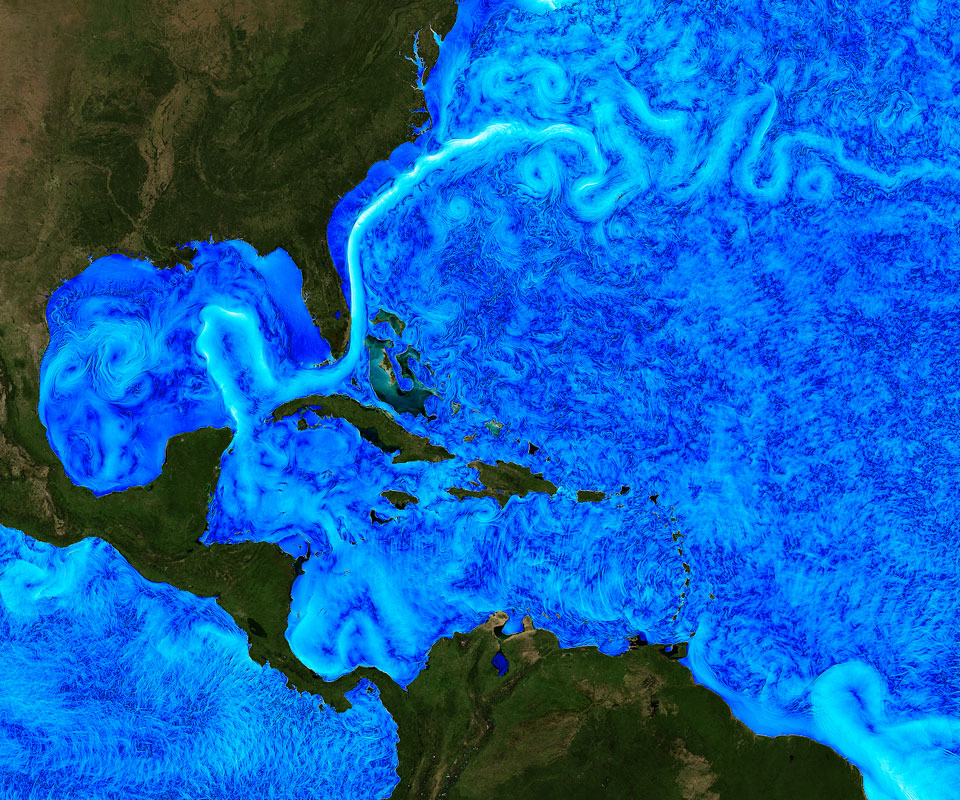
The simulations provide a virtual ocean that admits tidal energetics and submesoscale dynamics not normally represented in global calculations. This capability extends the simulated ocean behavior beyond broadly quasi-geostrophic flows and provides a preliminary example of a next-generation computational approach that will allow us to explicitly probe the interactions between the dominant energetic scales in the ocean and the instabilities that are usually parameterized.
The time-varying fields from these simulations have been recorded at hourly intervals. Comparison with satellite altimeter and current meter data indicate that the model skillfully represents ocean dynamics down to scales of a few kilometers. These simulations are proving to be remarkably useful in helping to increase understanding of how large- and small-scale ocean processes coexist and interact.
Results and Impact
Researchers in the Earth science community are using these simulations to:
- Investigate fundamental questions such as how the circulation, chemistry, and biology of the ocean collectively interact with atmospheric carbon.
- Explore where and when heat is absorbed by or released from the ocean.
- Determine how a pollutant plume or debris field might spread from a particular ocean location.
- Design in-situ observing systems, for example, next-generation ocean acoustic systems, and satellite missions such as NASA's Surface Water and Ocean Topography (SWOT) and the Winds and Currents Mission (WaCM), which will allow us to better monitor and understand ocean turbulence and its impacts on the critical life-support climate systems of our planet.
Why HPC Matters
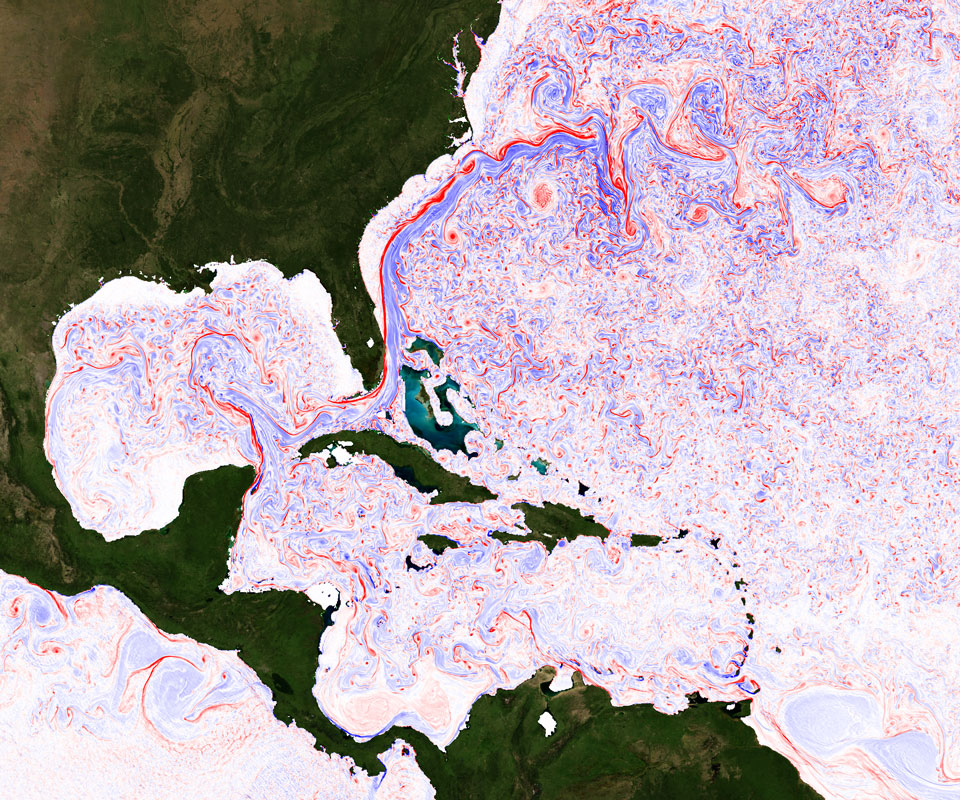
These high-resolution computational fluid dynamics simulations were performed in support of the NASA Science Mission Directorate. The project used the NASA Advanced Supercomputing facility's Pleiades system to integrate the MITgcm model with 22 billion ocean grid cells for a period of 13 months, resulting in 5,000 terabytes of model output. This required sustaining a throughput of 20 gigabits per second when redistributing and streaming output to disk. The computations required about 24 million processor-hours on up to 70,000 cores on Pleiades.
What's Next
As computational and storage capabilities continue to increase, this work has the potential to become a transformative strategy for understanding and predicting impact of global ocean circulation on the Earth's climate. A key next step is coupling of this ocean model with a fully interactive atmospheric model of similar resolution.
More Media
See additional images/videos related to this demo in our media gallery.
cnh@mit.edu Dimitris Menemenlis, NASA Jet Propulsion Laboratory
menemenlis@jpl.nasa.gov