
Advanced Computing Experiences from Hardware Accelerators to Quantum Computing
Overview
Numerical simulation is essential for predicting the weather and understanding Earth's climate. As scientists use more accurate models running at higher and higher resolutions, computational demands continue to increase. Historically, high-end computing (HEC) facilities such as the NASA Center for Climate Simulation (NCCS) have primarily consisted of homogeneous distributed clusters of x86-style processors with a fast interconnect fabric such as InfiniBand. As more performance was required, these facilities increased the number of processors to hundreds-of-thousands and used more powerful microchips and faster interconnect fabrics.
However, due to engineering constraints, the days of increasing clock speeds and fabricating chips with higher transistor densities are no more. And while clusters continue to push core counts toward the millions, organizing and connecting them is itself an engineering feat. In response to these challenges, the HEC community has begun experimenting with new types of hardware accelerators such as graphics processing units (GPUs) and Intel’s Xeon Phi Many Integrated Core (MIC) architecture. Indeed, the current fastest supercomputers, boasting performances in the tens of petaflops, are made with such accelerators. In addition, application-specific solutions such as D-Wave’s quantum annealing computer and IBM’s brain-inspired TrueNorth computer may provide profound performance increases and are active areas of research.
Project Details
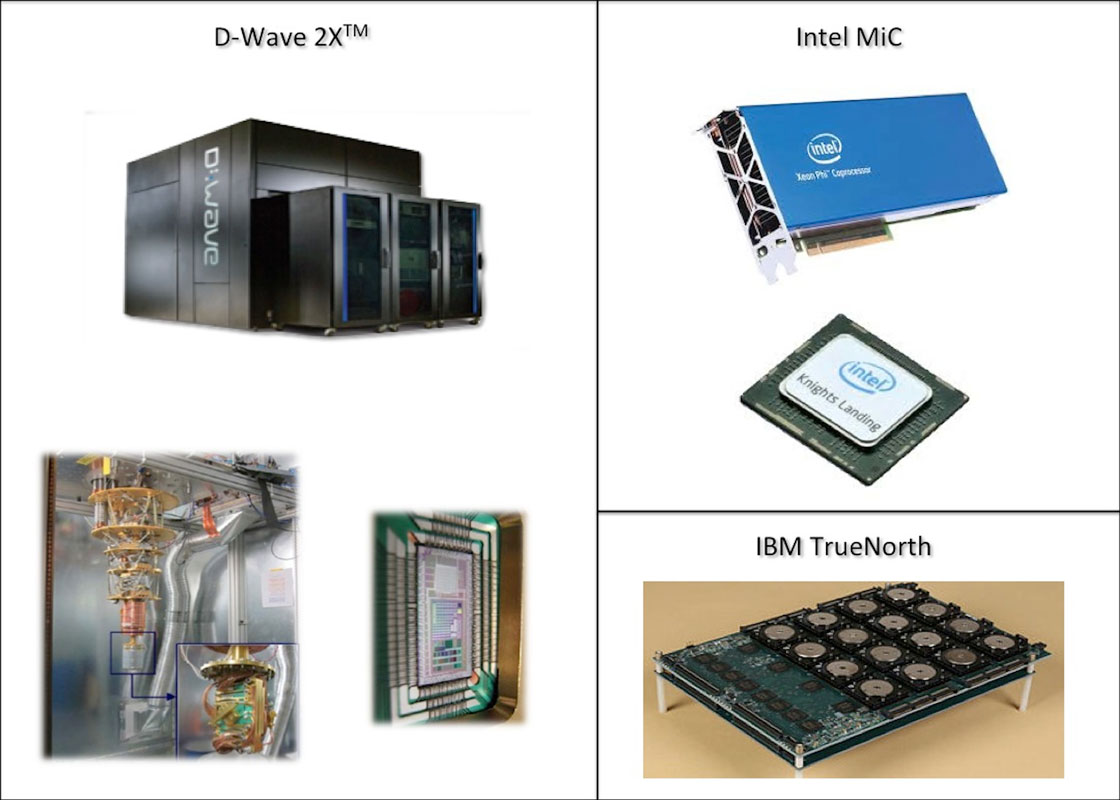
Researchers ported the dynamical core of NASA Goddard's Goddard Earth Observing System (GEOS-5) climate model to Intel's Xeon Phi architecture. OpenMP and structural changes enabled the dynamical core to run efficiently on the Phi architecture and allowed researchers to determine any performance gains achieved over the traditional Intel Xeon architecture.
Scientists analyze data from the Orbiting Carbon Observatory-2 (OCO-2) mission to estimate the annual terrestrial carbon dioxide uptake. Performing this estimation requires data assimilation and image registration of Moderate Resolution Imaging Spectroradiometer (MODIS) data. Researchers reformulated these numerical tasks to run on the D-Wave 2X quantum computer to determine whether quantum computing offers potential performance gains over traditional computing hardware.
Results and Impact
These studies investigated the potential of new computing architectures for performing important numerical tasks within climate science and provided insight and experience in the use of hardware accelerators and quantum annealing. Although studies carried out on Intel's "Knights Corner" Xeon Phi did not show a performance gain over the traditional Xeon architecture, Intel's recently released "Knights Landing" Xeon Phi may offer increased performance.
The D-Wave quantum computer was designed to solve quadratic unconstrained binary optimization problems (QUBOs). This restriction requires formulating numerical tasks as QUBOs. Researchers tested QUBO formulations of data assimilation and image registration on the D-Wave computer. However, due to the limited number of "quantum" bits and precision, these approaches were unsuccessful. The D-Wave quantum computer is also being used to generate Boltzmann statistics to train generative models like Restricted Boltzmann Machines, and is a current area of interest.
Why HPC Matters

Numerical simulations are essential for advancing climate science at NASA. Computational performance is one of the main limitations in achieving more accurate simulations. The search for HEC innovations is essential to advancing the state-of-the-art of climate simulations.
Craig Pelissier, NASA Goddard Space Flight Centercraig.s.pelissier@nasa.gov Dan Duffy, NASA Goddard Space Flight Center
daniel.q.duffy@nasa.gov