
Modeling Nanoscale Light Scattering by the Lunar Regolith
Overview
When Apollo astronauts brought back regolith (soil) samples from the moon, we learned that the soils are darker than the rocks that they come from. In addition, the moon's soils reflect less light at shorter wavelengths than they do at longer wavelengths—a phenomenon that shifts them further toward the infrared end of the spectrum—and the longer a soil has been exposed on the surface of the moon, the darker and "redder" it is. This change in reflectance is the result of a number of processes that affect materials on the surface of airless bodies, which we cumulatively refer to as "space weathering."
Our work is focused on learning the cause of space weathering effects on the lunar regolith and understanding the optics and physics behind it.
Project Details
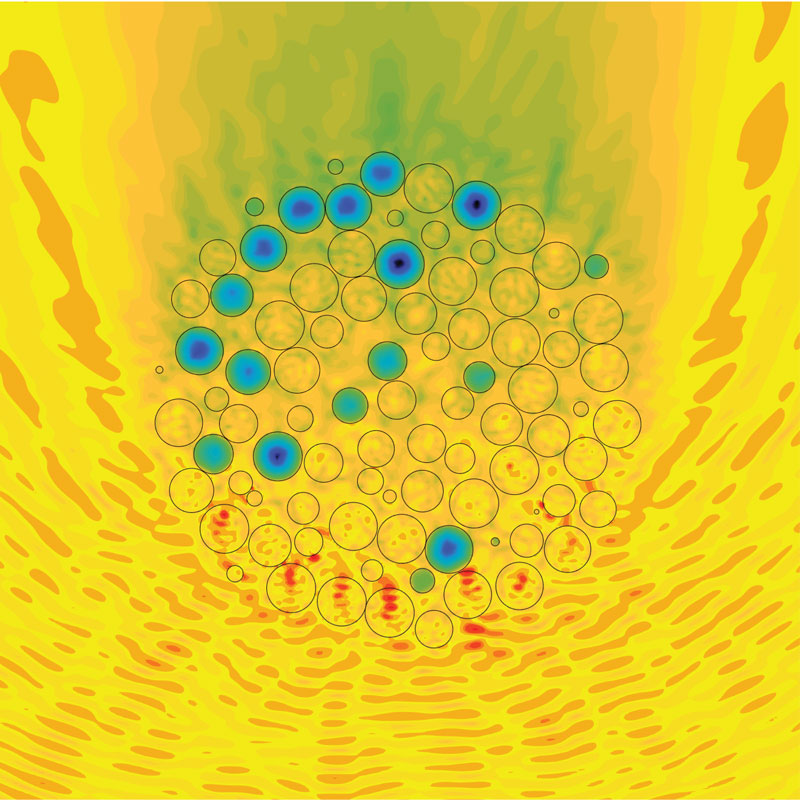
We use a combination of laboratory observations and computer models to characterize the optical effects of space weathering. Our goal is to produce a physics-based computer model that accurately reproduces the observed spectra of these materials, which will enable us to identify and account for the factors responsible for the change in appearance.
We use the Multiple Sphere T-Matrix Model (MSTM) to simulate the reflectance of mixtures of different substances. MSTM allows the construction of simulated clusters of spheres in any arrangement, as long as the surfaces of two spheres don't overlap. Each sphere is assigned an index of refraction and an extinction coefficient. The model then directly solves Maxwell's equations at every wave-particle interface. We can turn the model's output into a simulated reflectance profile, allowing us to directly compare our results to laboratory data and remote sensing observations of the lunar surface.
Results and Impact
The primary method used to determine the composition of the surfaces of planetary bodies is infrared spectroscopy. However, space weathering reduces the spectral contrast of the surfaces of airless bodies in the solar system—including the moon, asteroids, and comets—making it extremely difficult to remotely identify their composition. By fully understanding the optical effects of space weathering we can deconvolve its contribution to the spectrum and better recover compositional information.
In addition, our research is leading to better understanding the role of Mie scattering in natural systems. Mie scattering occurs when the particle that scatters the light and the light's wavelength are approximately the same size. Most models that are used to determine the composition of planetary surfaces do not account for Mie scattering, resulting in poor fits of model data to observations when particle sizes are smaller than about 10 microns. If successful, our model will take Mie scattering and other problems into account, providing much better solutions than existing techniques.
Why HPC Matters
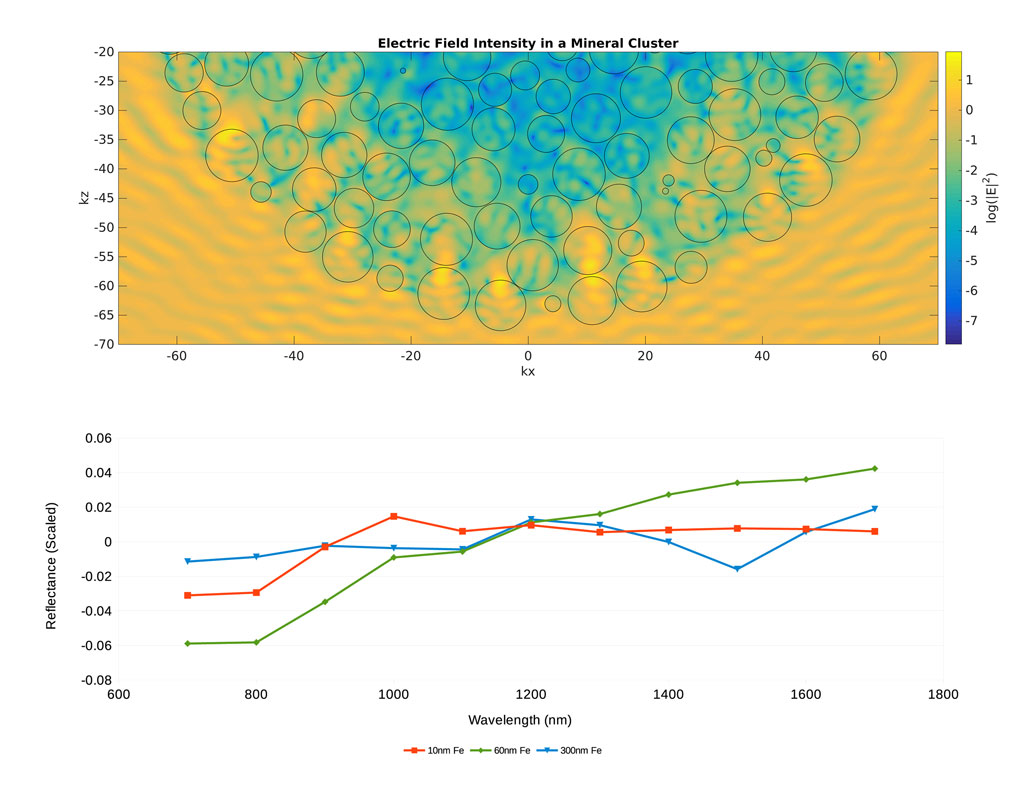
A typical MSTM model run involves solving several hundred thousand equations as many as 2.5 million times. Due to the nature of the math it uses, MSTM can take advantage of massively parallel systems like NASA's Pleiades supercomputer to vastly reduce computation times. Runs that take 6-8 hours on Pleiades would take years to run on a regular desktop computer. Without high-performance computing, our project would not be possible.
What's Next
We intend to increase the complexity of the particles we are examining with MSTM from spherical clusters of homogeneous particles to more realistic heterogeneous particles with inclusions of different substances and void spaces. This will result in more realistic simulations of complex lunar and asteroid compositions.
Carey Legett, Stony Brook Universitycarey.legett@stonybrook.edu Timothy Glotch, Stony Brook University
timothy.glotch@stonybrook.edu