
OpenStack Science Cloud: A Complementary Resource to HPC
Overview
The NASA Center for Climate Simulation (NCCS) at NASA's Goddard Space Flight Center is building a production OpenStack cluster within a physical container, separate from the NCCS Climate Computing Facility's high-performance computing (HPC) environment. The OpenStack cluster will be a more flexible environment for some use cases, such as applications or operating systems not found on the HPC cluster, work patterns that are not conducive to a batch scheduler, and more inherently parallel, loosely coupled processing.
One very appealing feature of OpenStack is the potential for an enhanced security environment. Whereas the HPC environment is a single security domain, Virtual Local Area Network (VLAN)-based OpenStack tenants allow for creating different security domains for different groups and tightly controlling what those tenants can access. Large, shared datasets will be available to authorized OpenStack tenants, just as they are accessible from the HPC cluster.
Project Details
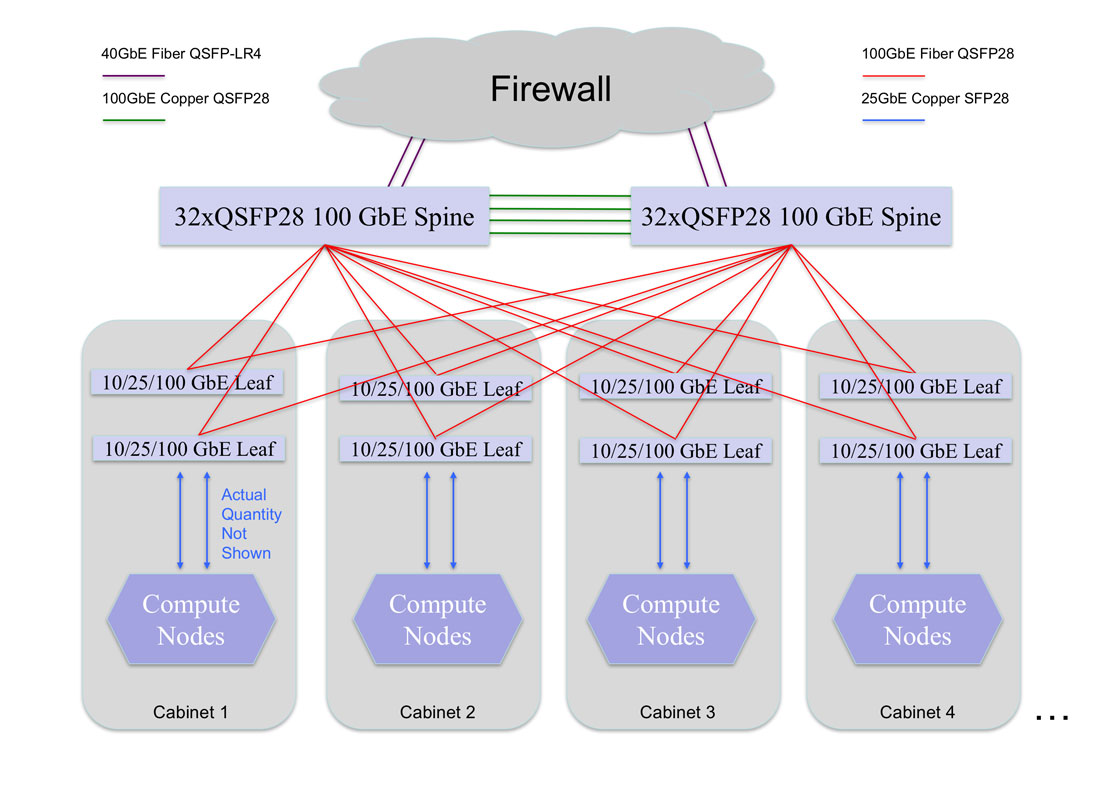
The NCCS is in the process of acquiring new hardware for installation in the production OpenStack cluster container. In the meantime, the NCCS has constructed a 30-node prototype cluster based on the Mitaka release of OpenStack. This has allowed the NCCS to refine its understanding of the myriad micro-services comprising a working OpenStack cluster. The prototype uses xCAT, a proven, reliable, and flexible tool for deploying bare metal that is familiar to many HPC system administrators. In addition to xCAT, the NCCS has used a combination of upstream Puppet modules, as well as Puppet modules written in-house, to create a system for deploying and managing OpenStack; the system has proven to be highly reproducible and fine-grained in its configuration capability.
Results and Impact
Using the prototype OpenStack Mitaka cluster, the NCCS has been able to implement the following technologies with a high degree of confidence:
- Neutron Distributed Virtual Routers (DVR) that are highly available (HA).
- SSL encryption of all network traffic within the control plane.
- HA controller nodes that are active/active behind HAProxy.
- Failover of HAProxy services with Pacemaker, Corosync, and STONITH.
- Secure in-tenant access to very large datasets, where the General Parallel File System (GPFS) is bridged to virtual machines (VMs) using NFSv4.
- DC2 user interface, which hides unnecessary features from the user, and is generally easier to use than Horizon.
Why HPC Matters

Cloud technologies are entering traditional HPC centers as a means of addressing the growth of new communities within computational science. Scientists are far from homogeneous in their abilities to leverage large, distributed-memory jobs. The NCCS therefore views OpenStack as a complementary resource to Discover, its 3.5-petaflop supercomputer. OpenStack allows the NCCS to create environments that are tailored to the needs of specific communities and to do so in a secure and minimally impactful way.
What's Next
Next year, the NCCS will be working to rack and install new hardware to implement its production OpenStack cluster, build a large Swift or Ceph cluster as a Glance storage backend, enable SDN coordination of switches running Linux, and optimize VM access to parallel filesystems.
Jonathan Mills, NASA Goddard Space Flight Centerjonathan.mills@nasa.gov Dan Duffy, NASA Goddard Space Flight Center
daniel.q.duffy@nasa.gov