
Simulating Solar Activity to Predict the Impact on Earth's Space Weather
Overview
Earth is vulnerable to bursts of X-rays and high-energy protons and electrons produced by energetic eruptions (flares and coronal mass ejections) from the solar surface. These space weather events can harm astronauts, disable satellites, disrupt radio communication and global positioning systems, and interfere with electricity distribution.
Earth's space weather is driven by the evolution of the sun's magnetic field, especially the emergence of new magnetic flux and active regions, commonly known as sunspots. A major NASA science goal is to combine observations and theoretical models of emerging magnetic fields in order to predict the occurrence of flares and coronal mass ejections.
Project Details
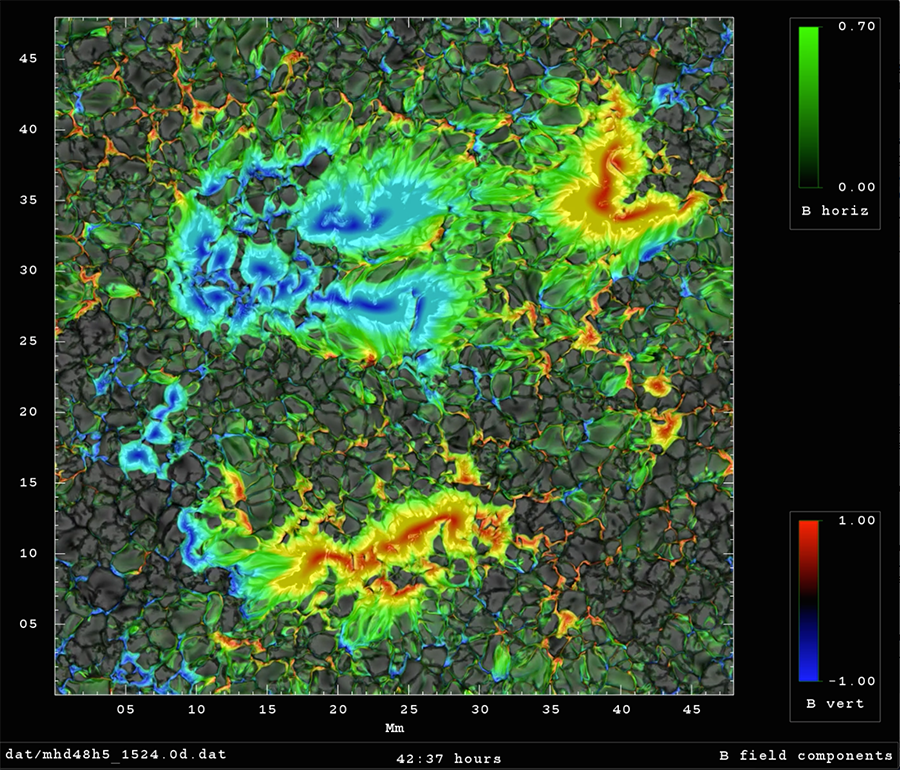
This project aims to model solar magneto-convection and understand its role in the emergence of magnetic fields through the solar surface and the formation of active regions. The outer 10% (two-thirds of the density scale heights) of the solar convection zone is modeled by numerically solving the conservation equations for mass, momentum, and energy plus the induction equation for the magnetic field using a three-dimensional, finite difference, magnetohydrodynamic simulation code.
In our code, ionization energy accounts for two-thirds of the energy transported near the solar surface. Excitation and ionization of the abundant solar elements is included in the equation of state. Radiation from the solar surface produces the low-entropy, high-density plasma whose buoyancy work drives the convective motions. Radiative heating and cooling is calculated by solving the radiation transfer equation using a 4-bin multi-group method and assuming local thermodynamic equilibrium. A horizontal magnetic field is specified as a bottom boundary condition.
Results and Impact
Our simulations reveal that convection twists the magnetic field into serpentine loops. When the tops of loops reach the visible solar surface, a magnetic bipole appears. As more flux emerges, like polarities merge to form strong field concentrations and sunspots. Results from these calculations are used as synthetic data for solar observational techniques. Observational signatures of active regions prior to their emergence are being sought using data from the Solar Dynamics Observatory. Our objective is to be able to predict when the dynamic solar weather will produce harmful space weather on Earth.
In the next phase of this project, we will use results from separate solar global dynamo calculations to provide more realistic bottom boundary conditions.
Why HPC Matters
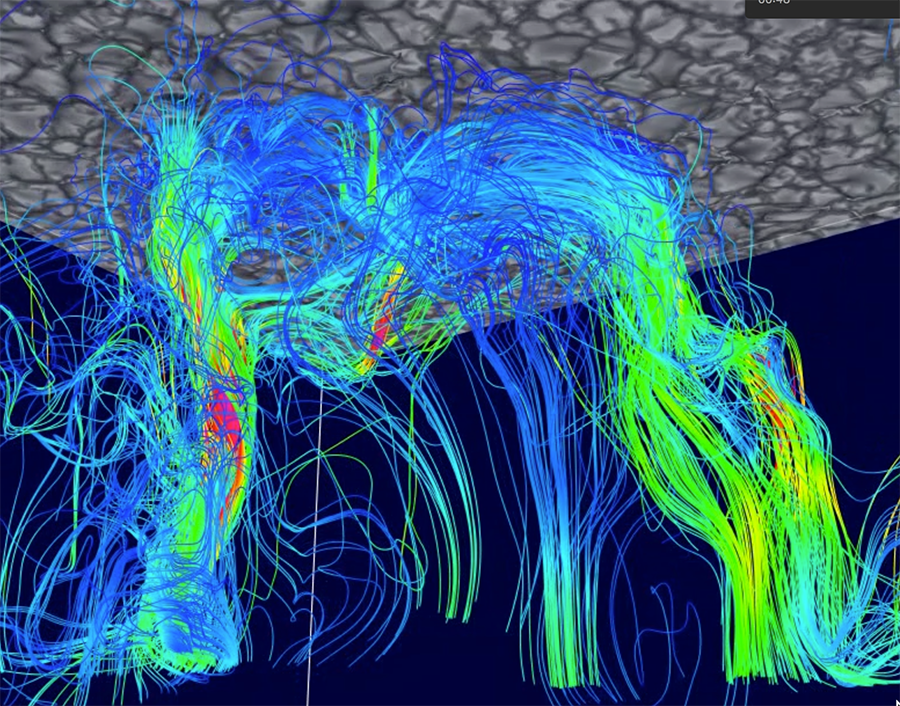
The simulations are being run on 4,032 cores on the Pleiades supercomputer at the NASA Advanced Supercomputing (NAS) facility at NASA's Ames Research Center. Multi-processor computers such as Pleiades are necessary to simulate magneto-convection with large enough dimensions (40322 x 500) to include interactions of very disparate spatial and temporal scales, for example, from active regions (100,000 kilometers) to sub-granules (24 kilometers). Deep convection (20–30 megameters) has a long turnover time—the time for fluid to make a circuit from bottom to top and back again—of two to three days, so a long evolutionary time is required for observable structures to develop and emerge. The NAS visualization team provides the sophisticated visualization methods necessary to understand the simulation results.
Robert Stein, Michigan State Universitystein@pa.msu.edu Aake Nordlund, Niels Bohr Institute
aake@nbi.ku.dk