
Numerical Simulation of Aircraft Noise
Overview
During aircraft takeoff and landing, a combination of jet noise and airframe noise cause large amplitude broadband sound waves. These waves propagate down to the ground where communities neighboring airports are disturbed by the annoying noise levels. Reduction of overall aircraft noise levels is a strong component of the design of next-generation subsonic and supersonic aircraft. In order to reduce noise, the underlying physics of the noise-generation mechanism must be understood. Numerical simulation plays a key role in understanding the dominant noise-generation mechanisms, and in assessing noise reduction concepts. Validation studies on jet noise and slat noise have been performed to gain confidence in the numerical simulation procedure.
Project Details
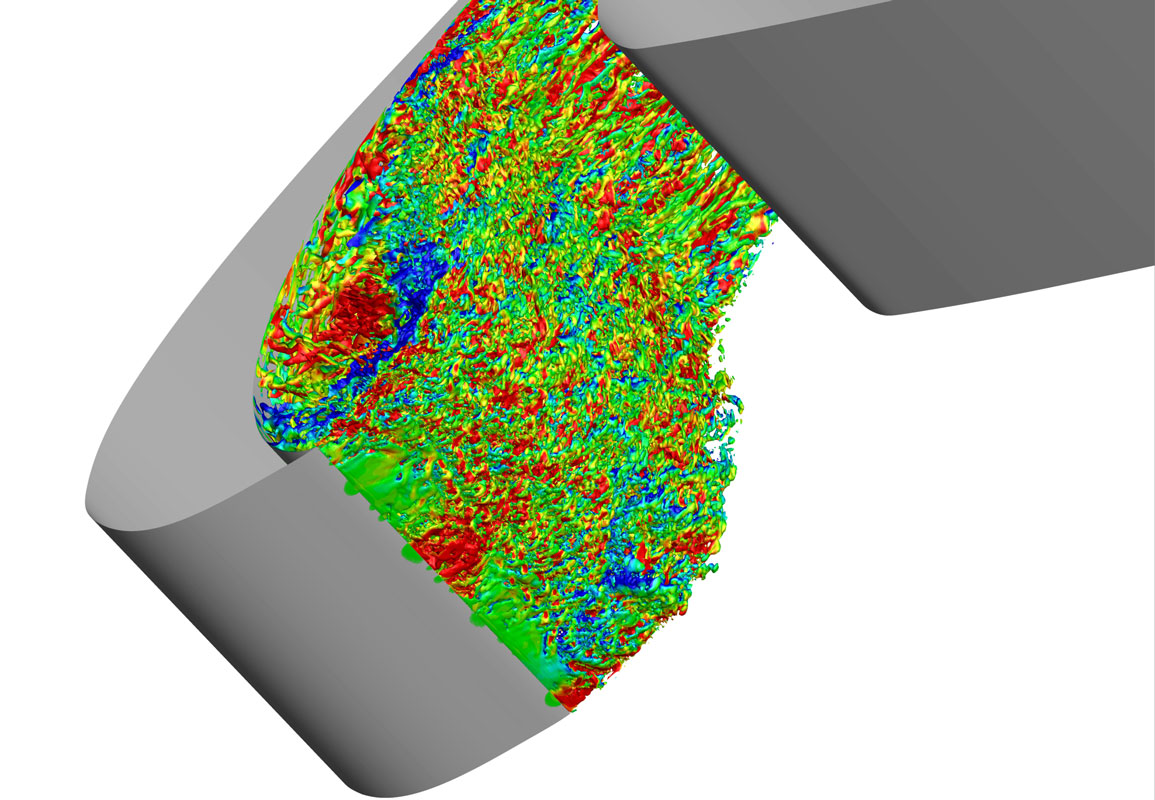
The Launch Ascent and Vehicle Aerodynamics (LAVA) solver framework, developed at NASA’s Ames Research Center, was used to perform high fidelity, time-accurate near-field computational fluid dynamics (CFD) analysis of both jet and slat noise. Noise generated by either the jet or the slat is then propagated to the far-field using the LAVA Ffowcs Williams-Hawkings (FWH) acoustic module. Comparisons to available experimental tests performed at NASA’s Glenn and Langley research centers are used to validate the computed results.
Results and Impact
To simulate the jet noise and slat noise, a higher-order accurate, finite-difference scheme for general non-orthogonal curvilinear coordinates was developed within LAVA, along with advanced hybrid Reynolds-Averaged Navier-Stokes/Large Eddy Simulation (RANS/LES) models. The increased accuracy in both the numerical discretization and the turbulence model allows fine-scale structures to be modeled on relatively coarser meshes, reducing the computational resource requirements. In addition, the use of structured overlapping grids allows relatively large grid calculations to be completed in less time due to the high efficiency of the data structures used in the solver. Impacts of the project include:
- Validation of the LAVA solver framework for predicting noise generation and sound propagation from both jets and high-lift devices.
- High-fidelity datasets to explore the noise-generating mechanisms using advanced post-processing tools also available in LAVA.
- Demonstration of the weakness of several popular hybrid RANS/LES models, implemented within LAVA, as the mesh is refined to very fine levels.
Why HPC Matters
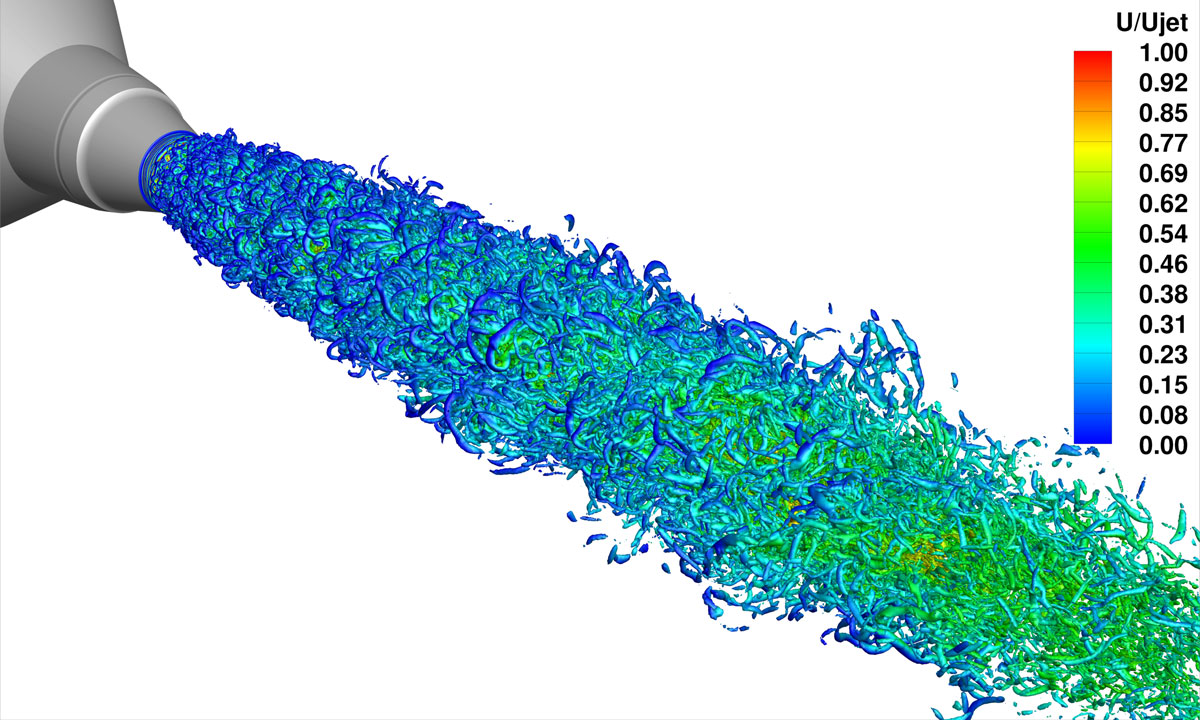
The high-fidelity, time-accurate near-field CFD analysis was performed on the Pleiades supercomputer at the NASA Advanced Supercomputing (NAS) facility using 500-1,300 cores for approximately two weeks per case. For the acoustic propagation, the Fast-Fourier transform of long-duration time series on both solid and permeable surfaces required large amounts of memory. Large-memory nodes on Pleiades, containing up to 256 gigabytes of memory, were used to efficiently perform this part of the FWH procedure.
What's Next
As validation of the LAVA solver framework for a large range of acoustic applications is coming to completion, the solver is now being applied to next-generation aircraft concepts with NASA's Advanced Air Vehicles Program (AAVP) and the Commercial Supersonic Transport (CST) program.
Cetin Kiris, NASA Ames Research Centercetin.c.kiris@nasa.gov Jeffrey Housman, NASA Ames Research Center
jeffrey.a.housman@nasa.gov