
Improving Prediction of Buffet Forces for Design of the Space Launch System
Overview
NASA is developing the Space Launch System (SLS) as a replacement for the retired space shuttle fleet. As the system design matures, the current shuttle-based solid rocket boosters (SRBs) may be replaced with advanced boosters, either solid or liquid fueled. These advanced boosters may have different geometrical shapes than the SRBs, incorporating larger diameters and/or blunter nose caps. We are using computational fluid dynamics (CFD) simulations to assess the aerodynamic impacts of alternate booster designs, with a focus on prediction of the unsteady flow field that causes buffeting. Buffet is a relatively low-frequency (less than 100 hertz) unsteady pressure loading that impacts the vehicle structural response as a whole and is a driver in the structural design of launch vehicles. Buffet forces are typically determined using sub-scale wind tunnel tests. The ability to predict these flow fields and resultant loads promises a powerful capability for the design of the SLS and future flight vehicles.
Project Details
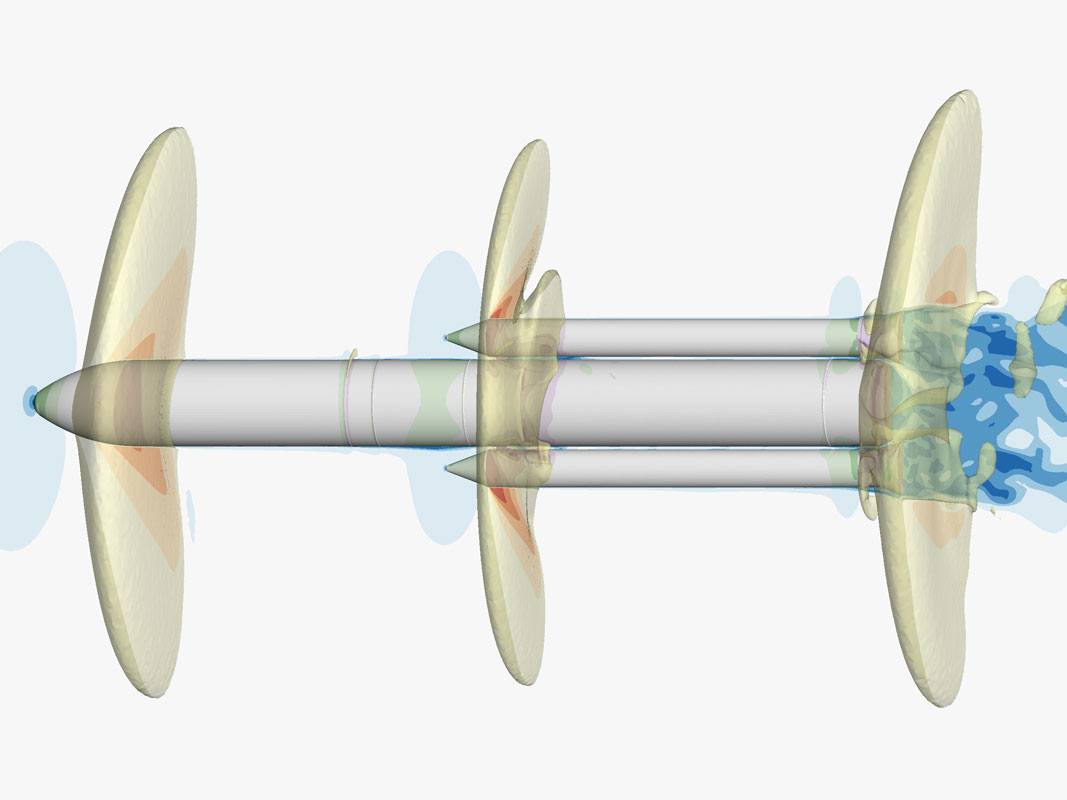
The transonic flow field about SLS cargo configurations was simulated with the Fully Unstructured Navier-Stokes, Three-Dimensional (FUN3D) CFD solver at wind tunnel conditions. Unsteady, time-accurate computations were performed using second-order Delayed-Detached Eddy Simulation (DDES).
Standard practice for predicting structural dynamic response due to aeroacoustic forcing has involved assumptions based on legacy experimental measurements under flat-plate turbulent boundary layers and modeled approximations of derived quantities representing the behavior of the surface fluctuating pressure cross-spectrum. Here too, these parameters were initially estimated from the computed cross-spectrum. However, we discovered that the full, computed cross-spectrum could be used directly—eliminating the model entirely.
Results and Impact
Our CFD-based aeroacoustics and buffet data were found to be in excellent quantitative agreement with ground-based test data. The detailed spatial resolution led to greatly enhanced understanding of loads generated by surface pressure fluctuations on the SLS. Long-duration times were required for statistical convergence due to the considerable variation in pressure signal spectra and levels. Standard Fourier analysis was not adequate, so specialized wavelet methods were developed to reduce the data in order to mitigate the effects of the long durations. Use of the full computed surface pressure cross-spectrum eliminated a significant amount of the uncertainty in predictions associated with model form assumptions. This translated into being able to reduce unnecessary safety margins that may otherwise overly limit the design.
Why HPC Matters
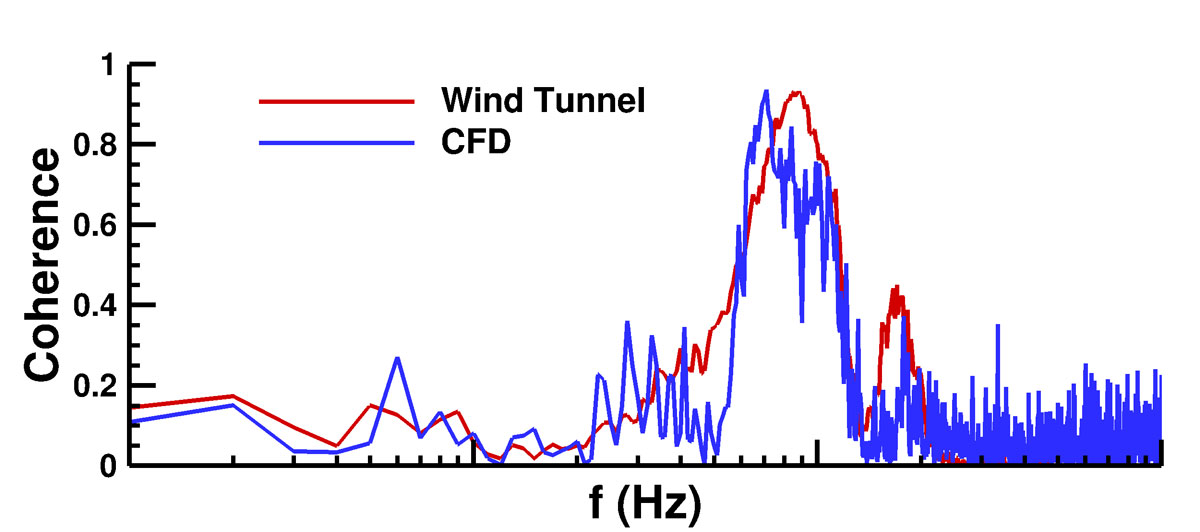
The time histories of fluctuating surface pressure for these complex flow fields are often highly non-stationary. This is due to the fact that the pressure signals contain both loud and quiet periods where the spectra and levels change considerably. As a result, the simulations need to be very long in duration in order to approach statistical convergence. Each simulation typically used 12,000 cores of NASA supercomputing resources and required approximately 36 million core-hours.
More Media
See additional images/videos related to this demo in our media gallery.
w.t.jones@nasa.gov Craig L. Streett, NASA Langley Research Center
craig.l.streett@nasa.gov