
Computational Aeroacoustics for Green Aviation Propulsion Technology
Overview
Over the last few years, there has been renewed interest in pursuing contra-rotating, open-rotor propulsion technology due to its potential to significantly reduce aircraft fuel consumption. A main concern for the design of such systems is that they must meet community and cabin noise standards. Hence, reliable noise prediction capabilities are essential to enable novel and fuel-efficient open-rotor systems. Immersed boundary and structured curvilinear grid approaches have reached a level of maturity to where they are now frequently employed for specific real-world applications within NASA, which makes these noise prediction models more reliable tools for aircraft design.
Project Details
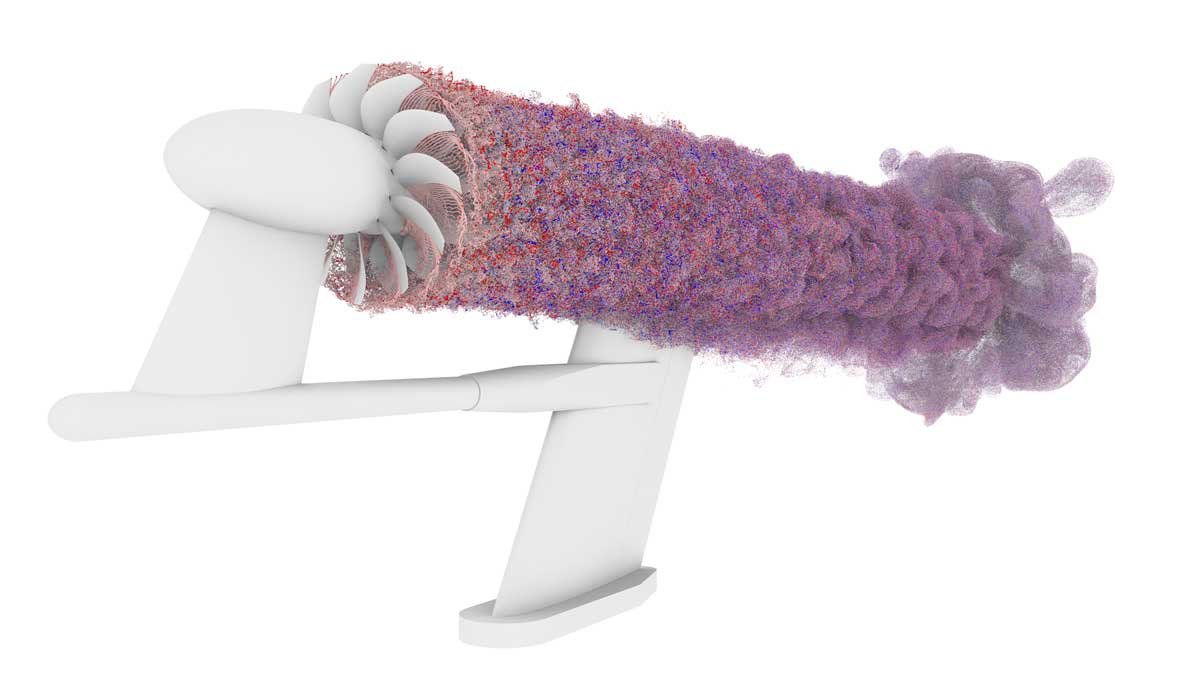
In recent years, NASA initiated several research efforts that have assessed the agency's capabilities for predicting noise source and for analyzing contra-rotating open rotors. This project demonstrates that our higher-order methods, developed within NASA's Launch Ascent and Vehicle Aerodynamics (LAVA) software framework, provide the ability to perform aeroacoustic analysis of wake-dominated flow fields. One of the key challenges of these models is to conduct efficient high-fidelity simulations of the relatively complex geometry. Our first-of-a-kind aeroacoustic simulations employ an immersed boundary method for an open-rotor application. In addition to applying the immersed boundary method to this moving boundary problem, we conducted a detailed aeroacoustic analysis of the noise-generation mechanisms encountered in the open-rotor flow.
In our previous work, the simulation data—both immersed boundary and curvilinear-based—compared well with available experimental wind tunnel data. The noise-generation mechanisms were analyzed by employing spectral analysis, proper orthogonal decomposition, and the causality method. Several low- to high-fidelity simulation tools were used to provide noise predictions, and their results were compared to the experimental data. In this work, both free and pylon-installed low-speed (Mach 0.2) cases were simulated, revealing pylon effects and allowing for further improvement of the CFD tools. Our work is supported by NASA's Advanced Air Transport Technology project.
Results and Impact
We employed higher-order accurate immersed boundary methods to simulate the highly complex flow field around an open rotor. Three key tasks were performed:
- Low-speed (landing or takeoff conditions) simulations of the open rotor with our novel higher-order immersed boundary method.
- Open rotor installation effects simulations, which included a pylon to more closely represent how the engines are attached to airplanes.
- Detailed analysis of the most dominant noise-generation mechanisms of the open-rotor propulsion system.
Several postprocessing tools (such as Fourier transforms) were used to obtain a detailed understanding of the noise-generation process. For the pylon-installed case, we found that higher turbulence levels vs. the no-pylon case were partially due to an improved wall model, and that pylon wake chopping enhances blade wake breakup. Through these higher-order accurate simulations, NASA continues to advance the state-of-the-art in CFD simulations for green aviation.
Why HPC Matters
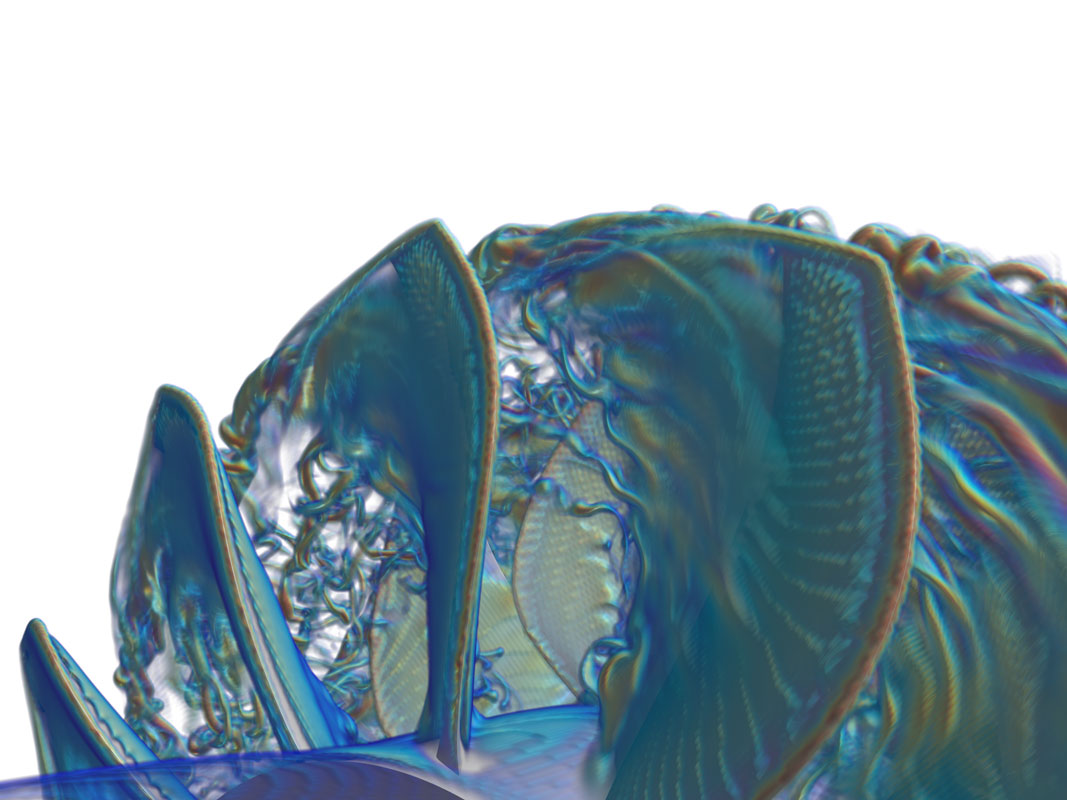
Using NASA's Pleiades supercomputer, the simulations consumed approximately three weeks of wall-clock time on 500–2,000 Intel Haswell cores. These simulations would not be possible without the use of a large cluster system like Pleiades. The visualization team at the NASA Advanced Supercomputing (NAS) facility helped generate ultra-high-quality renderings of the open-rotor flow physics.
More Media
See additional images/videos related to this demo in our media gallery.
michael.f.barad@nasa.gov Cetin Kiris, NASA Ames Research Center
cetin.c.kiris@nasa.gov