
Predictive Modeling for NASA Entry, Descent, and Landing Missions
Overview
Entry, descent, and landing (EDL) technologies ensure precise and safe landings for complex NASA entry missions such as the Mars Science Laboratory (MSL) and the Orion spacecraft. EDL modeling and simulation is an enabling capability used in every mission phase to define mission concepts, select appropriate architectures, design EDL systems, quantify margin and risk, ensure correct system operation, and analyze data returned from the entry system. Since it is impossible to fully test EDL concepts on the ground prior to use, accurate modeling and simulation capabilities are required to extrapolate ground test results to expected flight performance.
Project Details

The Entry Systems Modeling (ESM) Project identifies promising mid-Technology Readiness Level capabilities and matures them in order to deliver game-changing products for NASA EDL missions. ESM relies heavily on partnerships within NASA, academia, and industry to accomplish key objectives and deliver new capabilities with high mission relevance.
Results and Impact
The ESM team has made several key impacts on EDL modeling and simulation during the last year, including:
- Provided new data on shock layer radiation and worked to update the Orion margin policy for Exploration Mission-1 (EM-1), saving significant thermal protection system mass.
- Demonstrated that infrared radiation from carbon dioxide could account for the difference between flight data and predictions for the Mars Science Laboratory Entry Descent and Landing Instrument (MEDLI) sensors on the MSL, which measured the temperatures and atmospheric pressures during the entry. Our data provided the justification needed to include a radiometer on the MEDLI-2 instrument aboard the Mars 2020 entry vehicle.
- Produced a full, dynamic, trajectory-based simulation of an entry body, from hypersonic to subsonic flow. The results of this simulation establish the credibility of computational fluid dynamics for use in analyzing and predicting capsule dynamic stability.
- Established a new, fully coupled parachute fluid-structure interaction capability based on an eddy solver developed at NASA Ames Research Center. This capability, when mature, will revolutionize our ability to understand the dynamic behavior of parachutes during descent, and will inform residual risk for Orion during single chute out abort scenarios.
- Demonstrated that high-fidelity models for ablating heat shield materials can accurately predict critical material properties including porosity, permeability, and thermal conductivity if actual geometry is used as input.
Why HPC Matters
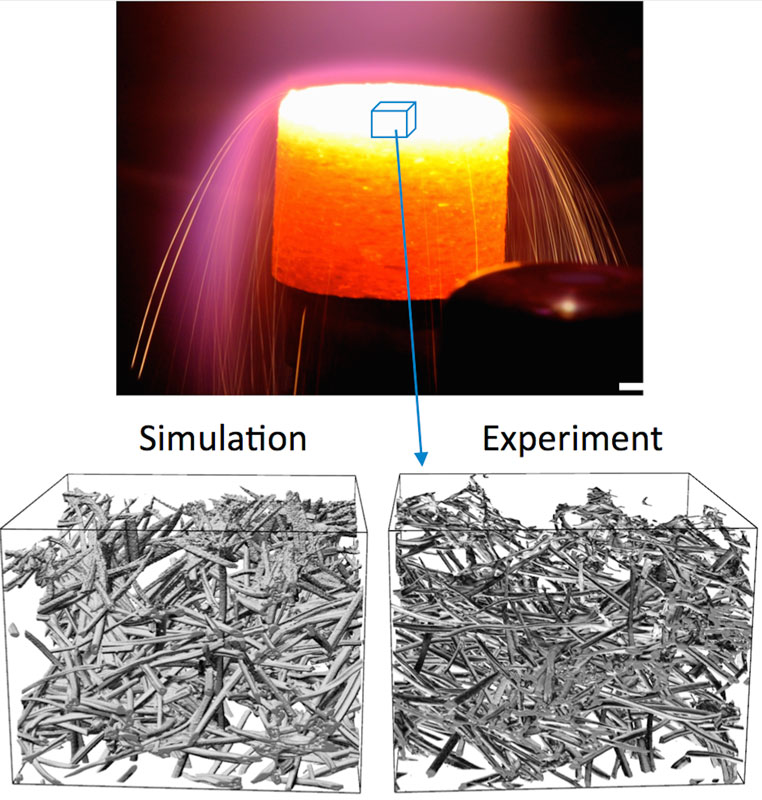
Over the last year, the ESM team used over 7 million node-hours—primarily on the Pleiades supercomputer at the NASA Advanced Supercomputing facility. Many of the team's groundbreaking modeling and simulation advancements require time-accurate simulations of dynamic problems with relatively large, inherent time scales of interest. These simulations are computationally expensive, and even with optimized codes, high-performance computing (HPC) resources are critical.
What's Next
The ESM team continues to push the state of the art in EDL modeling and simulation capabilities. Further development of high-fidelity models for dynamic processes in fluids, computational material design, GPU-optimized Direct Simulation Monte Carlo simulations, and ab initio simulations of key physical phenomena in shock layer radiation will push the boundaries of NASA's HPC technologies.
More Media
See additional images/videos related to this demo in our media gallery.
michael.j.wright@nasa.gov