
New Insights into Dynamic Stall for High Performance Helicopters
Overview
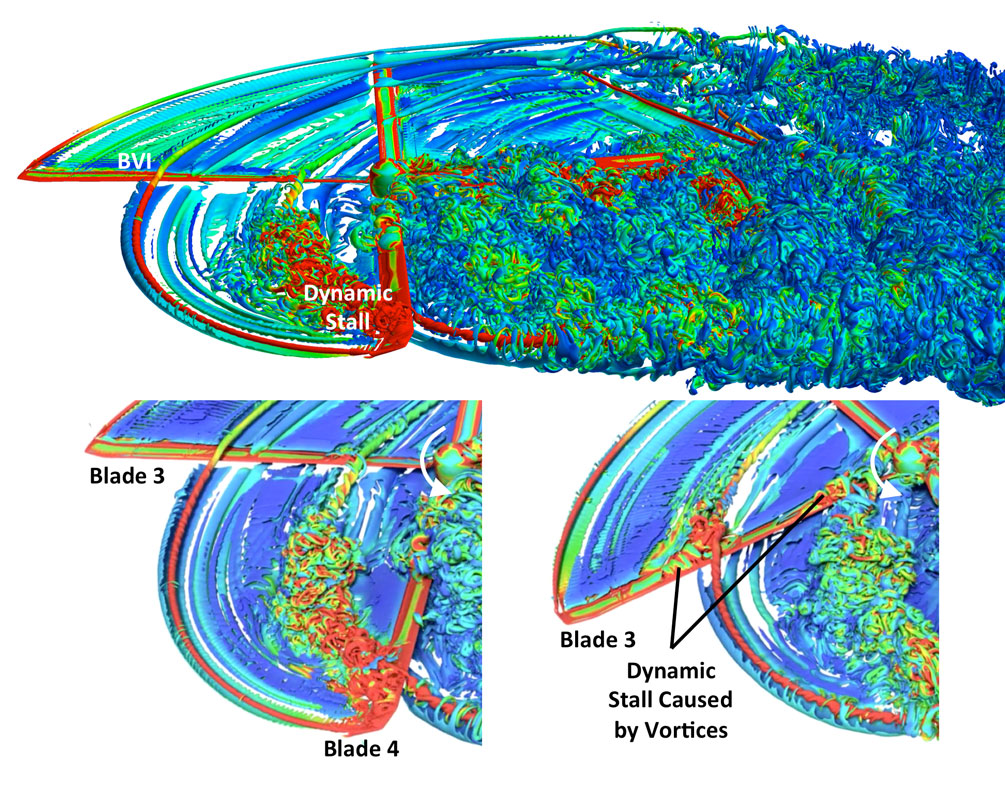
An important goal of NASA's Revolutionary Vertical Lift Technology (RVLT) Project is to increase a helicopter's forward-flight speed and lifting capability in an environmentally responsible manner—for example, by reducing noise levels and fuel consumption through better designs and hybrid propulsion systems. However, some new high-performance designs can lead to blade-vortex interactions (BVI) and dynamic stall, where a helicopter's blade-tip vortices strike and interact with other spinning rotor blades. Dynamic stall causes a sudden reduction in thrust, which can be dangerous and limits a helicopter's lifting capability and flight speed. Computational fluid dynamics (CFD) is providing greater insight and improved prediction accuracy for BVI and dynamic stall.
Project Details

An accurate CFD simulation depends on adequately resolving the important turbulent flow features. Dynamic stall is particularly challenging, prompting the question: To what degree does the CFD accuracy depend on resolving the flow features with finer grids, and how much does it depend on the turbulence model? For our project, adaptive mesh refinement (AMR) is used to address part of this question by automatically and efficiently refining the vortices in the rotor wake.
Results and Impact
NASA's OVERFLOW code is used to evaluate the effects of AMR refinement of the vortex wake for an isolated Blackhawk helicopter rotor during BVI and dynamic stall events. The rest of the helicopter fuselage and other vehicle components could be included in the computational model, but we excluded them because they don't affect the fundamental nature of the flow. These simulations help address the question posed above. We found that:
- The predicted aerodynamic loads did not depend on refining the rotor wake beyond what is normally done for engineering calculations. This surprising result is good news for design engineers who must compute many CFD simulations on coarser grids to reduce analysis time and cost.
- Vortices passing over the top of rotor blades triggered dynamic stall. It was previously thought that a rotor blade pitching up to a high angle of attack was the sole cause of dynamic stall. Therefore, decades of experiments and CFD validation have focused on the simpler problem of a two-dimensional pitching airfoil. Our recent findings indicate that BVI increases the local airfoil's angle of attack, which can cause dynamic stall.
- Time-dependent flow visualization was crucial to understanding the relationship between blade-tip vortices and dynamic stall.
Why HPC Matters
These flow simulations were made possible by NASA's Pleiades supercomputer, using 5,628 Intel Xeon Broadwell cores for 1-2 weeks. Grid sizes varied from 78 million to 1.8 billion grid points using SGI's Message Passing Interface (MPI) and OpenMP with two threads. Solutions typically required 6-36 hours of wall-clock time per rotor revolution, and up to 270 terabytes of disk space to make high-resolution movies of the unsteady flow simulations.
What's Next
Our next challenge is to explore the use of AMR on the rotor blade surface rather than the rotor’s vortex wake. We anticipate that this will improve the CFD correlation with experiment, reduce the computational cost, and pinpoint to what degree grid resolution and the turbulence model each affect solution accuracy.
More Media
See additional images/videos related to this demo in our media gallery.
neal.chaderjian@nasa.gov