
Improving Fidelity of Launch Vehicle Liftoff Acoustic Simulations
Overview
Space launch vehicles experience high acoustic loads during ignition and liftoff. These loads are affected by the interaction of the rocket plume's acoustic waves with the launch pad structure. Taking advantage of highly parallelized computational fluid dynamics (CFD) analysis tools, optimized for running on NASA supercomputers, we are now able to simulate highly complex plume formation and interaction with launch pad geometry and capture the sources of acoustic noise in the plume shear layers and impingement regions. These CFD solvers robustly capture the acoustic fluctuations but are too dissipative to accurately resolve the propagation of the acoustic waves throughout the launch environment domain along the vehicle.
Project Details
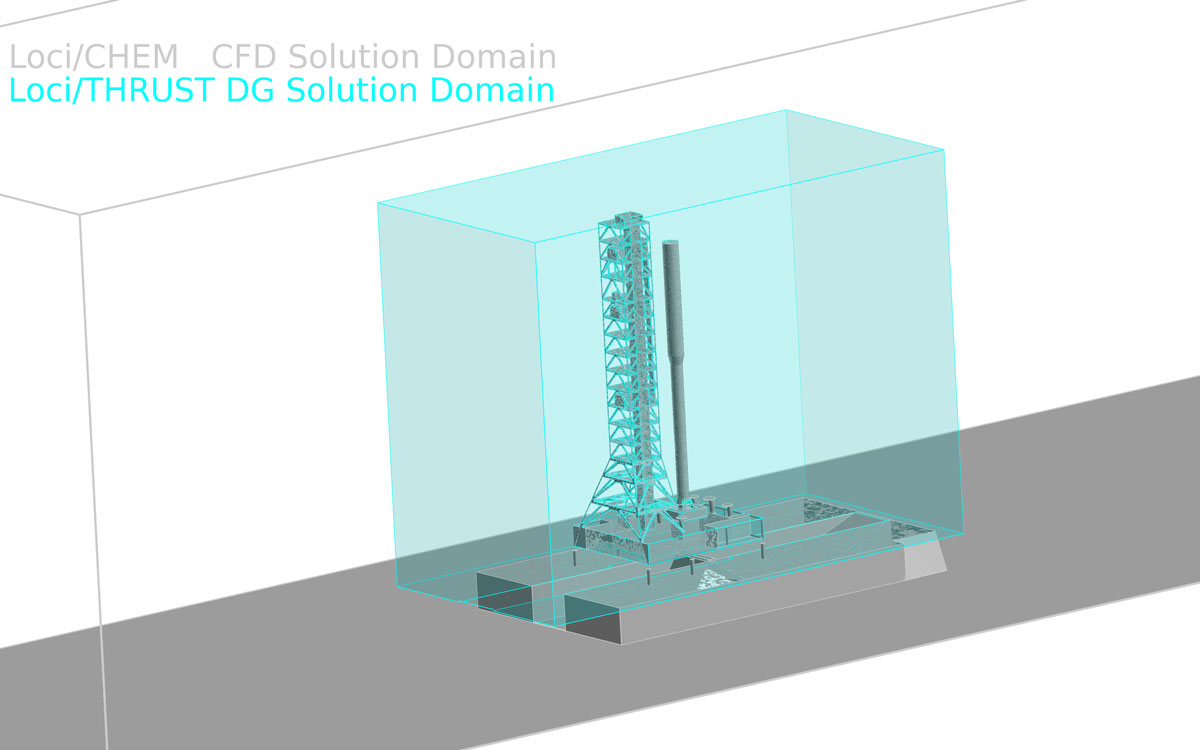
We have developed a hybrid CFD and computational aero-acoustics (CFD/CAA) modeling framework to improve such liftoff acoustic environment predictions. The framework combines the existing, highly scalable NASA CFD code, Loci/CHEM, with a high-order accurate discontinuous Galerkin (DG) solver, Loci/THRUST, developed in the same framework. Loci/THRUST employs a low-dissipation, high-order, unstructured DG method to accurately propagate acoustic waves away from the source regions across large distances. The DG solver can solve up to fourth-order solutions for non-linear, conservative acoustic field propagation. Higher-order boundary conditions are implemented to accurately model the reflection and refraction of acoustic waves on launch pad components. The DG solver accepts generalized unstructured meshes, enabling efficient application of common mesh-generation tools for CHEM and THRUST simulations. The DG solution is coupled with the CFD solution at interface boundaries placed near the CFD acoustic source regions.
Initial software testing and validation of the higher-order acoustic propagation technique were accomplished via comparison with acoustic data from the Ares Scale Model Acoustic Test (ASMAT) experiments at NASA's Marshall Space Flight Center. This validation simulation served to evaluate the capabilities and production readiness of the CFD/CAA framework toward resolving the experimentally observed spectrum of acoustic frequency content. Many improvements to the numerical algorithm, boundary conditions, and communication process between the simulations were then identified. Our initial simulations were performed with the third-order DG solver. Testing with the fourth-order solver will commence as soon as higher-order boundary conditions have been fully implemented.
Results and Impact
Our new CFD/CAA approach has proven highly capable of accurately propagating and conserving the acoustic wave field over the complex launch vehicle and launch pad geometry. Acoustic wave content was preserved to a significantly higher frequency range in the DG solver predictions than in the CFD solution, especially at sensor locations farther away from the plume source regions in the upper portions of the vehicle. This improved capability to perform high-fidelity computational acoustic field simulations increases confidence in the specification and understanding of launch acoustic loads design environments. Understanding of the acoustic environments can now be expanded beyond the data available from the limited number of sub-scale tests that could be performed for ASMAT and the current Scale Model Acoustic Test (SMAT) for the Space Launch System (SLS). Numerical simulations can be applied in evaluating various sound suppression measures, reducing the need for expensive testing.
Why HPC Matters
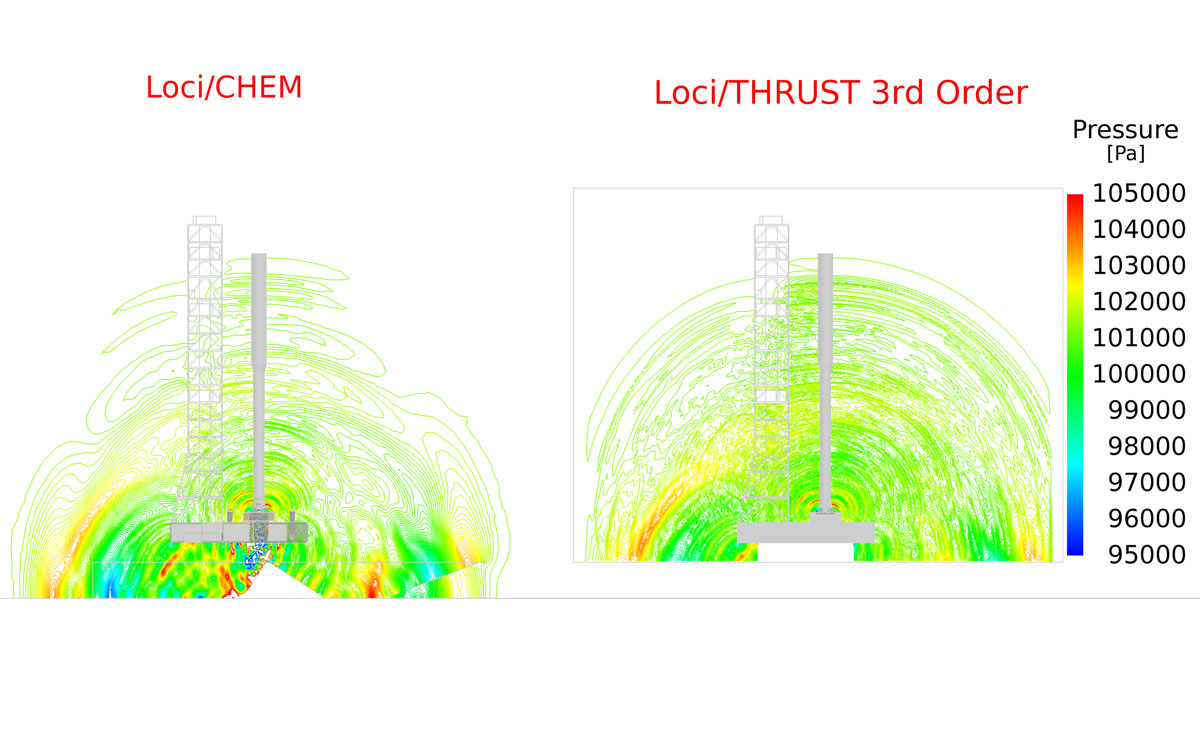
NASA supercomputing resources are instrumental in completing this type of analysis. The computational model requires nearly 300 million mesh cells to simultaneously resolve the launch vehicle and launch pad details and adequately capture the acoustic sources at the rocket plumes. Both simulations are executed simultaneously, exchanging transient boundary condition input to the DG solution, utilizing the sophisticated message passing enabled by the high-performance computers at the NASA Advanced Supercomputing (NAS) facility. Each of the ASMAT simulations used 2,000 parallel computing processors on the Pleiades supercomputer. The simulation of the ignition dynamics and acoustic field propagation used nearly 2 million processor-hours over the time frame of two to three weeks.
Peter Liever, NASA Marshall Space Flight Centerpeter.a.liever@nasa.gov Jeff West, NASA Marshall Space Flight Center
jeffrey.s.west@nasa.gov