Multiphase Simulations of the SLS Launch Environment
Overview
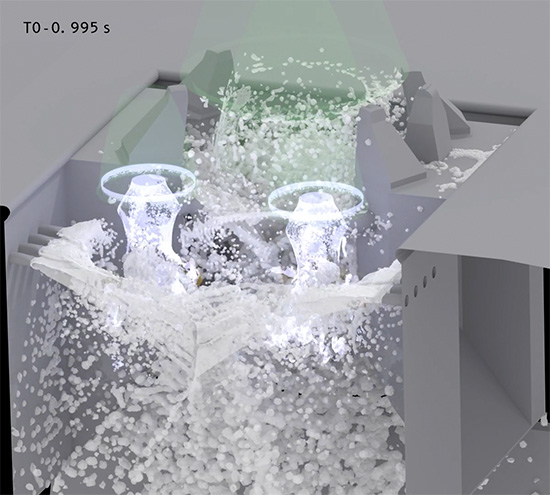
NASA’s Space Launch System (SLS), which will send astronauts back to the Moon in the next few years with the Artemis Program, is powered by four RS-25 engines and two solid rocket boosters (SRBs). During launch, the SLS propulsion system generates intense acoustics and other powerful waves, such as ignition overpressure (IOP) which, if unmitigated, have the potential to damage the vehicle and possibly cause loss of mission or crew. To protect the vehicle from these powerful waves, the SLS launch pad design includes an ignition overpressure/sound suppression (IOP/SS) system that sprays 270,000 gallons per minute of water very close to the SRB and RS-25 nozzles. The SRB and RS-25 engine plumes, and the proximity of the IOP/SS water, create a complex multiphase (gas and liquid) environment during the ignition sequence. The interplay among these systems creates challenges related to water spray into/onto engine nozzles, potential debris transport, and additional transient loads due to strong plume-water interactions—all of which the SLS vehicle must be able to withstand.
Prior to the first uncrewed Artemis launch this year, the SLS multiphase liftoff environment was largely unknown due to differences from the Space Shuttle and other programs. Some data was available from tests of individual systems, but no integrated testing or analysis was available. Even post-launch analysis of Artemis I cannot provide a full understanding of the complex physics involved due to limited (or obstructed) camera views and instrumentation. Computational fluid dynamics (CFD) is being used to investigate the details of the multiphase environment that could not be measured, help interpret the data gathered from the launch, and ultimately identify phenomena that are a concern for future flights.
Project Details
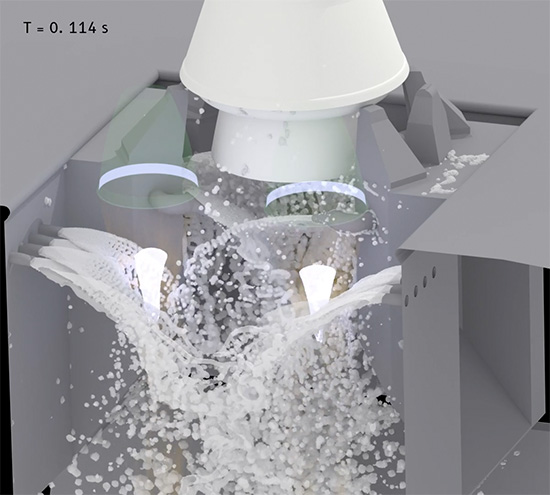
Engineers at NASA’s Marshall Space Flight Center performed simulations of the SLS ignition sequence using the Loci/STREAM-Volume of Fluid (VoF) multiphase CFD solver. Prior efforts successfully validated the CFD solver against various tests, giving analysts confidence in their ability to simulate the SLS multiphase liftoff environment prior to the Artemis I launch. The CFD simulation of the SLS ignition sequence was conducted in three phases. First, the IOP/SS water system was simulated for approximately six seconds to reach a quasi-steady state. Next, the RS-25 engine plumes were activated and held at full power for one second. Finally, the SRB booster was activated and the simulation was carried out until the time just prior to vehicle motion. This simulation process mimics the conditions that exist at launch.
Results and Impact
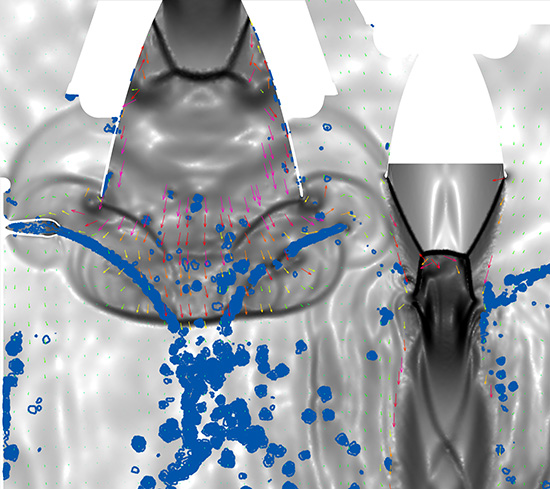
The SLS ignition sequence simulation results provide deep understanding of the underlying physics that occur during launch. Observations from the simulation include reduction of water splashing into/onto the engine nozzles, change in angling of the dense water sheets, and the origin of the powerful ignition overpressure (IOP) wave. These observations directly inform the SLS program on subjects including plume-water-induced side loads, debris transport, and the launch acoustics environment. Additionally, with post-launch comparison of CFD observations to flight data, these tools can be applied to launch vehicles and environments other than SLS with confidence.
Why HPC Matters
The SLS ignition sequence CFD simulations are conducted on meshes of up to hundreds of millions of cells, on thousands of processors, for weeks at a time. These simulations generate terabytes of data that must also be stored and archived for future use on HPC systems. Simply put, the CFD simulations would not be possible without NASA’s HPC resources.
What's Next
Continued comparisons between the Artemis I flight data and the CFD simulations will both improve confidence in the CFD results and provide deeper understanding into the SLS multiphase launch environment. This will be used to provide insight for decision making for the first crewed SLS flight, Artemis II. Future simulations will target new configurations of the SLS launch environment, including the IOP/SS water required to support the more powerful variants of the SLS vehicle, such as Block 1B crewed and cargo configurations. Additionally, this capability provides NASA the ability to investigate launch environments for vehicles other than the SLS to support other agency space missions.
Researchers
- Travis Rivord, NASA Marshall Space Flight Center Please enable Javascript to see email address.
- Brandon Williams, NASA Marshall Space Flight Center Please enable Javascript to see email address.