New Findings in Solar Magnetic Cycles and Waves in Stellar Interiors
Overview
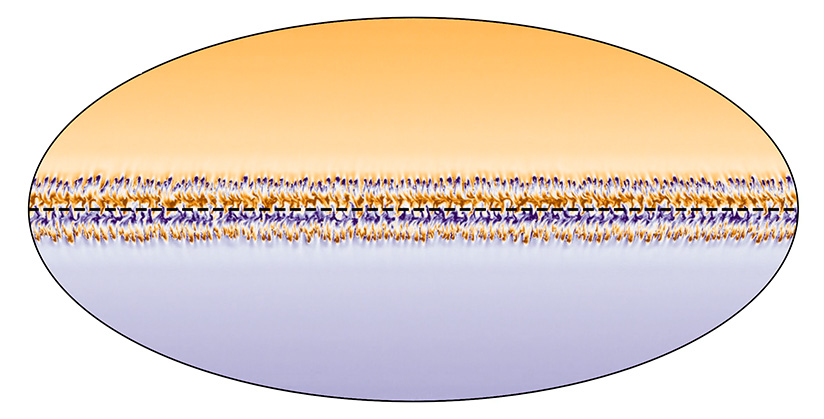
The Sun and other stars possess striking features like magnetic starspots, at their surface—and convection and differential rotation in their interiors. The Sun and other stars possess convectively stable and unstable regions and magnetic fields. What remains a mystery is how these magnetic fields arise and what internal processes drive their variability. Is it instabilities arising from a near-surface shear, convection, or other processes that lead to their creation and destruction during a magnetic cycle? And, how do these magnetic fields influence the Sun’s atmosphere and Earth’s delicate magnetic shield? As part of the effort to understand the Sun, it is informative to examine which magnetic structures are stable inside stars. Does evidence for those deep interior magnetic fields appear in the surface wave patterns of other stars? Can changes in the wave patterns help us assess other important processes, such as chemical mixing?
Project Details
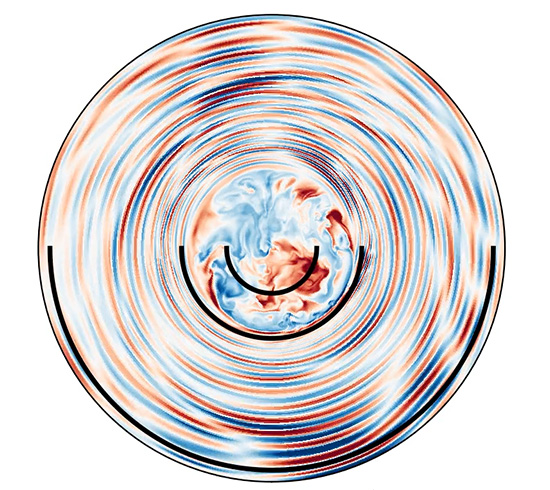
This project aims to answer these questions through the study of magnetic dynamos, convection, and mixing processes, including how they interact to produce waves that can be detected through asteroseismology—the study of surface waves that can be used to probe a star’s interior, like seismology can explore the Earth’s interior. We run simulations of these stars to better understand how those magnetic fields are built and how the flows in these regions generate waves that propagate to their surfaces. Stars also provide a means of understanding extreme parameter regimes of turbulence, which we seek to explore.
Results and Impact
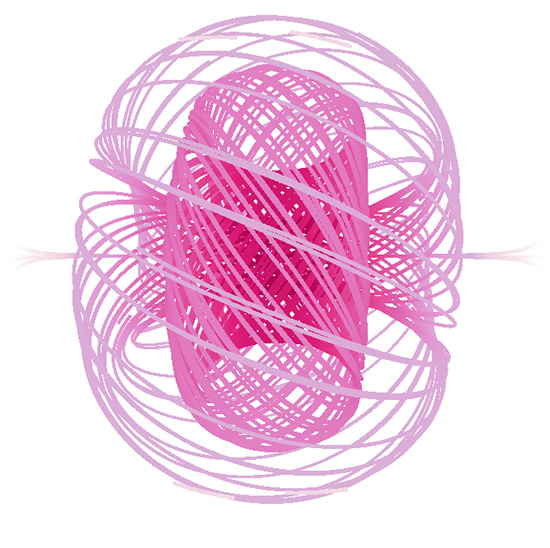
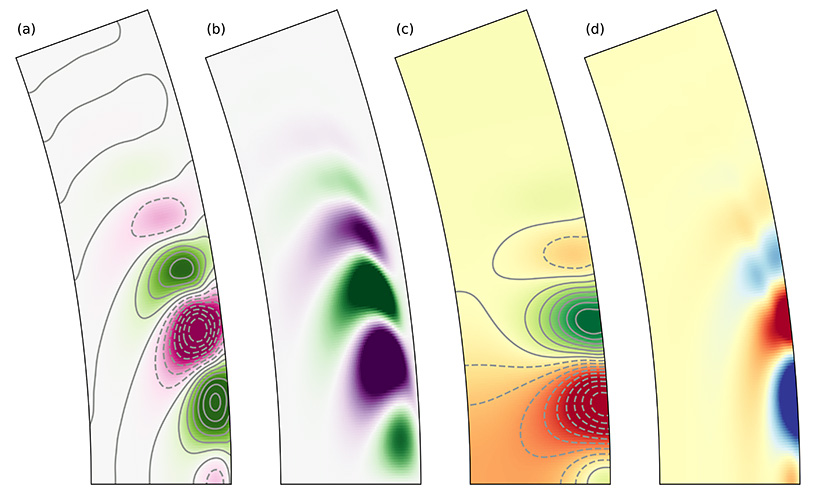
Using resources at the NASA Advanced Supercomputing (NAS) facility at Ames Research Center, we found that Prendergast magnetic field configurations—which were previously believed to be stable—are unstable, meaning that magnetic equilibrium solutions may be more difficult to obtain. Our recent simulations of penetrative rotating convection have enabled a more accurate modeling of stellar evolution. We discovered that some solar and stellar dynamos are linked to the magneto-rotational instability (MRI) if there is sufficient radial differential rotation, showing an alternative path for stellar dynamo theory. Recent 3D simulations capture the convection, the wave excitation region, and the wave propagation to estimate their surface amplitudes, allowing us to compare our results to stellar observations.
Why HPC Matters
NASA’s high-end computing (HEC) resources enable work with Dedalus, a flexible and spectral framework, much of which requires large-scale computation for solving partial differential equations. On these resources, Dedalus solves several classes of problems: eigenvalue, initial value, and boundary value. Each class uses different HEC resources. Eigenvalue problems require substantial memory, few cores per node, and solving a given problem over a large set of parameters in parallel. Initial value problems are usually nonlinear, requiring many cores, little memory, and many iterations to complete a run with a single set of parameters. Boundary value problems, like eigenvalue problems, are parallelized only over the parameter set. Experts at the NAS facility optimized parts of the Dedalus code to run these simulations on NAS HEC resources and to build software stacks that support many users.
What's Next
We aim to better understand the nonlinear MRI in the solar near-surface shear layer, provide new magnetic equilibrium solutions for rotating stars, and estimate surface wave amplitudes to guide the interpretation of stellar observations.
More Information
- The Stability of Prendergast Magnetic Fields
- Stellar Convective Penetration: Parameterized Theory and Dynamical Simulations
- Schwarzschild and Ledoux are Equivalent on Evolutionary Timescales
- Asteroseismic inference of the near-core magnetic field strength in the main-sequence B star HD 43317
Researchers
- Kyle Augustson, Northwestern University Please enable Javascript to see email address.
- Daniel Lecoanet, Northwestern University Please enable Javascript to see email address.