Microscale Modeling of NASA Thermal Protection Materials
Overview

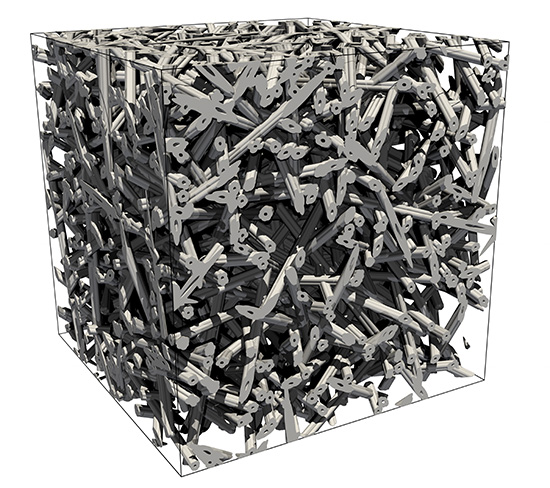
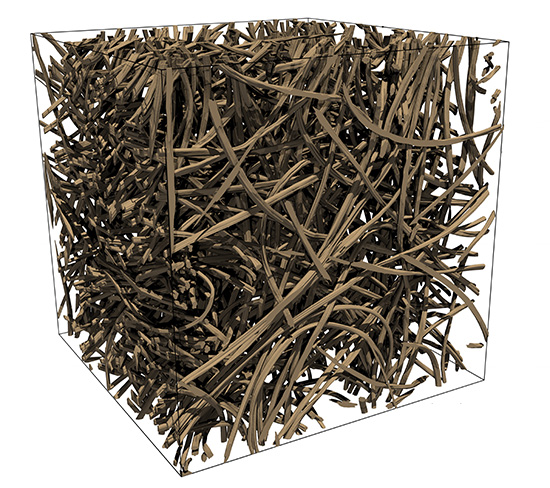
To better understand and design thermal protection systems (TPS) for spacecraft, NASA scientists use numerical modeling to simulate the structure and behavior of heat shield materials at multiple levels, ranging from full-scale TPS modeling on a vehicle down to the atomic scale. For microscale modeling, where the material microstructure is simulated, an imaging technique called X-ray microtomography is used to generate high-resolution 3D images of a material’s internal structure. Over the past decade, X-ray microtomography has altered the materials science field with its ability to non-destructively analyze a material microstructure. NASA’s Porous Microstructure Analysis (PuMA) software, developed at Ames Research Center, provides a robust and efficient framework for computing material properties based on these 3D microstructures, and it has provided unprecedented insights into materials relevant for different missions, including heat-shields, parachute fabrics, meteorites, and other advanced composites.
Project Details

The PuMA software was originally developed as a tool to accurately predict material properties for TPS based on 3D microstructural models provided by microtomography. From a materials microstructure, PuMA can compute a material’s porosity, surface area, pore diameters, effective thermal or electrical conductivity, anisotropic conductivity, material orientation, elasticity, tortuosity, and permeability. PuMA also includes solvers to simulate transient thermal transport and the decomposition of materials via oxidation. The software has grown extensively to include the ability to generate advanced synthetic microstructures with the aim of tailoring and optimizing their performance. Since PuMA was written with modularity and flexibility as software principles, the framework has provided the ability to easily add new physical models as the agency tests new TPS materials.
PuMA gives researchers the capability to model a comprehensive spectrum of material properties, from the most fundamental geometric features of a microstructure to advanced anisotropic thermoelastic and chemical properties, and can generate artificial microstructures ranging from simple analytical shapes to complex fibrous woven and non-woven geometries. Researchers can combine material generation and material characterization to enable parametric studies and sensitivity analyses to optimize the microstructural performance, which can inform mission design decisions and reliability assessments for TPS materials.
NASA has released PuMA as an open-source software with the goal of providing the scientific community access to both the specific physical solvers and a generic framework to build custom functionality for materials science.
Results and Impact

The governing equations solved by PuMA are applicable across a wide range of physical problems and length scales, from nano- to meter-scale multi-material systems. Because of this breadth in physical models, PuMA has been adopted in a uniquely diverse range of research topics, including advanced composites, concrete, 3D printed material analysis, geological flows, porous media combustion, meteorite analysis, parachute fabrics, batteries, and even the analysis of flow within teeth cavities. Users of PuMA are spread across NASA, government institutions, domestic and international universities, and private companies.
Why HPC Matters
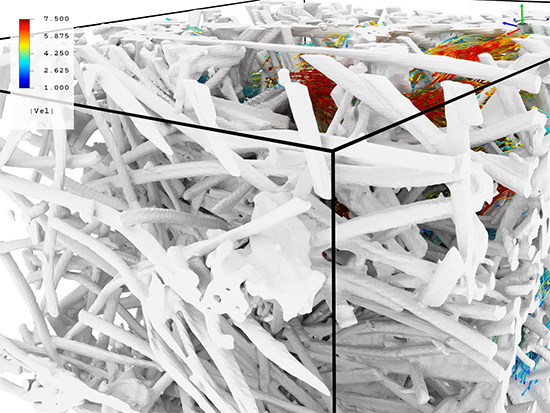
The microscale modeling effort at NASA Ames heavily utilizes the high-performance computing (HPC) resources at the NASA Advanced Supercomputing facility, including the petascale Pleiades and Electra systems. The microscale flow modeling research uses both PuMA and the SPARTA direct simulation Monte Carlo tool, developed at Sandia National Laboratories, and relies on NASA HPC for large scale computations.
What's Next
Ultimately the PuMA development team plans to continue to improve and build upon the numerical solvers in the framework. As an open source code, they expect continued development and involvement from academic users, and believe that the field of microscale analysis will open the door for optimized material design that the capabilities in PuMA will help pave the way toward.
More Information
- NASA PuMA Github Repository
- PuMA Gitlab Dev Repository
- PuMA conda-forge Channel
- PuMA YouTube Channel
- PuMA Gitter Community Chat
- PuMA User Documentation
- Google Colab Tutorials for PuMA
Researchers
- Joseph C. Ferguson, NASA Ames Research Center / Stanford University Please enable Javascript to see email address.
- John Thornton, NASA Ames Research Center Please enable Javascript to see email address.
- Federico Semeraro, NASA Ames Research Center Please enable Javascript to see email address.
- Arnaud Borner, NASA Ames Research Center Please enable Javascript to see email address.