Modeling Dynamical Processes in the Solar Interior with 3D Global Simulations
Overview
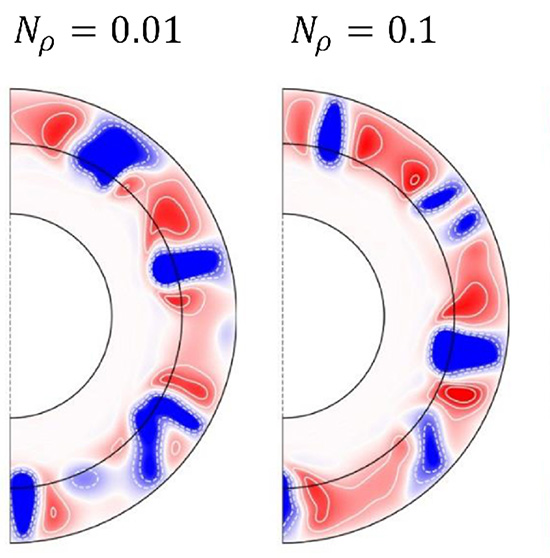
A major challenge in Heliophysics is understanding the dynamics driving the nearly periodic magnetic activity cycle that is observed in the Sun. Within the Sun’s outer layers, the combined action of turbulent convection, meridional circulation, and differential rotation (inferred through helioseismic observations) are thought to give rise to the solar dynamo—the process that generates the Sun’s magnetic field. In particular, the tachocline, a thin transition shear layer that resides in the interface between the Sun’s convection zone and radiative zone, has been presumed to be the seat of the solar dynamo. We employed 3D global simulations to gain insight into the dynamical processes and balances occurring within the convection zone-radiative zone interface, which will help us improve our understanding of the solar tachocline and its role in the solar dynamo process.
Project Details
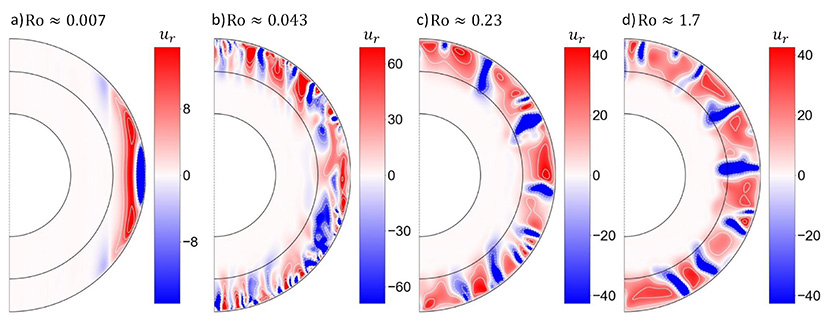
The convective motions generated in the Sun’s turbulent convection zone can propagate into the underlying stable radiative layer through a process called overshooting. Overshooting is thought to play a significant role in the Sun and other stars, as it can result in the mixing of chemical species and can transport angular momentum and magnetic fields; in addition, part of the tachocline must overlap with the overshoot region below the base of the convection zone. To study these phenomena, we ran a series of 3D simulations of overshooting convection in a spherical shell using the Rayleigh open-source convection code. Our setup consisted of an outer convective region overlying a stably stratified zone. We performed a systematic study of overshooting convection in both a nonrotating and a rotating regime. We varied the number of density scale-heights in the convection zone, the degree of convective driving, and the rotation rate in order to understand the effect of density stratification and rotation on the overshooting dynamics.
Results and Impact
Our results suggest that the amount of overshooting below the base of the convection zone (related to the depth to which the turbulent motions overshoot into the stable zone) depends on the ratio of the density stratification in the stable zone over that of the convective region. For the rotating cases, we found that the amount of overshoot decreases when rotation becomes stronger, and scales as Ro0.23 (where Ro is the Rossby number that is defined as the ratio of inertial force to Coriolis force). Although the input parameters used in numerical simulations are far from the actual solar values, due to computational constraints on spatio-temporal resolution, these results provide scaling laws that can help us estimate the solar overshoot depth by facilitating its extrapolation to solar values. They also provide us with constraints of these dynamical processes that can be ultimately tested against observations.
Why HPC Matters

High spatial resolution and long simulation times are required in order to capture the disparate spatio-temporal scales characteristic of solar convection. Most of the 22 models developed in this study possessed a spatial resolution of 192 × 528 × 1056 (or higher) and required many months to run on NASA’s Pleiades supercomputer, using approximately 4,100 Broadwell cores. The resources required to evolve these models and to store and analyze their output are far beyond those available on a modern desktop or even a typical university cluster. Put simply, these state-of-the art global simulations are necessary for gaining a better understanding of the perplexing dynamics occurring in the solar interior—but they would have been impossible without the support of the NASA High-End Computing program.
What's Next
We are currently assessing different parameter regimes to determine which ones lead to differential rotation profiles consistent with those observed in the Sun. Within those solar-like regimes, we plan to investigate mean flows and angular momentum transport in the convection zone and the overshoot region as well as their dependence on different input parameters. The next step is to add magnetism and study the different dynamical processes associated with the interaction of both overshooting convective motions and large-scale mean flows with magnetic fields. These efforts will ultimately shed new light on the dynamo process and facilitate the creation of a self-consistent, fully nonlinear model of the tachocline dynamics.
More Information
- On the Dynamics of Overshooting Convection in Spherical Shells: Effect of Density Stratification and Rotation
- Github Repository for the Rayleigh Open-source 3D Convection Code
Researchers
- Lydia Korre, University of Colorado Boulder Please enable Javascript to see email address.
- Nicholas Featherstone, Southwest Research Institute Please enable Javascript to see email address.