Improving Satellite-Based Snow Estimates with GPU-Accelerated Deep Learning
Overview
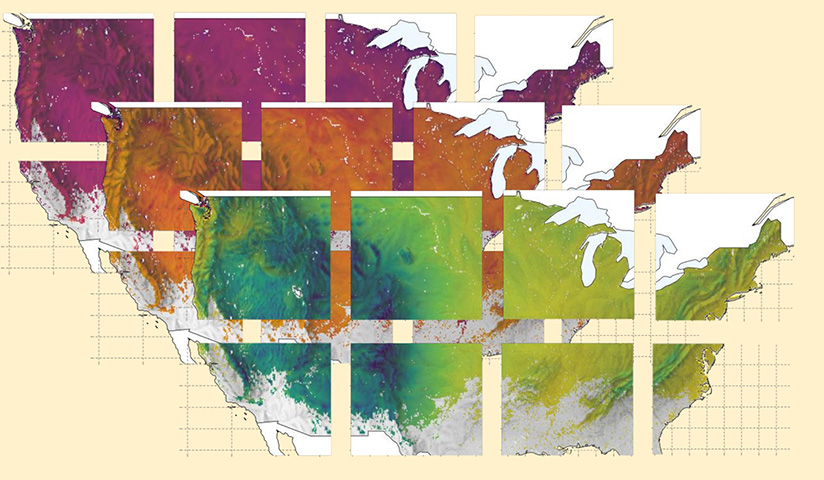
Snow conditions on the Earth’s land surface— vital components of the global hydrological cycle—play a critical role in determining local and regional climate and seaononal water availability. Despite its well-recognized importance, the accurate characterization of snowpack states is challenging due to the highly variable nature of snow formation, accumulation, and melt processes, and there is a growing need for snow estimates that are both reliable and timely. To support this need, a team of researchers in the Biospheric Sciences and Hydrological Sciences Laboratories of the Earth Sciences Division at the NASA Goddard Space Flight Center are developing an improved snow dynamics system using a novel deep learning (DL) approach. This DL-based data system estimates daily snow depth and snow water equivalent for the continental United States using far fewer computing resources but with much greater accuracy.
Project Details
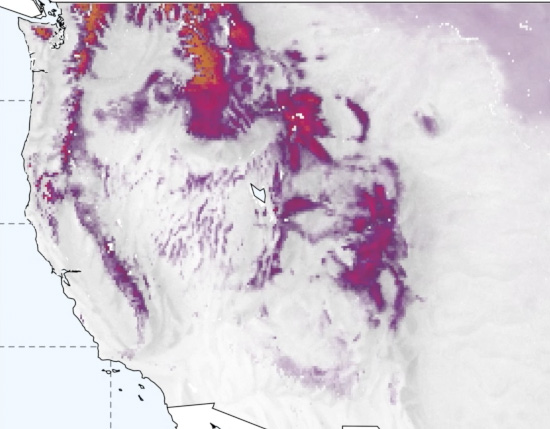
The core algorithm of the developed simulation system is a GPU-accelerated version of a DL approach known as Convolutional Neural Networks (CNN). This particular CNN uses passive microwave information from the Advanced Microwave Scanning Radiometer 2 (AMSR2) aboard the GCOM-W satellite as a key data source to train the model against in-situ snow measurements collected from various sources. The trained DL model then generates spatially continuous snow estimates across the continental U.S. at 10-kilometer resolution. The researchers are currently expanding this DL system to provide estimates for global usage.
Results and Impact
The GPU-accelerated CNN algorithm was able to provide snow depth simulations with a 60% improvement in performance compared to the currently operational snow depth estimates using only satellite data. Moreover, both the inference and training can be done using a single GPU for the entire continental U.S. compared to numerous nodes using a traditional physics-based snow model. Due to the DL model’s ability to simulate snow depth far more accurately using less resources, it will be a valuable tool for understanding the role of the snow dynamics in the spatiotemporal changes in the hydrological cycle.
Why HPC Matters
High-end computing (HEC) platforms at the NASA Center for Climate Simulation (NCCS) are critical for providing essential resources for preparing our modeling systems for emerging HEC systems and exploring new science developments. These DL-based snow simulations were made possible due to unrestricted access to the Tesla V100 GPUs on the NCCS Explore/ADAPT Science Cloud.
What's Next
Given the success of GPU-accelerated snow dynamics, the team at NASA Goddard is now preparing to expand these simulations to a global scale. The team is also exploring the possibility of applying DL to Global Precipitation Measurement (GPM) mission data and building a long-term climate data record by merging multiple satellite products.
More Information
Researchers
- Goutam Konapala, NASA Goddard Space Flight Center Please enable Javascript to see email address.
- Sujay Kumar, NASA Goddard Space Flight Center Please enable Javascript to see email address.
- Carrie Vuyovich, NASA Goddard Space Flight Center Please enable Javascript to see email address.