Will AI/ML Take Over HPC and the World?
Overview
The applications and use of artificial intelligence and machine learning (AI/ML) have exploded in recent years due to a convergence of compute hardware acceleration, software frameworks, and data availability. From autonomous vehicles to ML-informed suggestions of which movie to watch next on streaming platforms based on past selection patterns, to deep fakes, AI/ML is inundating our lives as well as high-performance computing (HPC). Should we be concerned? What should we do about this trend, and how will it affect HPC at NASA? Join us to explore current research, the potential pitfalls and dangers of using AI/ML for science, and how HPC centers can be better prepared.
Project Details

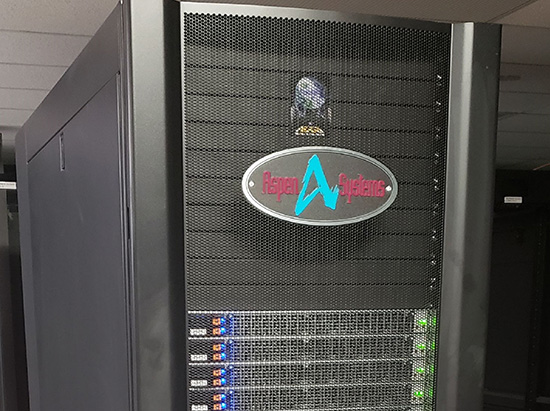
The NASA High-End Computing (HEC) Program supports science and engineering research across all agency mission directorates, and there has been a major increase in the requirements to support AI/ML in the last few years. Across the HEC Program, systems specifically designed to support AI/ML are being deployed for training scientific data, for inference, and for the creation of surrogates to augment physics-based models.
In addition to these requirements, NASA is also embarking upon the Transform to Open Science (TOPS) mission that is focused on ensuring accessibility, reproducibility, transparency, and inclusivity in science. NASA’s HEC centers must be able to balance these rapidly emerging science requirements with initiatives like TOPS to meet the future needs of NASA scientists and engineers.
Results and Impact

The initial deployments of AI/ML systems specifically designed for HPC have already yielded amazing science results at NASA:
- Data scientist Brian Powell’s research explores the Transiting Exoplanet Survey Satellite (TESS) Full Frame Images (FFIs) using ML to discover never-seen quadruple and sextuple star systems.
- Research scientist Jim Tucker is mapping carbon biomass by measuring the canopy area and height of trees from space over areas larger than the continental United States.
- Research scientist Mark Carroll and collaborators are using NASA’s Ice, Cloud, and land Elevation Satellite (ICESat-2) measurements to create bioclimatic predictors and apply to future climate scenarios.
- Application scientists are training models to augment physics-based components to increase the performance for large-scale, high-resolution simulations.
Why HPC Matters
Given NASA’s mission, NASA data centers are uniquely positioned to have access to and analyze extremely large datasets. Observations of the Earth have been at petascales for decades and are growing at exponential rates in upcoming missions, with solar observations already in the multi-petabyte range. To adequately train and perform inference across these large datasets, HPC capabilities are needed.
As NASA’s scientific models move toward exascale computing capabilities, there is a push toward creating models that couple physical-based systems with AI/ML trained surrogates. An example of this is NASA’s high-resolution Goddard Earth Observing System (GEOS) weather model: GEOS uses traditional physics-based calculations but is coupled with an inference model that can perform spatiotemporal downscaling with sufficient accuracy for science applications. These types of applications represent the future of NASA research as we move toward creating a digital twin of the universe, and that can only be performed using HPC.
What's Next
This unique combination of requirements—continuing traditional HPC applications, supporting AI/ML, and providing capabilities to support the transformation to open science—is a significant challenge for NASA. In addition to the rapid changes in the technology landscape (for example, processors, file systems, and software stacks), NASA HEC centers are faced with the challenges of supporting ethical and open scientific research. Through a partnership with the American Geophysical Union (AGU), new standards are emerging for ethical AI/ML research to be announced in the December meeting. The need for openness and reproducibility will affect the HPC environments and will become important components for future system architectures.
More Information
- NASA’s High-End Computing (HEC) Program
- NASA Center for Climate Simulation
- NASA Advanced Supercomputing (NAS) Division
- NASA’s Transform to Open Science (TOPS) Mission
Researchers
- Daniel Duffy, NASA Goddard Space Flight Center Please enable Javascript to see email address.
- Mike Little, NASA Goddard Space Flight Center Please enable Javascript to see email address.