Tracking the Fuel for Galaxy Growth
Overview
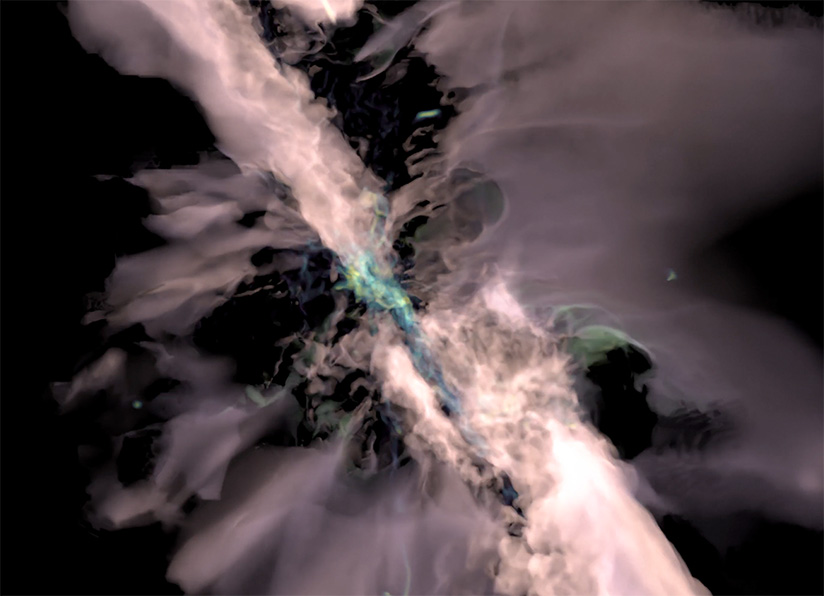
Thanks in large part to observations made by NASA’s Hubble Space Telescope, we now know that the parts of galaxies we can see—the glowing stars and gas—are actually surrounded by a giant reservoir of diffuse and nearly invisible gas that we call the circumgalactic medium (CGM). Galaxies form new stars out of gaseous material that is accreted from the CGM, so understanding the properties and origin of this material is fundamental to understanding galaxy evolution. However, the processes that affect accreting gas and how it makes its journey through the CGM to the galaxy are open questions. The Hubble Space Telescope can only observe this gas if there happens to be a distant bright object behind it that can illuminate it, like a lighthouse shining through fog. There are only a handful of bright lighthouses behind any given galaxy, so we turn to simulations to help us fill in the gaps.
Project Details
The FOGGIE (Figuring Out Gas & Galaxies In Enzo) project is a suite of galaxy evolution simulations. We start by simulating a large chunk of the universe, then pick a handful of galaxies within this chunk to “zoom in” on. These galaxies are then re-simulated at a much higher resolution. In particular, FOGGIE specializes in resolving the diffuse gas surrounding galaxies, the circumgalactic medium. By forcing a strict resolution requirement not just within the galaxies themselves, but also in the space surrounding them, FOGGIE can achieve exquisite resolution in the diffuse circumgalactic gas. This high resolution is necessary when it comes to understanding how galaxies get their gas: by resolving the small-scale interactions between inflowing gas, outflowing gas, and gas at a variety of temperatures and densities, we can test different theoretical models of galaxy evolution, compare the results to observations, and ultimately increase our understanding of galaxy feeding and growth.
Results and Impact
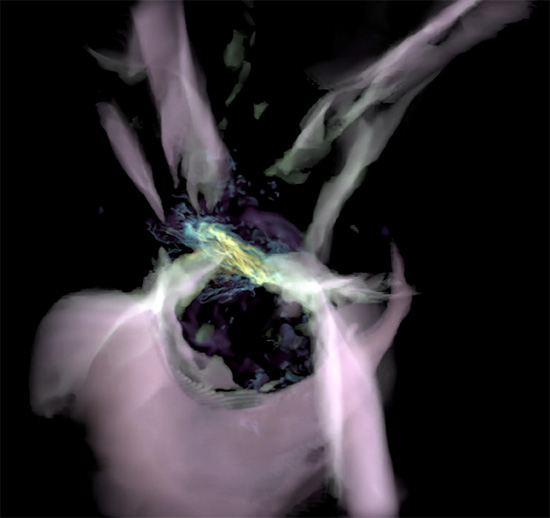
The FOGGIE simulations reveal that most of the gas falling through the CGM onto a galaxy is predominantly cooler than the rest of the CGM gas that is not flowing inward. They also show that the accreting gas hasn’t been affected by the heavy elements that are formed in stars, suggesting that it is nearly pristine gas that has never been located near another galaxy. Importantly, FOGGIE’s high resolution reveals interface regions, where the accreting gas slides by and interacts with the other, warmer gas in the CGM. These interface regions are subject to instabilities that help the cool and pristine accreting gas heat up and mix into the warmer gas surrounding it. Ultimately, the FOGGIE simulations are helping us understand how this fresh gas reaches the galaxy and what happens to it along the way through the CGM.
Why HPC Matters
The FOGGIE simulations would not be possible without significant computing power. Each of the six galaxies simulated in the FOGGIE suite is run on 512 Intel Xeon Haswell nodes on NASA’s Pleiades supercomputer, and takes 12-18 months of wall-clock time, or several million node-hours, to simulate the galaxies through 13.7 billion years of cosmic time. Each node has 128 gigabytes (GB) of memory, which is necessary to simulate the nearly 200 million resolution elements in the gas and stars within and around the simulated galaxies. Such a large number of resolution elements produces large output files as well, up to 15-30 GB per simulation output. FOGGIE also has exquisite time resolution, with a simulation output every 5 million years of cosmic time, leading to thousands of simulation outputs per galaxy and hundreds of terabytes of data in total. Once the simulations are run, analyzing the outputs to produce visualizations and answer scientific questions takes additional computational resources, requiring hundreds of gigabytes of memory, fast I/O speeds, and several hundred thousand more node-hours of code running on Pleiades.
What's Next
The next generation of FOGGIE simulations will include larger cosmic volumes and higher resolution in the regions outside of galaxies. This requires moving to the new Enzo-E code, which is scalable to thousands of processors and will enable a truly revolutionary number of resolution elements to be simulated at once. Until then, the FOGGIE team is continuing to analyze the current generation of FOGGIE simulations to understand how galaxies form and evolve.
More Information
Researchers
- Cassi Lochhaas, Space Telescope Science Institute Please enable Javascript to see email address.
- Molly Peeples, Space Telescope Science Institute/Johns Hopkins University Please enable Javascript to see email address.
- Jason Tumlinson, Space Telescope Science Institute/Johns Hopkins University Please enable Javascript to see email address.