Simulating Sunquakes: The Impact of Flares on the Sun
Overview
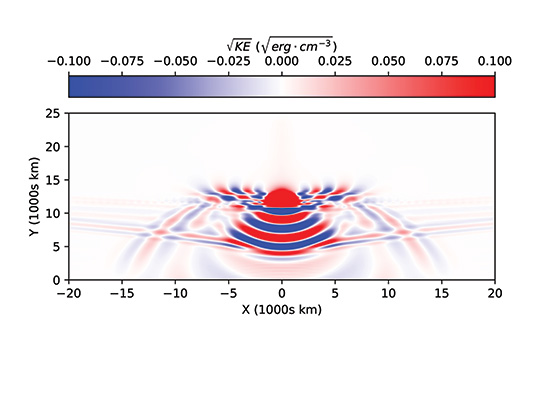
Solar flares occur when magnetic energy is released on the Sun in the form of heat and light. Most people are familiar with the effects of solar flares on Earth: extra static on the radio, poor GPS navigation, and stunning auroras if the conditions are right. An often overlooked effect of solar flares is their impact on the Sun itself. Some solar flares, particularly the strong ones, can excite the Sun-equivalent of an earthquake: a sunquake. Where earthquakes are generated by tectonic plates shifting inside the Earth, sunquakes are generated when fast-moving particles accelerated by solar flares hit the Sun’s surface and transfer their energy in the form of pressure waves. Our work looks at how the Sun responds to the energy released by solar flares, and how this corresponds to what we see in observations. The results of this work give us a deeper understanding of how energy is transported during
a solar flare.
Project Details
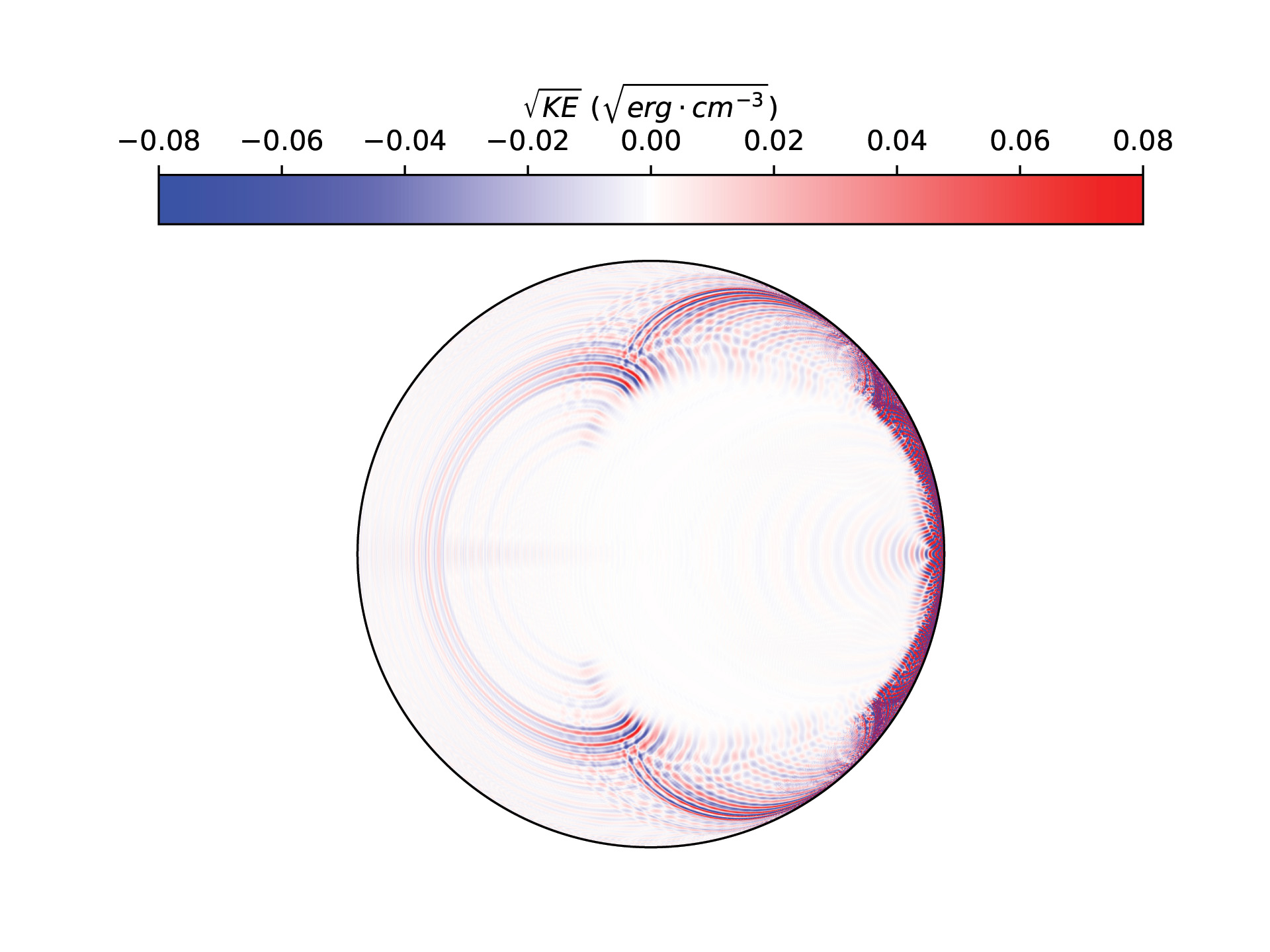
In our model, we consider how the pressure, density, and velocity of plasma changes as sunquakes travel through the Sun’s interior. Because the density and pressure in the Sun increase with depth, a portion of the waves that travel downward is reflected back up to the surface. Some data about the flare, such as the location and quantity of energy released, can be recovered by examining how long these waves take to return to the surface, as well as how strong the reflected wave is. We use data from modeled flares as an input for our model, where we can adjust the total energy of the flare and the minimum energy of the particles accelerated by the flare. Each of these parameters strongly affects the types and amplitude of waves that are excited.
Results and Impact
Initially, we expected the flares that had more high-energy particles to generate the strongest sunquakes. Since these high-energy particles are moving so quickly, they’re more likely to travel through the Sun’s atmosphere without collisions and can deposit their energy into denser regions more effectively. However, we found the flares with more lower-energy particles generated the strongest sunquakes. These particles can’t penetrate as deeply into the Sun, yet are able to accelerate the thin layers of the solar atmosphere to very high speeds—efficiently transferring their energy into sunquakes that travel throughout the Sun. Additionally, flares with lower-energy particles tended to generate strong acoustic-gravity waves (compared to the normal pressure waves), which haven’t been measured in observed sunquakes. These findings indicate that a “sweet spot” exists in terms of the particle energies in flares that cause some flares to generate sunquakes while others do not.
Why HPC Matters
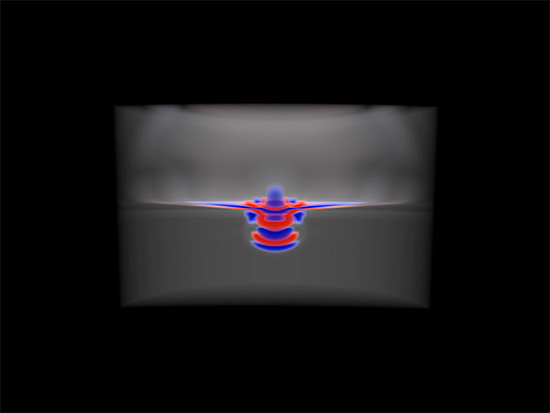
Compared to the size of the Sun, the flare energy is released in a relatively small area of a few hundred kilometers (km) and up to 1,000 km across. The sunquake that we observed travels tens to hundreds of thousands of km. Resolving these scales requires many grid points in the simulation, which in turn generate very large data files. The high performance computing (HPC) resources available at the NASA Advanced Supercomputing (NAS) facility are key to working with these large files, which require more memory to open than several laptops combined. The Lou data storage system provides a quick and reliable means of storing and accessing the generated data. Additionally, our model requires several hundred processor-cores of the Pleiades supercomputer to perform our simulations in a reasonable timeframe.
What's Next
To date, we have only considered one type of particle—protons—and looked at how effective certain energies are at generating sunquakes. We know that electrons are also accelerated by solar flares and deposit their energy differently than protons. In future work, we will examine the effectiveness of electrons in generating sunquakes and whether observations can be explained by a combination of the two.
More Information
Researchers
- John Stefan, New Jersey Institute of Technology Please enable Javascript to see email address.
- Alexander Kosovichev, New Jersey Institute of Technology Please enable Javascript to see email address.