An Innovative Strategy for Ensemble Seasonal Forecasts
Overview
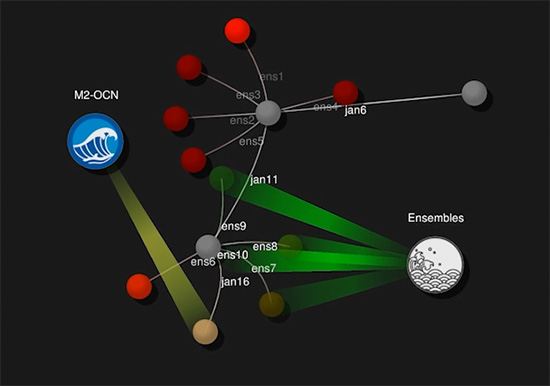
At NASA’s Global Modeling and Assimilation Office (GMAO), we produce seasonal forecasts on a monthly basis. Because seasonal forecasts are an inherently “noisy” endeavor, many individual forecasts are run to produce an ensemble forecast. Using the agency’s high-performance computing resources at the NASA Advanced Supercomputing facility, we developed a new strategy to conduct these ensemble forecasts that produces more “reliable” forecasts. This innovative Synchronized Multiple Time-lagged (SMT) approach will be included in the new version of GMAO’s Subseasonal to Seasonal Prediction system, GEOS-S2S-3.
Project Details
The method used to generate ensemble forecasts is critical for the forecast skill at these time scales, where the forecasts are fundamentally a probabilistic endeavor. An appropriate choice of ensemble perturbations is required to provide reliable seasonal/subseasonal forecasts to a wide range of users—from agricultural to health and military sectors. The SMT approach computes perturbations that describe the uncertainty of key atmospheric and oceanic modes of variability. Using large ensembles is important for the forecast skill of some leading modes of subseasonal atmospheric variability, but less so for forecasts with longer lead times. To make optimal use of computational resources, we reduce the forecast ensemble size after about three months of lead time, using a clustering approach.
We generated a retrospective suite of forecasts that runs for each month from 1992 to 2022 (for 30 years, or 360 initial condition months). Each month of forecasts includes 40 members that run for three months, and another 10 members that run for an additional six months, resulting in 180 simulated months for each month of forecast initial states.
Results and Impact
The SMT approach allows for “reliable” and computationally efficient suite of retrospective forecasts to be generated; it ensures that an ensemble of forecasts properly spans the range of possible forecasts. This is critical to study predictability and to improve the prediction skill of the ensemble, providing NASA and other scientists with the tools to study seasonal forecasting and use them to advance our ability to make these long range, societally relevant predictions.
Why HPC Matters
The suite of retrospective forecasts could not be performed without the use of substantial computational resources. The computations each run on 4,600 AMD Rome processors on the Aitken supercomputer at NASA’s Ames Research Center, at a wall-clock time of three hours per simulated month.
What's Next
The next important steps involve making the output from these simulations available to other researchers and to the public to be used to study predictability at seasonal scales.
More Information
Researchers
- Andrea Molod, NASA Goddard Space Flight Center Please enable Javascript to see email address.