Building Aerodynamic Databases for NASA’s Space Launch System
Overview

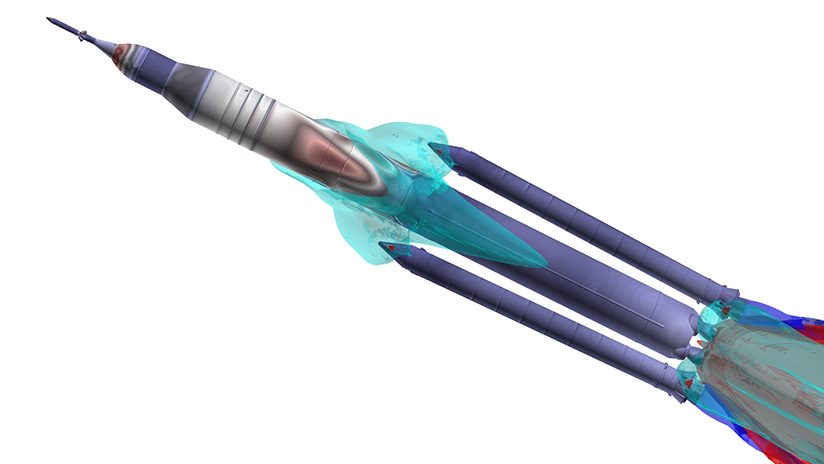
NASA’s Artemis program is the agency’s mission to return to the Moon by 2025 with the first woman and the first person of color, with the goal to eventually reach Mars. Artemis uses NASA’s Space Launch System (SLS), one of the most powerful rockets ever constructed, to send astronauts and cargo to lunar orbit. It is critical to understand the aerodynamic forces on the SLS and Orion crew vehicle during launch and ascent through Earth’s atmosphere, so a team of computational fluid dynamics (CFD) researchers at NASA’s Ames Research Center is developing detailed aerodynamic databases to ensure that the payload survives the ascent through the Earth’s atmosphere. These CFD databases are constructed for a plethora of flight conditions and complex interactions of the various vehicle components that are difficult to model in an experimental setting. High-performance computing (HPC) resources are critical in providing the necessary computational power to generate enough accurate CFD simulations to produce the quality of database needed to assure mission safety.
Project Details

The team used CFD simulations with various NASA-developed solvers, including OVERFLOW, FUN3D, and Cart3D, to construct aerodynamic databases for both the ascent and booster separation—when the two solid rocket boosters separate from the main vehicle—portions of an SLS launch. Tens of thousands of individual CFD simulations have been run supporting various SLS configurations and different Artemis missions. Both the ascent and separation phases of flight require researchers to model complex flow physics, including the interaction of multiple rocket plumes.
While computationally-derived databases were used in the later days of the Space Shuttle program, CFD models have greatly improved as the power and efficiency of NASA HPC as grown, adding increased complexity, finer details down to the smallest protuberances, increased volume of data, and faster turnaround times. Furthermore, modern software practices, including revision control and in-house case management software (programmed in Python), have been paramount for effective data control and the minimization of human error.
Results and Impact
The databases developed by the CFD team at Ames are used by various groups in the SLS program, including NASA’s Guidance, Navigation, and Control team and agency partners like Boeing, Northrop Grumman, and the United Launch Alliance. They have been used for the development of large-scale items such as building ascent trajectories and verifying the structural integrity for vehicle protuberances during ascent. Ultimately, these databases are critical in ensuring the success of all Artemis missions and any future missions using the SLS.
Why HPC Matters
All of the CFD simulations needed to build these aerodynamic databases were run on the Pleiades, Electra, and Aitken supercomputers at the NASA Advanced Supercomputing facility over the duration of the SLS program. Millions of processor hours were needed to generate enough data to provide adequate coverage for each of the simulated phases of flight. It would be impossible to reproduce the data generated for these databases without significant HPC resources. Reduced-order methods would require numerous simplifying assumptions that would increase the uncertainty of the data provided and put the mission—and astronauts—at risk.
What's Next
As the Space Launch System transitions from a developmental program to an active one, flight data will be used to verify computational methods and results, and to identify potential improvements to the databases themselves. SLS development continues as new vehicle configurations are introduced and new missions are planned. The ever-expanding NASA HPC resources will allow for new and improved databases to be generated using lessons learned from earlier SLS flights. Ultimately these newer databases will continue to increase future SLS mission safety.
More Information
Researchers
- Jamie Meeroff, NASA Ames Research Center Please enable Javascript to see email address.
- Stuart Rogers, NASA Ames Research Center Please enable Javascript to see email address.
- Derek Dalle, NASA Ames Research Center Please enable Javascript to see email address.
- Guy Schauerhamer, NASA Ames Research Center Please enable Javascript to see email address.