A Quantum-Mechanics Driven Computational Framework for Cosmochemistry and Materials Modeling
Overview
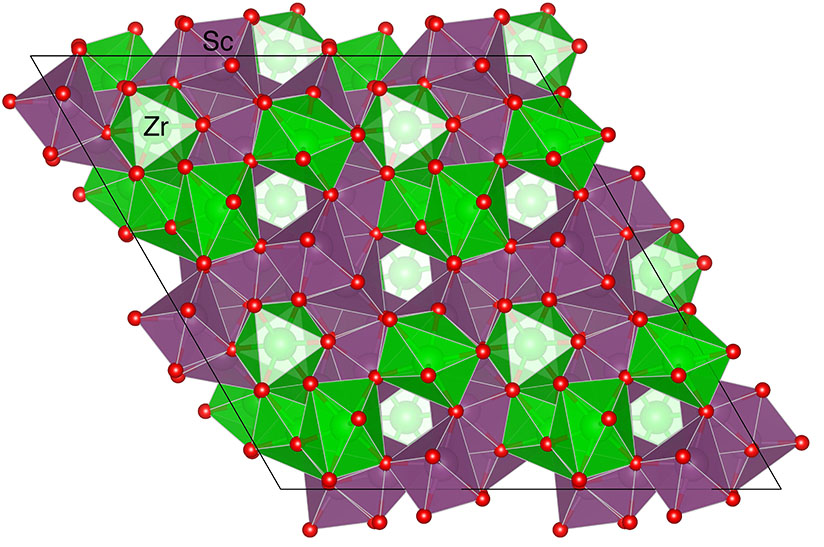
A new computational model that simulates materials starting from quantum-mechanical descriptions of atoms is playing a crucial role in several NASA projects, including a NASA Emerging Worlds cosmochemistry project to study the early solar nebula and the GaLORE project (Gaseous Lunar Oxygen from Regolith Electrolysis), which aims to achieve novel alloy design for oxygen production on the Moon.
Supercomputing resources at the NASA Advanced Supercomputing (NAS) facility are crucial to our first-principles framework of materials computation and modeling, which must capture the physics across vastly different length scales. With these powerful resources, research into computational materials is achieving atomic-scale insights into various thermophysical and thermochemical behaviors, in addition to improving existing models of materials behavior. These achievements are driving technological advances at an accelerated speed.
Project Details
Our goal for the cosmochemistry project is to describe the thermal and chemical composition of the early solar nebula—a protoplanetary disk that eventually evolved into our Solar System—from experimental investigation of meteorites, in conjunction with the materials modeling. Calcium-aluminum-rich inclusions (CAIs) found within meteorites were the first solids that condensed in the high-temperature region of this nebula and offer clues into the early landscape. These mineral collections show a myriad of microstructures, crystal chemistries, and defect structures, when analyzed in conjunction with the thermodynamic models, which enables us to simulate the early nebula—especially in the high-temperature region of the early solar nebula.
In the case of alloy development, we are supporting NASA’s goal to produce oxygen on the Moon from lunar soil via electrolysis—an approach that requires ultra-refractory (UR) materials that can work at extreme temperatures and oxidation-reducing conditions. Molten regolith electrolysis (MRE) occurs at temperatures as high as 1,873 Kelvin, and the unavailability of ultra-refractory electrode materials have been limiting aspects for developing the technology. Motivated by these research interests, we have undertaken thermodynamic and kinetic modeling of materials within our computational framework.
Results and Impact
Using our first-principles-driven thermodynamic modeling of CAI phases, we predicted the condensation sequences of refractory and ultra-refractory minerals within the high-temperature region of the early solar nebula. By simulating crystal chemistries in phases such as magnesium aluminate spinel, we developed a “nebular thermochronometer” to determine the temperatures of certain physical processes in the nebula. Similarly, ongoing modeling of the crystal chemistry of another CAI mineral, hibonite, is enabling development of an oxybarometer, which—when applied to the CAI assemblages—helps us to gauge the thermal and chemical conditions that prevailed during their formation.
One of the most important impacts of this work is to show the interplay between thermochemistry and the gas-and-dust dynamics in the nebula. Our calculations of condensation revealed the conditions under which the early refractory dust occurred. When analyzed in conjunction with the meteoritic studies, the calculated condensation sequence revealed the signatures of the mixing gas-and-dust system in the early solar nebula.
Pertaining to MRE electrode development, our materials modeling effort has predicted superior alloy compositions that can work at the targeted temperatures in the molten regolith. This computational research may also help optimize the electrolysis process by predicting an efficient melt pretreatment step, wherein the regolith is compositionally tamed to produce oxygen in the targeted temperature-window of operation.
Why HPC Matters
NAS supercomputing resources have enabled us to develop a nebular thermochronometer; predict condensation phase diagrams; and conduct rapid screening of UR electrodes.
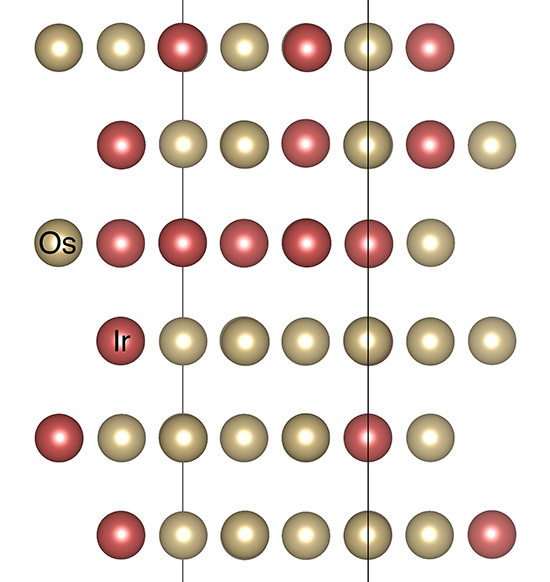
The quantum mechanics-based, first-principles calculations that are crucial to our thermodynamic modeling of meteoretic and UR material systems are made possible by NAS supercomputers. We used a density functional theory (DFT)-based code, Vienna Ab initio Simulation Package (VASP), to run simulations requiring 100–600 processors each, with a runtime up to 100 hours on the Aitken supercomputer. Calculations include different properties and materials systems, such as oxides, phosphide, platinum group alloys, and transitions metal alloys. For example, phonon calculations of platinum group alloys and Allendeite—named after the Allende meteorite where it was first found—each required 600 processors with a wall time of approximately 60 hours on Aitken.
What's Next
Recent investigations of primitive solids in meteorites have revealed many ultra-refractory phases, such as scandium- and zirconium-bearing Allendeite. Measuring the high-temperature thermochemistry of these mineral solutions in a huge composition space is a difficult task. An additional challenge in modeling the microstructure evolution of the UR phases is to incorporate the effects of kinetic processes with underlying solid-state diffusion. To this end, we propose to employ our first-principles quantum-mechanics driven computational framework to predict the thermochemistry and atomic transport in the entire temperature and composition space of all the UR phases pertaining to meteorites and MRE technology.
More Information
Researchers
- Venkateswara Rao Manga, University of Arizona Please enable Javascript to see email address.
- Thomas J. Zega, University of Arizona Please enable Javascript to see email address.
- Kevin D. Grossman, NASA, Kennedy Space Center Please enable Javascript to see email address.