Supercomputing in Supersonics: Analyzing Noise Predictions from High-Speed Aircraft
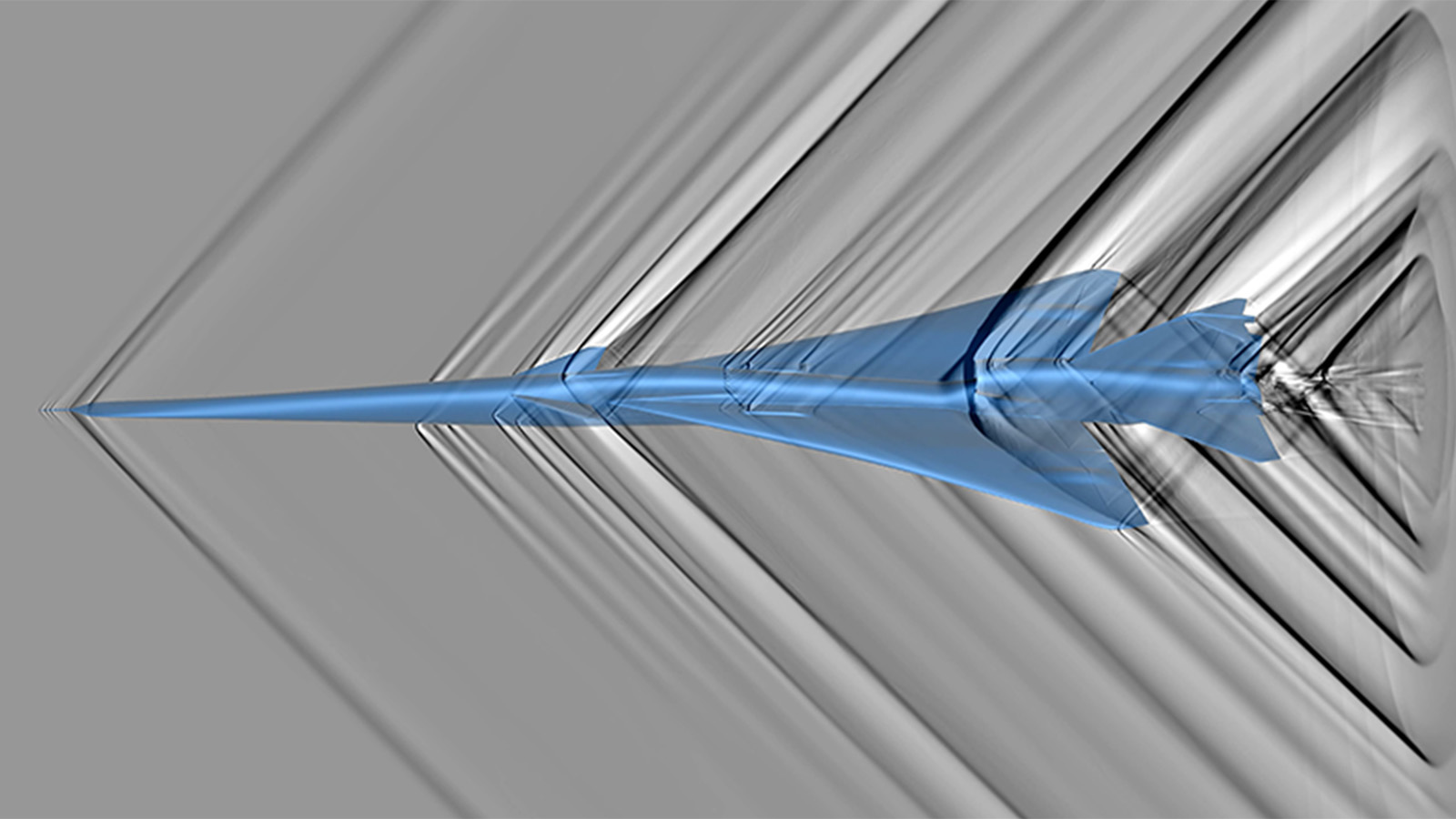
One of NASA’s strategic goals for aeronautics is innovation in commercial high-speed aircraft, with a vision of fast air travel widely available to the traveling public in the near future. Researchers at NASA’s Ames Research Center in Silicon Valley are performing high-fidelity simulations to design quiet supersonic aircraft like the Quesst Mission’s X-59 flight demonstrator to analyse the vehicle’s potential performance prior to its first flight in 2025. The research team is utilizing NASA high-performance computing resources to predict the variability in the level of noise reaching the ground due to uncertainty in temperature, relative humidity and wind profiles in the atmosphere, and fluctuations in cruise conditions. Advances in uncertainty quatification algorithms and computational fluid dynamics have recently addressed many of the key technical challenges for future en-route noise certification-by-analysis—where aircraft can be accurately evaluated using computational methods, in lieu of expensive wind tunnel and flight testing.
NASA High-End Computing at Ames Research Center, and specifically the Aitken supercomputer, enabled acoustic signature uncertainty quantification under conditions expected during planned test flights, accounting for the complex aircraft geometry and uncertainties in the state of the atmosphere and flight conditions.
Marian Nemec,
NASA Ames Research Center
Quick Facts
- Uncertainty quantification requires many high-fidelity queries to accurately simulate the target engineering outputs of vehicle design, which results in large databases with long turnaround times.
- The Ames team primarily used the AMD Rome nodes on the agency’s Aitken supercomputer at the NASA Advanced Supercomputing facility. Their simulations typically ran 8-12 wall-clock hours, with many jobs running simultaneously, and each job taking full advantage of the 128 cores per node.
- Each database for this project contains between 1,000 and 50,000 simulations, which are being used to generate loudness statistics for each aircraft design. This work is an important step toward enabling noise certification-by-analysis for future supersonic aircraft.
- The team’s results show that the probability of satisfying the X-59 acoustic design goal of 75 decibels during supersonic test flights at Edwards Air Force Base in summer months is 92%, based on a 20-year window of atmospheric observations.
Researchers
- Marian Nemec, NASA Ames Research Center Please enable Javascript to see email address.
- Michael Aftosmis, NASA Ames Research Center Please enable Javascript to see email address.
