Future-Proof Performance Portability for Weather and Climate Models
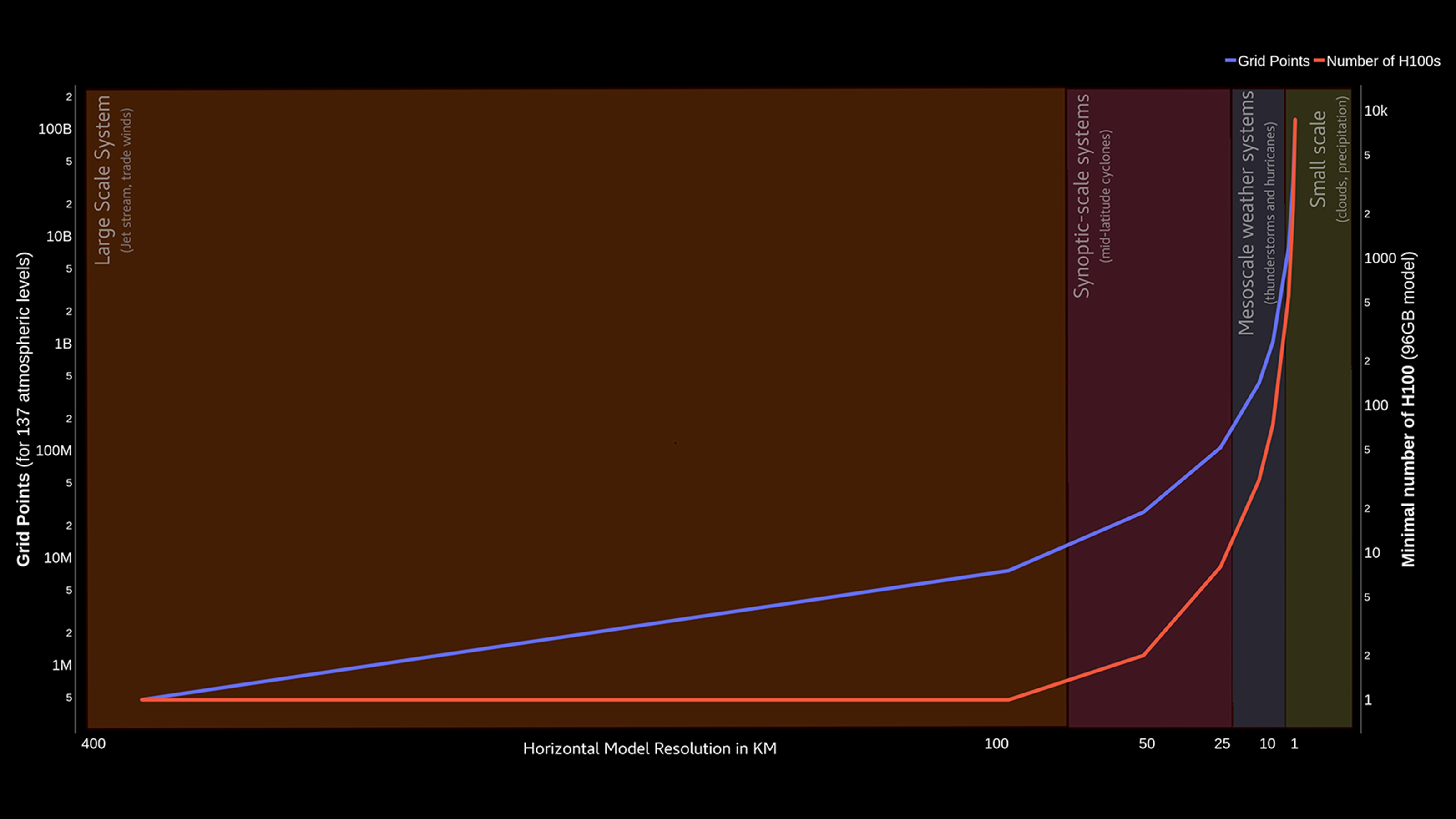
The Software Modernization Team within NASA’s Advanced Software Technology Group is deploying the Python-based NOAA/NASA Domain Specific Language (NDSL) to enable the NASA Goddard Earth Observing System (GEOS) weather and climate model to execute efficiently on GPUs and beyond. After presenting the initial results at SC23, with up to 4.4x acceleration of the model dynamics, the team is now focused on moving the model physics under NDSL and unlocking further GPU capabilities for GEOS.
NDSL enforces a strict separation of the science code from the compiled code executed at runtime so that scientists can focus on the science represented and developers on code performance. If this approach can yield powerful performance portability, it would be a bold departure from the classic implementation methodology where the scientists are responsible for both science and performance. To measure the impact of this new technological paradigm, researchers defined a series of metrics on scientific targets (for example, model resolution, increased model skills), software quality, and operational goals. The team will evaluate the technology against those metrics.
Coding for high-performance computing has as always been a challenge. From the early days of MPI to the new hybrid CPU/GPU infrastructure, the challenges keep complexifying the coding tasks. With the help of the NCCS, we are aiming at evolving the way we address those challenges going forward by creating a separation between science code and executed code, helping scientists and developers to focus on their core work.
Florian Deconinck,
NASA Goddard Space Flight Center
Quick Facts
- The project aims to leverage the Discover supercomputer and future high-end computing systems at the NASA Center for Climate Simulation (NCCS) as well as help the NCCS design their future GPU partitions.
- Beyond the technological benefits and risks, deploying a fundamentally different coding paradigm requires significant thinking about usability and acceptance. This work goes beyond software development to actively supporting scientists by listening to their needs and engaging in their daily work.
- The team aims to tool the GEOS numerical code for the next decade through a bold approach that will allow growth in atmospheric science and computer science by enforcing a clean separation between science code and performance.
- Researchers started a two-year project (2024–2026) with the objective of proving the technology within GEOS, at scale, and on multiple hardware platforms.
Researcher
- Florian Deconinck, NASA Goddard Space Flight Center Please enable Javascript to see email address.
