The Sun in Action! 3D Realistic Modeling from Tiny to Large Scales
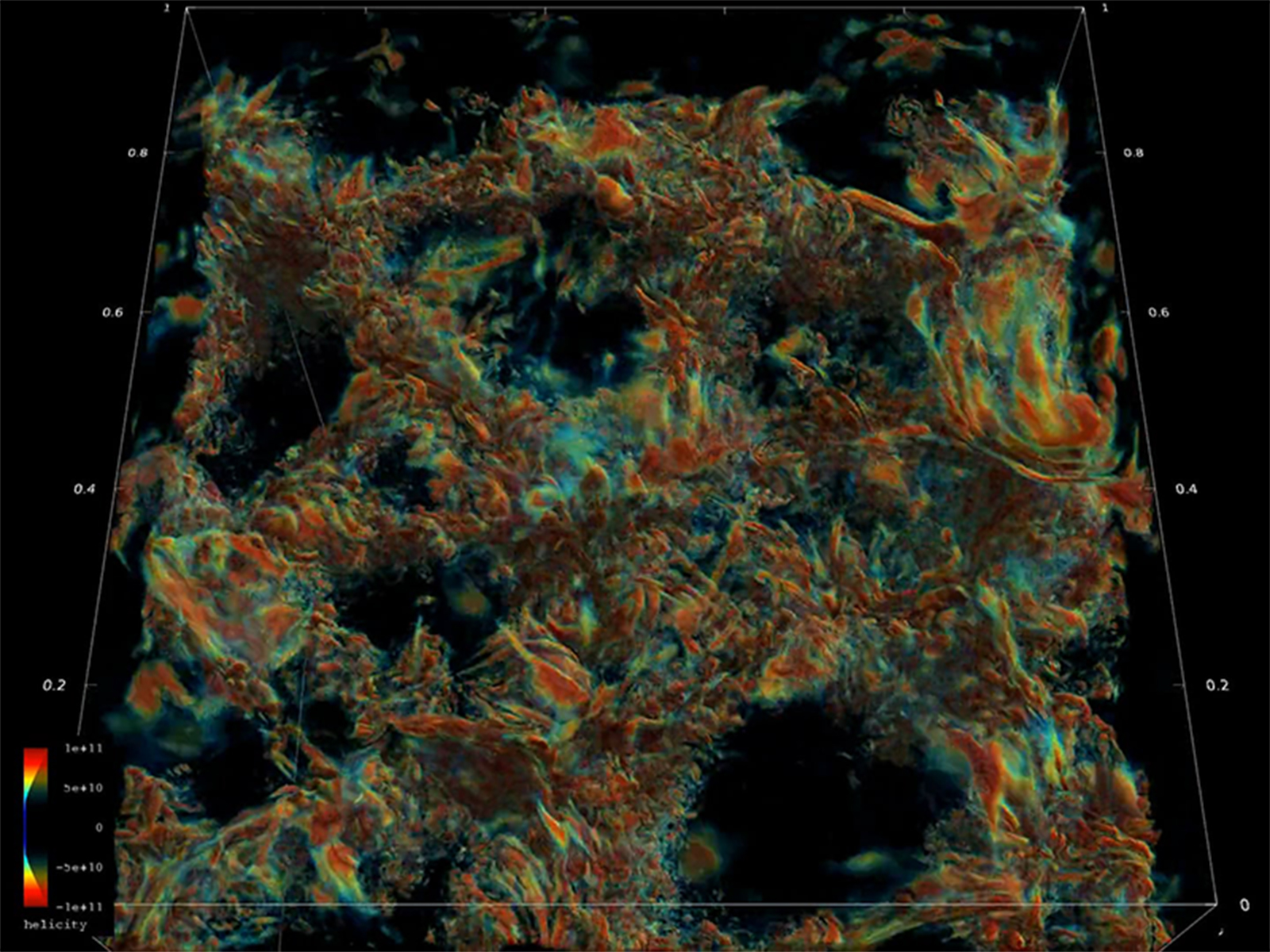
The variability and activity of the Sun influences Earth's space environment and are primary contributors to changes in space weather that can interfere with satellite electronics, radio communications and GPS signals, and even power grids on Earth. Using NASA's advanced computational capabilities, scientists at NASA’s Ames Research Center perform 3D realistic radiative hydrodynamic and magnetohydrodynamic modeling dynamics of the Sun—from the deep interior regions to the atmosphere—on scales significantly smaller than any telescope can resolve to scales larger than the American continents. This research allows the team to investigate the impact of solar rotation on the structure of the solar convection zone, in addition to improving our understanding of the origins of solar jets and tornadoes and how the Sun produces sound waves that probe the solar interior. The most recent models provided evidence of the substructure of the near-surface shear layer. They uncovered the significant effect of the Coriolis force on the properties and subsurface dynamics of solar convection. For the first time, the realistic models allowed the scientists to study the physics of solar plasma from small to large scales, enabling them to get inside the nature of observed phenomena with NASA heliophysics space missions such as the Solar Dynamics Observatory, Solar Orbiter, and Hinode.
These 3D realistic simulations utilize state-of-the-art advances in modeling radiating plasma in the presence of the Sun’s magnetic fields and rotation in the highly stratified medium. NASA’s supercomputing capabilities and comprehensive user support allow us to address challenging, long-standing questions of solar dynamics.
Irina Kitiashvili,
NASA Ames Research Center
Quick Facts
- The 3D realistic hydrodynamics modeling enables the discovery of a 6,200-mile-thick near-surface layer of the Sun (the leptocline) that is crucial for understanding how subsurface magnetic fields reorganize just before their emergence on the solar surface.
- Solar dynamics were modeled with NASA’s StellarBox code on the Pleiades, Electra, and Aitken supercomputers at the NASA Advanced Supercomputing (NAS) facility at Ames Research Center. The user support team helped accelerate I/O by 100 times, significantly reducing computational costs.
- The model results are used to generate synthetic observables for calibration and interpretation of observations from the Helioseismic and Magnetic Imager onboard the Solar Dynamics Observatory and test existing and new techniques to reconstruct subsurface dynamics and structure of the Sun.
- The project’s next step is to expand the current modeling effort to the whole convection zone and investigate the self-organization of the magnetic fields from small-scale distributed patches to a sunspot.
Researchers
- Irina Kitiashvili, NASA Ames Research Center Please enable Javascript to see email address.
- Alan Wray, NASA Ames Research Center Please enable Javascript to see email address.
