Coupled Simulations of Propellant and Vehicle Dynamics Over Extreme Duration Time Scales
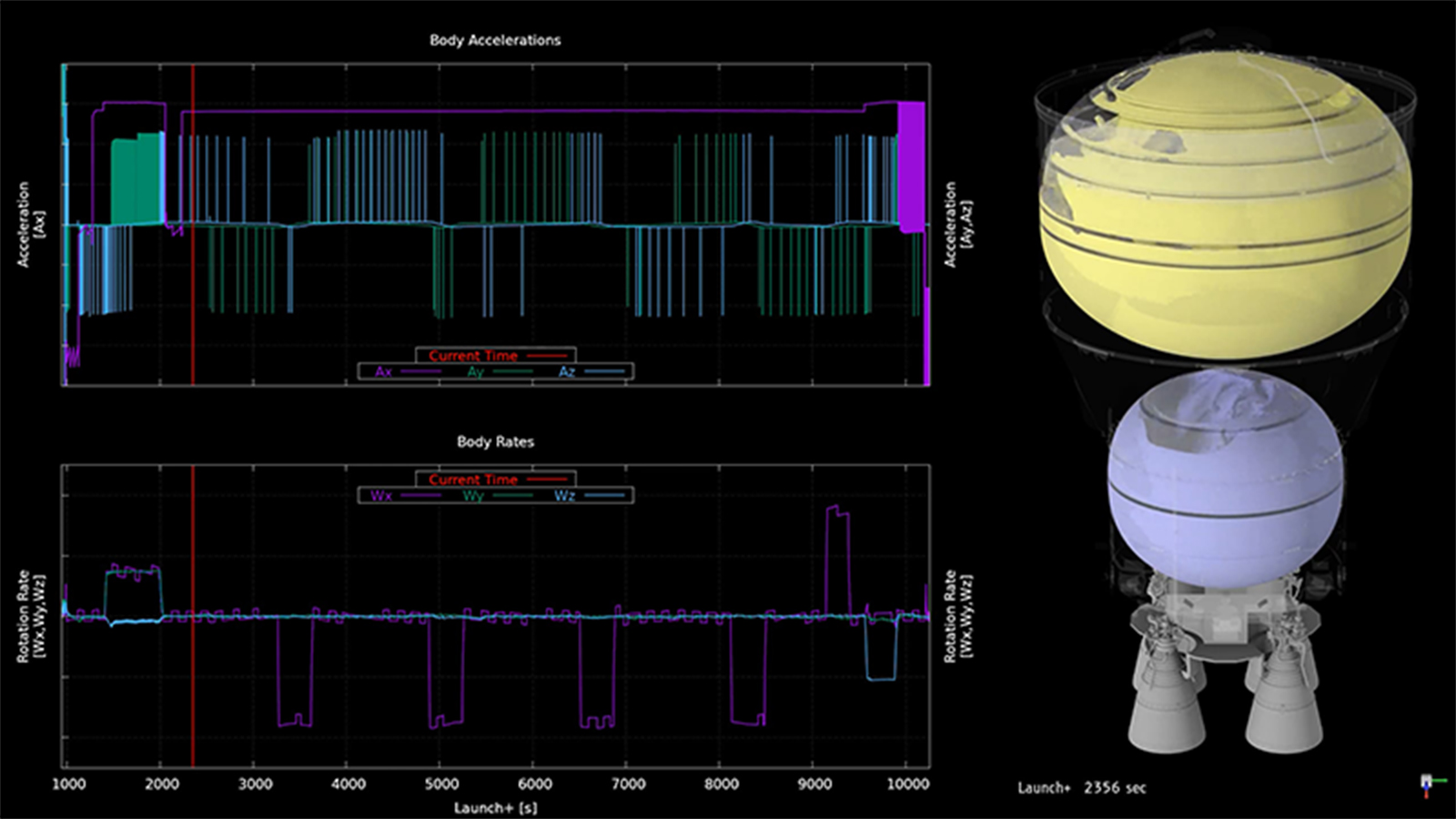
Methods for mitigating unwanted movement of liquid propellant, known as slosh, have a long history in the development of launch, landing, and in-space vehicles. When designing spacecraft, engineers typically rely on semi-empirical slosh models that can be reduced to simple mechanical analogs, which are easy to incorporate into full vehicle flight dynamics simulations. However, common mechanical slosh models break down in simulations of the low-gravity portions of flight, such as when a vehicle enters a coasting period in its trajectory. Without direct modeling, estimating the effects of slosh in these scenarios can require adding large margins on various design parameters.
To fill this modeling gap, simulations utilizing computational fluid dynamics (CFD) with coupling to a vehicle dynamics model can be used, but long-duration coast phases can be computationally expensive with this approach. Recently, engineers from the Fluid Dynamics Branch at NASA’s Marshall Space Flight Center successfully completed a parametric analysis consisting of twenty-eight primary simulations of the Space Launch System (SLS) Exploration Upper Stage in order to support an assessment of hydrazine propellant mass usage by its Reaction Control System during two coast phases. First, the team evaluated open-loop stability control with loose coupling to the vehicle model. Next, they determined sensitivity using a more tightly coupled closed-loop model linking the CFD solver and vehicle model. Each case simulated several thousands of seconds of mission time and required continuous run times over two months.
NASA supercomputing resources and the ability to reserve nodes enabled simulation of propellant control for entire mission phases using coupled CFD and vehicle model analysis, a necessary capability to ensure safety of flagship NASA missions.
Jacob Brodnick,
NASA Marshall Space Flight Center
Quick Facts
- This analysis successfully produced useful estimates of hydrazine usage using CFD as the most trusted method of low-gravity slosh modeling despite the high computational resource cost.
- The longest duration case required eighty days of non-continuous compute time, with an estimated 2,800,000 core hours. The follow-on closed-loop analysis was completed in fifty-two days using an estimated 3,200,000 core hours. The simulations were run on NASA’s Aitken, Pleiades, and Electra supercomputers.
- Successful coupling of the CFD solver and vehicle model is a significant capability improvement that can be carried forward to a wide range of future analyses, bolstered by the plug-and-play flexibility for both tools should other models be desired.
- Visualizations of the tank dynamics provided further insights for evaluating propellant settling maneuvers. Methods were developed to mitigate the potential for propellant venting and possibly freezing in the vent lines, which could cause a blockage
Researchers
- Marco Sansone, NASA Marshall Space Flight Center Please enable Javascript to see email address.
