Analyzing the Artemis I Launch Environment with Multiphase CFD
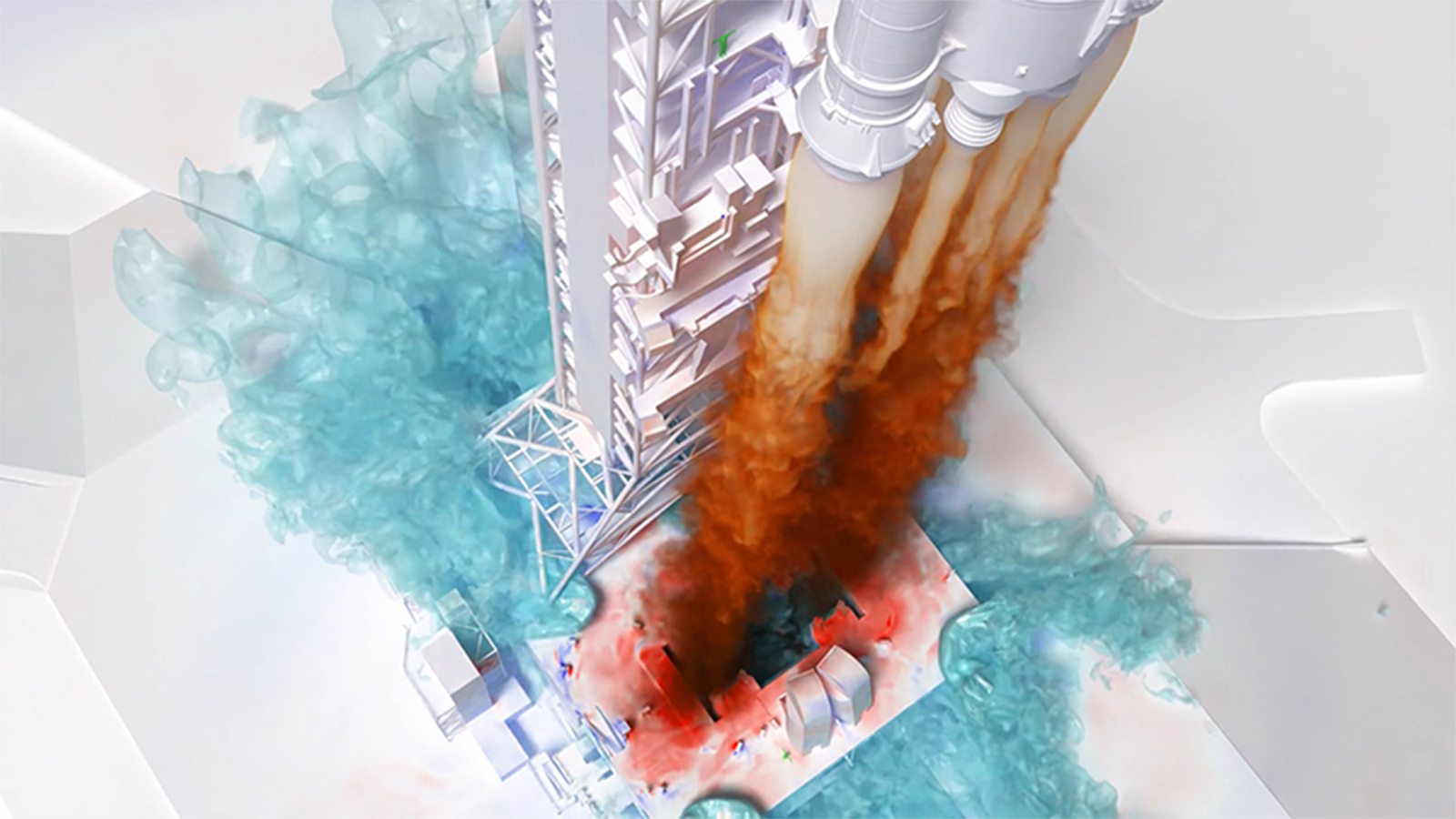
The Launch, Ascent, and Vehicle Aerodynamics (LAVA) team in the NASA Advanced Supercomputing (NAS) Division is advancing prediction capabilities to simulate the Artemis mission launch environment, in particular exhaust plume impingement, which can create hazardous forces and vibrations that may damage critical infrastructure or the vehicle payload during launch. During the Artemis I launch in 2022, some of the mobile launcher’s structure was damaged due to pressure and vibration, including tubing welds and the protective cover on the launcher’s elevator doors. While the mobile launcher is equipped with several water systems designed to dampen pressure forces and acoustic waves, we don’t completely understand the complex physics and dynamics of the interaction between the rocket plume and the water-based suppression systems.
Using the LAVA cartesian software’s multiphase capabilities, the team simulated the Artemis I launch environment. In this model, the rocket is held lofted in space at seven seconds after liftoff with all water systems turned on. To quantify the water’s effect on the environment, the team compared this simulation to one that used the same approach, but without the water systems turned on. They were able to show that the system generally dampens pressure and acoustic signals, but that the exhaust flow from the plume can redirect the water in a way that significantly increases maximum pressure forces. The results from this simulation gives insight into the environment that caused the damages during the Artemis I launch and is helping in the redesign of the launch pad and mobile launcher for the upcoming Artemis II launch in 2025.
Simulating launch environments is computationally expensive. However, including the additional physics to model the water systems and water-plume interaction accurately makes these simulations nearly unattainable without world-class computing resources. The resources at the NASA Advanced Supercomputing facility allow us to simulate these environments in extreme detail, giving valuable data and novel insights to agency engineers working on the mobile launcher in preparation for future Artemis launches.
Chris DeGrendele,
NASA Ames Research Center
Quick Facts
- This simulation was run on 180 AMD Rome nodes of NASA’s Aitken supercomputer, taking roughly 25 days and generating over 400 terabytes of data. Significant help and support from NAS support staff was provided to help keep the simulation running steadily for such a long period over so many nodes.
- The LAVA team was able to show that the water-based sound suppression system is very effective in acoustic sound suppression, but can cause increased integrated loads on specific parts of the mobile launcher structure.
- All the data from this work has been post processed and delivered to aerospace engineers at NASA’s Kennedy Space Center, including statistics of loads over integrated surfaces, pressure signals at probe locations, and acoustic data.
- While the team is continuing to analyze and provide insight into this and previous simulations of the launch environment, they are preparing for upcoming efforts targeted for the Artemis II launch with a new flame deflector and mobile launcher design.
Researchers
- Chris DeGrendele, NASA Ames Please enable Javascript to see email address.
- Scott Neuhoff, NASA Ames Please enable Javascript to see email address.
