Enabling Sky-High Commutes: Simulating NASA’s Tilt-Wing Air Taxi Concept
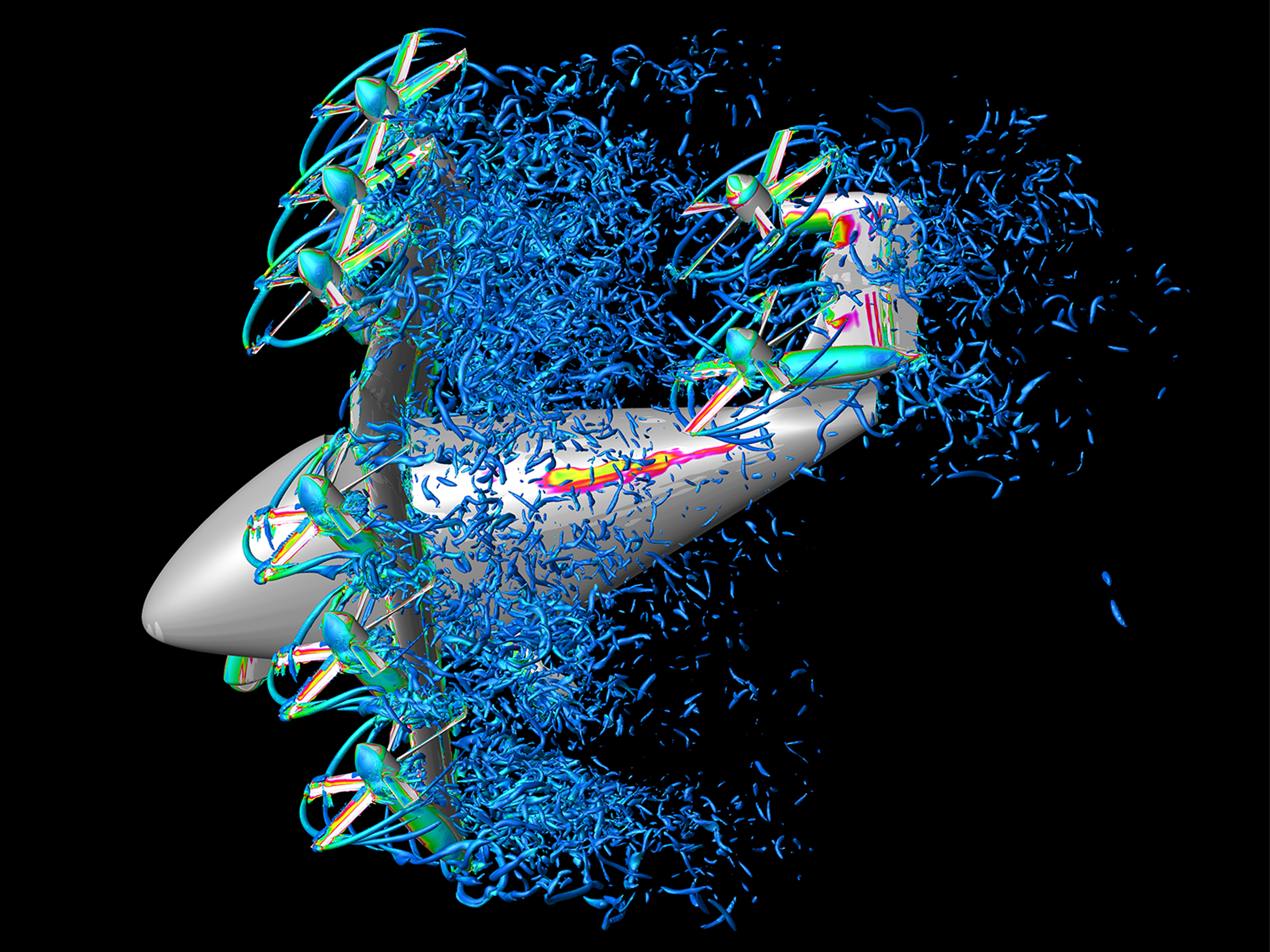
NASA is paving the way for a new era of urban transportation, which will bring air taxi rides to everyday city travel. This transformative technology is known as advanced air mobility. Although early use of inter-city aerial travel traces back to helicopters, the high-operating costs, significant noise pollution, and lack of public acceptance limited their widespread adoption. Within the Revolutionary Vertical Lift Technology project, NASA is exploring several conceptual designs to usher in the next generation of urban air transportation. The tilt-wing configuration is a promising aircraft design that can take off and land vertically, much like a helicopter, and with the speed and efficiency of an airplane. This versatility makes the tilt-wing ideal to navigate congested urban landscapes with limited space. However, the transition between hover and forward flight represents the most critical flight phase to ensure safe operation. For this reason, a team of research scientists at the NASA Advanced Supercomputing (NAS) facility at the agency’s Ames Research Center is simulating the flow physics around NASA’s tilt-wing air taxi by means of high-fidelity computational fluid dynamics (CFD) tools. The goal of these simulations is to provide a deeper understanding of the complex aerodynamic interactions during transition from hover to forward flight to enable safer and more efficient operation of the aircraft. The lessons learned are being used by private companies and NASA engineers to lift urban air mobility off the ground.
The power of NASA’s supercomputers is crucial for simulating the complex aerodynamics and flight dynamics of urban air taxis. The resources at the NAS facility provide us with the ability to process massive amounts of data and run extremely detailed simulations, ultimately allowing us to optimize the design of the next-generation vehicles.
David Garcia Perez,
NASA Ames Research Center
Quick Facts
- The tilt-wing vehicle simulations were carried out using NASA’s OVERFLOW CFD solver on the Aitken supercomputer at the NAS facility. Each simulation ran for 20 days using between 2,500 and 3,000 Intel Xeon Cascade Lake processors, generating 100 terabytes of data for just five proprotor revolutions.
- With the aid of computational results, researchers can more effectively characterize how proprotor-wing interactions affect flow separation over the wing—a major concern for vehicle safety, performance, and controllability. Understanding these aerodynamic interactions is essential for devising strategies to mitigate flow separation.
- High-fidelity CFD methods capture complex aerodynamic interactions and provide a broad range of flowfield details that can be investigated to validate and/or calibrate preliminary design tools that rely on low-fidelity modeling. This way. the primary effects of flow separation and unsteadiness of the blade loading can be partially accounted for in conceptual design. Additionally, the results of this study will serve as comparison with experimental data and can help in prioritizing relevant test conditions in future experiments.
- The next steps of this project will involve the analysis of different flight conditions within the transition corridor, as well as the sensitivity of the results to various simulation parameters and numerical schemes.
Researchers
- David Garcia Perez, NASA Ames Research Center Please enable Javascript to see email address.
- Patricia Ventura Diaz, NASA Ames Research Center Please enable Javascript to see email address.
