Forecasting Space Weather Using Machine Learning
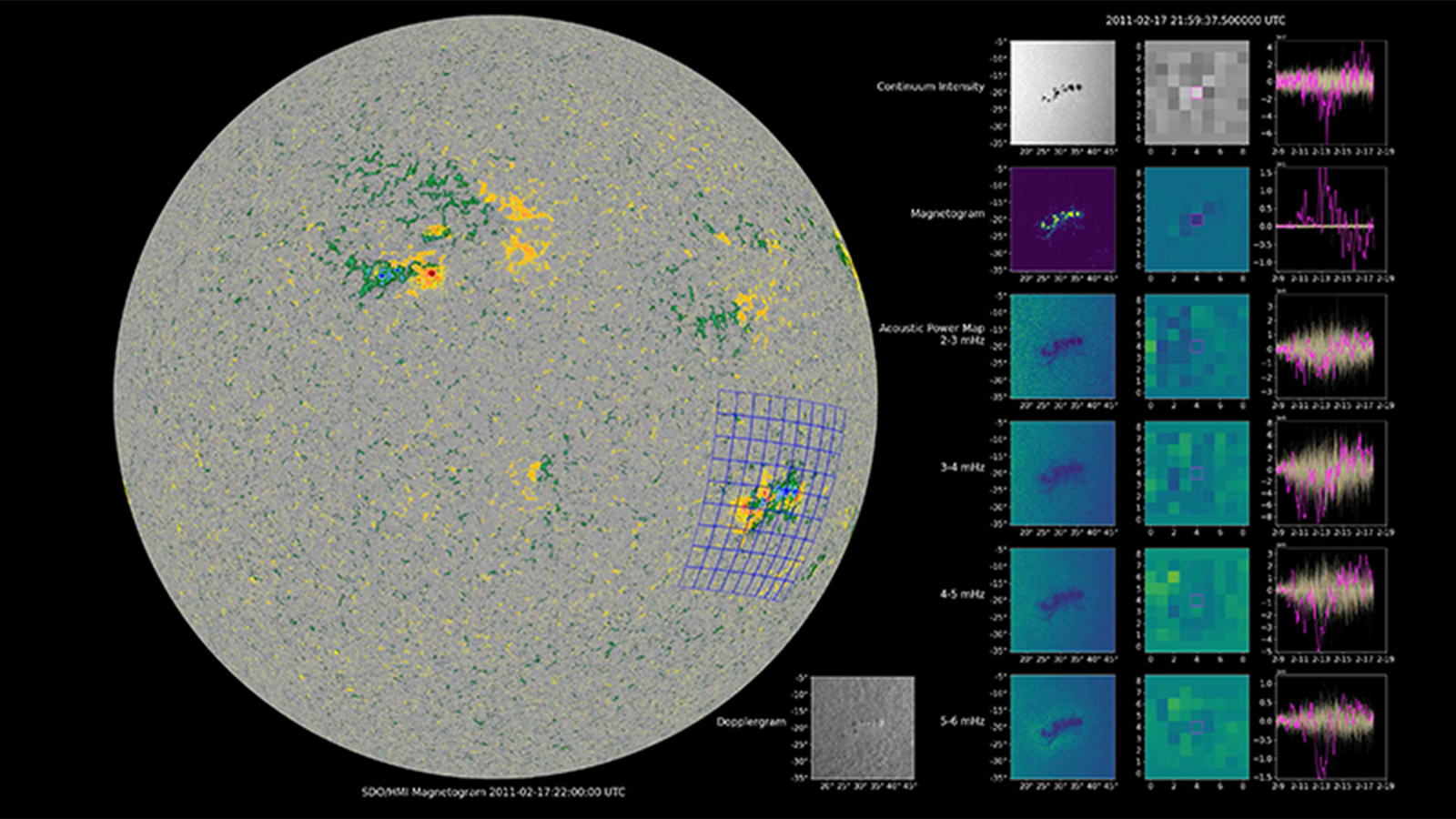
Space weather is a branch of space physics that studies the environmental conditions in space that are primarily caused by the Sun’s activities, such as solar flares. The ability to forecast space weather phenomena is critical because it can help protect essential technologies like satellites, power grids, and communication systems from potential disruptions, as well as astronauts in space from harmful doses of radiation. To forecast upcoming flaring activity, scientists at the NASA Advanced Supercomputing (NAS) facility at Ames Research Center developed a machine learning (ML) model to predict the emergence of large sunspots on the solar surface using observations from the Helioseismic and Magnetic Imager (HMI) on board NASA’s Solar Dynamics Observatory (SDO). In some cases, the energy released by these eruptions can accelerate plasma to a very high speed. As a result, the strong flux of high-energy particles that travel through space, so-called Solar Energetic Particle (SEP) events, may impact Earth's environment. The scientists aim to provide ML-driven technology that will aid with processing large amounts of historical data from NASA’s Solar and Heliospheric Observatory (SoHO) and SDO satellites to forecast SEP events.
Using the NVIDIA A100 GPU nodes available at the NASA Advanced Supercomputing facility, we were able to significantly accelerate the training of machine learning models that are critical for processing large datasets and building more reliable solar flare forecast modules.
Spyros Kasapis,
NASA Ames Research Center
Quick Facts
- NASA’s Pleiades supercomputer at the NAS facility was used to process observations from the SoHO and SDO space missions and train and test the machine learning models to predict the appearance of sunspots on the solar surface and Solar Energetic Particle (SEP) events.
- Machine learning models have proven capable of capturing those changes in solar photospheric dynamics that signal the emergence and evolution of magnetic flux, which can lead to eruptive activity.
- The datasets created for ML model training, along with the models themselves, will be made publicly available, allowing for the investigation of various solar phenomena. The products of this work will aid with the community’s understanding of how different space weather phenomena are connected.
- Future research will improve the existing predictive capabilities of ML models to transition towards the operational forecast of space weather disturbances.
Researchers
- Spiridon Kasapis, NASA Ames Research Center Please enable Javascript to see email address.
- Irina Kitiashvili, NASA Ames Research Center Please enable Javascript to see email address.
More Information
- Solar Active Regions Emergence Prediction Using Long Short-Term Memory Networks
- Forecasting SEP Events During Solar Cycles 23 and 24 Using Interpretable Machine Learning
- Predicting the Emergence of Solar Active Regions Using Machine Learning
- Interpretable machine learning to forecast SEP events for solar cycle 23
- Solar Dynamics Observatory
- Helioseismic and Magnetic Imager
- Sun In Time
