NASA-GPT: Searching the Entire NASA Technical Reports Server Using AI
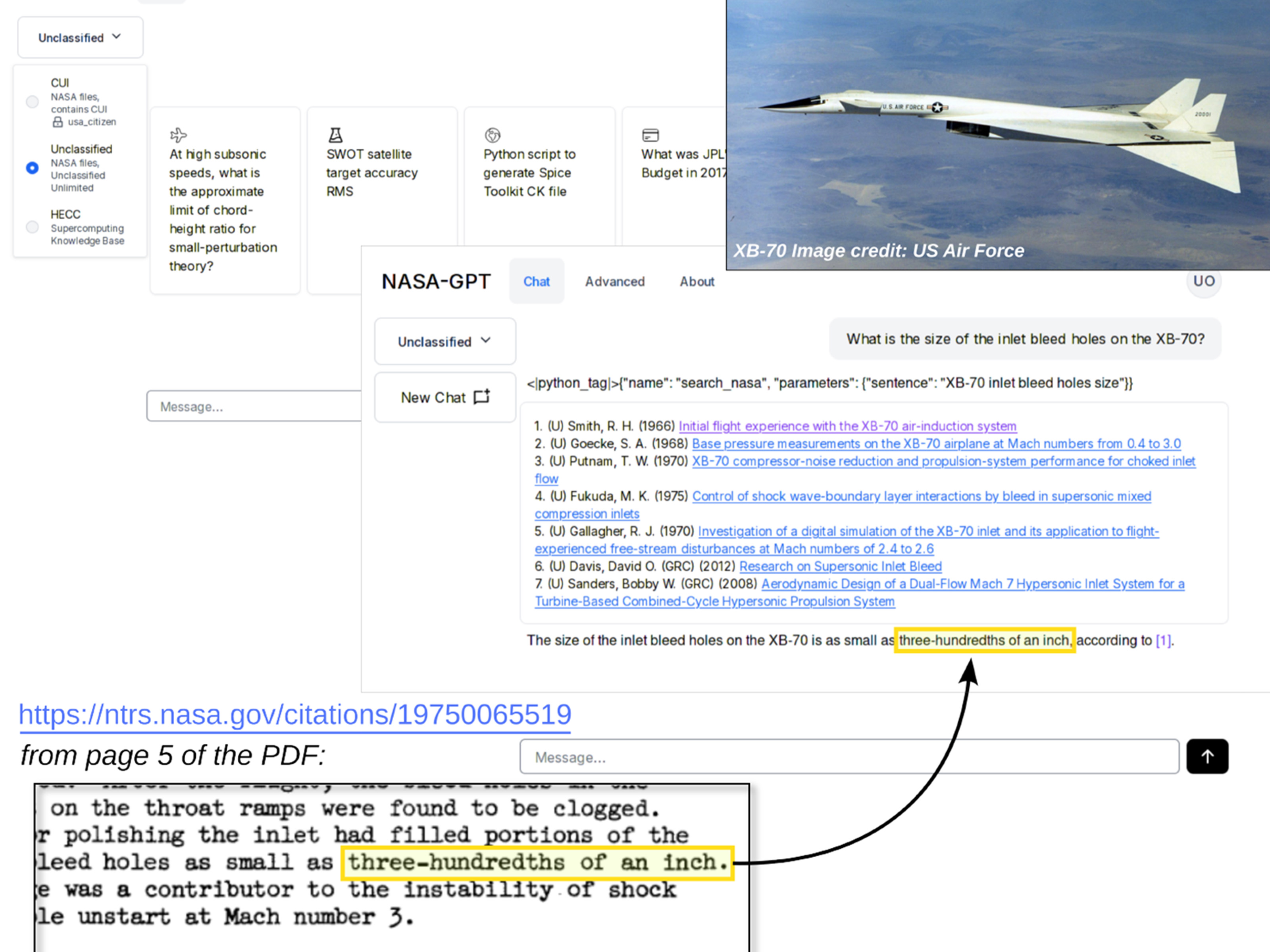
Researchers at NASA’s Ames Research Center in Silicon Valley are using artificial intelligence (AI) tools to create a data-sharing resource for the agency’s scientific and engineering staff. NASA-GPT is a non-cloud, internally hosted chatbot and AI-enhanced search tool with access to several of the agency’s report servers and data repositories, including the NASA Technical Reports Server, the JPL Technical Reports Server, and more. It can answer specific questions about NASA programs, like “What insulation material was used on the liquid hydrogen tank of the second stage of the Saturn V?” or “What was the size of the inlet bleed holes on the XB-70?”, allowing users to quickly access key data from published reports, presentations, and logs. It also provides links to the relevant sources so that users can verify that the language model is not just hallucinating an answer, a phenomenon that other chatbots have recently come under fire for. In addition to its research applications, NASA-GPT can also answer technical and procedural questions about how to use the computational resources provided by the NASA Advanced Supercomputing Division. While the tool only took a few weeks for the team at Ames to create, the future applications within NASA are nearly endless.
Most of us have experimented with modern large language model tools and found them to amazing and helpful. Much of our work at NASA cannot make use of those commercial tools, but with the resources available at the NASA Advanced Supercomputing facility, we can recreate much of that capability for an internal userbase. The tool we created in just a few weeks would have cost hundreds of thousands of dollars to procure from a commercial provider.
Derek Dalle,
NASA Ames Research Center
Quick Facts
- Running large language models (LLM) is not easy; the full NASA-GPT model needs at least four of the Cabeus supercomputer’s NVIDIA A100 GPUs to run, though multiple users can use it simultaneously. Many GPU hours were also used to convert roughly three million PDFs to text to make them readable by the model.
- NASA-GPT has wildly exceeded the team’s expectations for its ability to find helpful answers. Although the model currently does not process images, it will sometimes refer to specific figure numbers within papers for possible answers to questions, allowing users to dig deeper into the source material.
- One key feature is to be able to use the LLM with data that would not be allowed to be uploaded to the cloud, including assistance writing modules for running code in agency supercomputing environments.
- The development team are currently working to add more datasets to the model, and they are hoping to make the tool available to all NASA-badged users.
Researchers
- Derek Dalle, NASA Ames Research Center Please enable Javascript to see email address.
- Sam Foxman, NASA Ames Research Center Please enable Javascript to see email address.
