Scale-Resolving Methods for Accurately Predicting the Aerodynamics of In-Flight Icing
Timothy A. Sandstrom, NASA/Ames
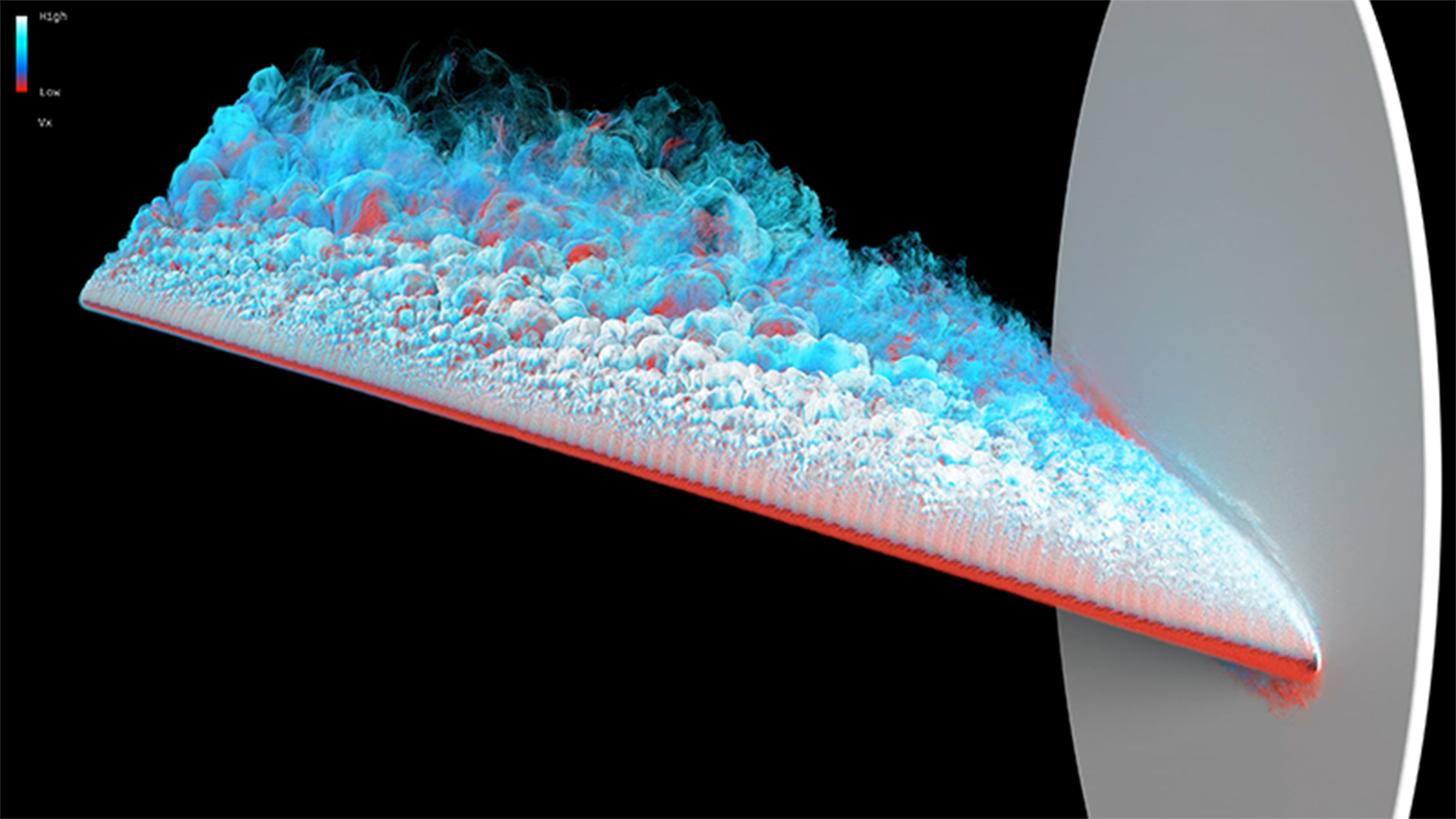
To better understand the effects of in-flight icing—the buildup of ice on aircraft surfaces during flight—NASA's Advanced Air Transport Technology (AATT) and Transformational Tools and Technologies (TTT) Projects are looking for ways to reliably predict the aerodynamic performance of planes in these conditions and find a solution to the known adverse effects of ice buildup, such as reduced lift, non-linear changes in pitching moment, and increased drag. However, wind tunnel and flight-testing approaches for understanding the flow physics of in-flight icing and then certifying new designs are highly resource intensive, both in terms of time and financial cost, frequently making them impractical for evaluating next-generation aircraft configurations. The Launch, Ascent, and Vehicle Aerodynamics (LAVA) group at NASA’s Ames Research Center is assessing the ability of scale-resolving numerical methods to make accurate and efficient aerodynamic predictions of in-flight icing. Recently, the team used the LAVA framework to evaluate the aerodynamic performance of a swept wing with high-fidelity and smooth leading-edge ice shapes using wall-modeled large-eddy simulations with structured hybrid curvilinear body-fitted/immersed-boundary and unstructured Voronoi grids. The curvilinear approach models the effect of ice on the airflow through source terms added to the governing equations, while the Voronoi strategy includes the ice representation directly in the mesh. Aerodynamic results––including integrated loads, surface pressure profiles, and skin-friction streamlines––were compared against experimental results collected at the Wichita State University wind tunnel. Interestingly, the simulations showed better agreement with the experiment for the high-fidelity ice shape compared to the smooth ice shape, likely due to simpler flow physics near the leading edge.
Leveraging Ames’ new GPU-based Cabeus supercomputer, the recently GPU-ported LAVA unstructured solver, along with LAVA’s Voronoi meshing tool, greatly reduces the turnaround time for simulating complex icing configurations. These advancements enable computationally efficient exploration of aerodynamic performance under icing conditions, guiding future numerical modeling choices for next-generation aircraft designs.
David Craig Penner,
NASA Ames Research Center
Quick Facts
- The cases run with the curvilinear approach involved between 400 and 600 million grid points and were simulated using 6,400 cores for approximately two days on either AMD Rome processors on the Aitken supercomputer or Skylake processors on the Electra supercomputer at the NASA Advanced Supercomputing (NAS) facility. The cases run with unstructured grids ranged from 5 to 220 million polyhedral cells and were solved on similar CPU resources, in addition to leveraging the recently ported GPU version of the code––which ran on 4 to 12 NVIDIA A100 GPU nodes and achieved rapid turnaround times of 12 hours for a 50-million cell mesh.
- LAVA’s Voronoi meshing tool significantly reduced the time required to generate meshes for this case. Surprisingly, while the high-fidelity ice shape was more challenging to mesh compared to the smooth ice shape, it was easier to simulate due to the simpler flow physics near the leading edge.
- These results will help guide numerical modeling choices for simulating a next-generation transonic truss-braced wing configuration with ice buildup.
- The next steps are to evaluate the performance of a Cartesian immersed-boundary approach for this case and assess the sensitivities of the numerical schemes.
Researchers
- David A. Craig Penner, NASA Ames Research Center Please enable Javascript to see email address.
- Victor C. B. Sousa, NASA Ames Research Center Please enable Javascript to see email address.
