Decoding Martian Dust: Brownout Simulations of the Ingenuity Mars Helicopter
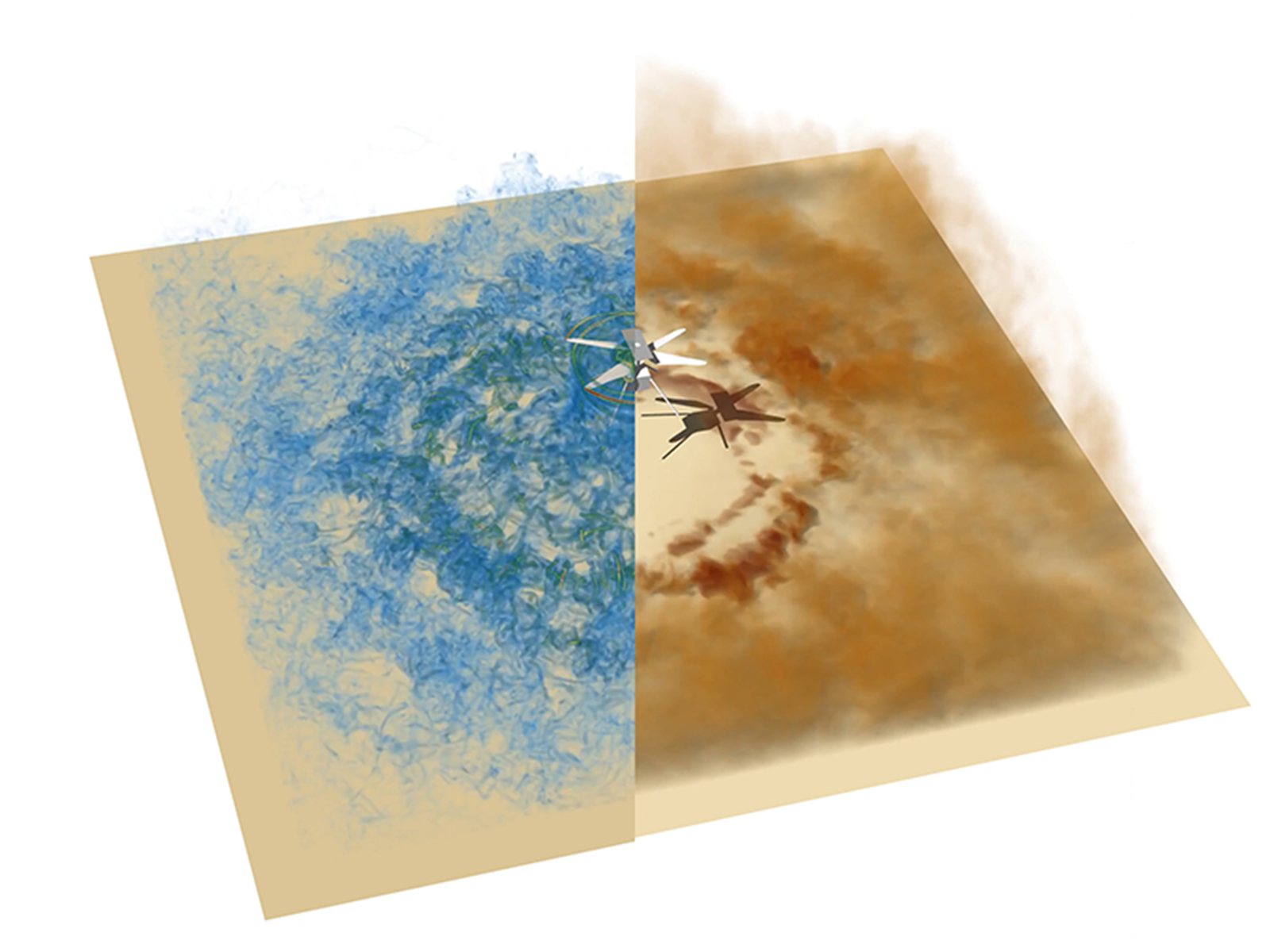
NASA’s Ingenuity Mars helicopter is the first device to sustain powered flight on an atmosphere other than Earth. With over 70 flights, Ingenuity has paved the journey for extraterrestrial flight exploration. On dusty planets like Mars, dust clouds can form during takeoff and landing due to rotor wash—a strong vertical current of air between the helicopter and the ground. The complex flow when the rotorcraft is close to the ground—a position known as “ground effect”—can interact with the dusty environment, creating brownout, where clouds of dust are kicked up into the air around the vehicle. Future NASA missions with heavier vehicles, such as the Dragonfly rotorcraft lander to Saturn’s moon Titan or the Mars Sample Helicopter, must account for brownout during the design phase, as it could jeopardize safe operations.
A team of aerospace engineers at the NASA Advanced Supercomputing (NAS) facility at Ames Research Center used a Vortex Particle-Mesh (VPM) method to simulate the Ingenuity small rotorcraft in ground effect with brownout. The transport of dust was implemented in VPM and allows the NAS team to track the distribution and total mass of rising dust as a function of time. The simulations were compared with data observed in situ on Mars to verify the implementation. Six flights of the Ingenuity helicopter were video recorded between April and September 2021 by the Perseverance rover, and the videos were specially processed to calculate the amount of dust lifted.
NASA’s supercomputers were essential in simulating Ingenuity’s rotors and Martian dust, and being able to run dozens of simulations with a short turnaround time. These simulations mark the first step in understanding brownout conditions on other planets, laying the groundwork for safer and more reliable rotorcraft operations in extraterrestrial environments.
Patricia Ventura Diaz,
NASA Ames Research Center
Quick Facts
- Dozens of cases were run using 200 to 900 processors on NASA’s Pleiades supercomputer. Simulations usually finished within a day per case using Vortex Particle-Mesh, a mid-fidelity computational fluid dynamics code that scales and runs efficiently.
- The objectives of this research were to showcase the efficacy of modern numerical models to simulate brownout on other planets and compare with observations.
- The data derived from Ingenuity’s observations provided a wealth of information that still has secrets to unveil. Beyond that, Ingenuity’s unprecedented achievements have certainly paved the way for future exploration missions on extraterrestrial worlds.
- The next steps are to test the VPM code for other missions on Mars and other dusty environments such as the Dragonfly rotorcraft lander to Titan.
Researchers
- Patricia Ventura Diaz, NASA Ames Research Center Please enable Javascript to see email address.
- Denis-Gabriel Caprace, NASA Ames Research Center Please enable Javascript to see email address.
More Information
- Ingenuity Mars Helicopter
- Paper: Comparing Planetary Helicopter Brownout Observations with Numerical Predictions for Ingenuity
- Simulating Air Taxi Safety: NASA’s Quadcopter in Ground Effect
- Lifting and Transport of Martian Dust by the Ingenuity Helicopter Rotor Downwash as Observed by High-Speed Imaging from the Perseverance Rover
