Unveiling Neutron Stars: Simulations and AI Insights into Cosmic Emissions
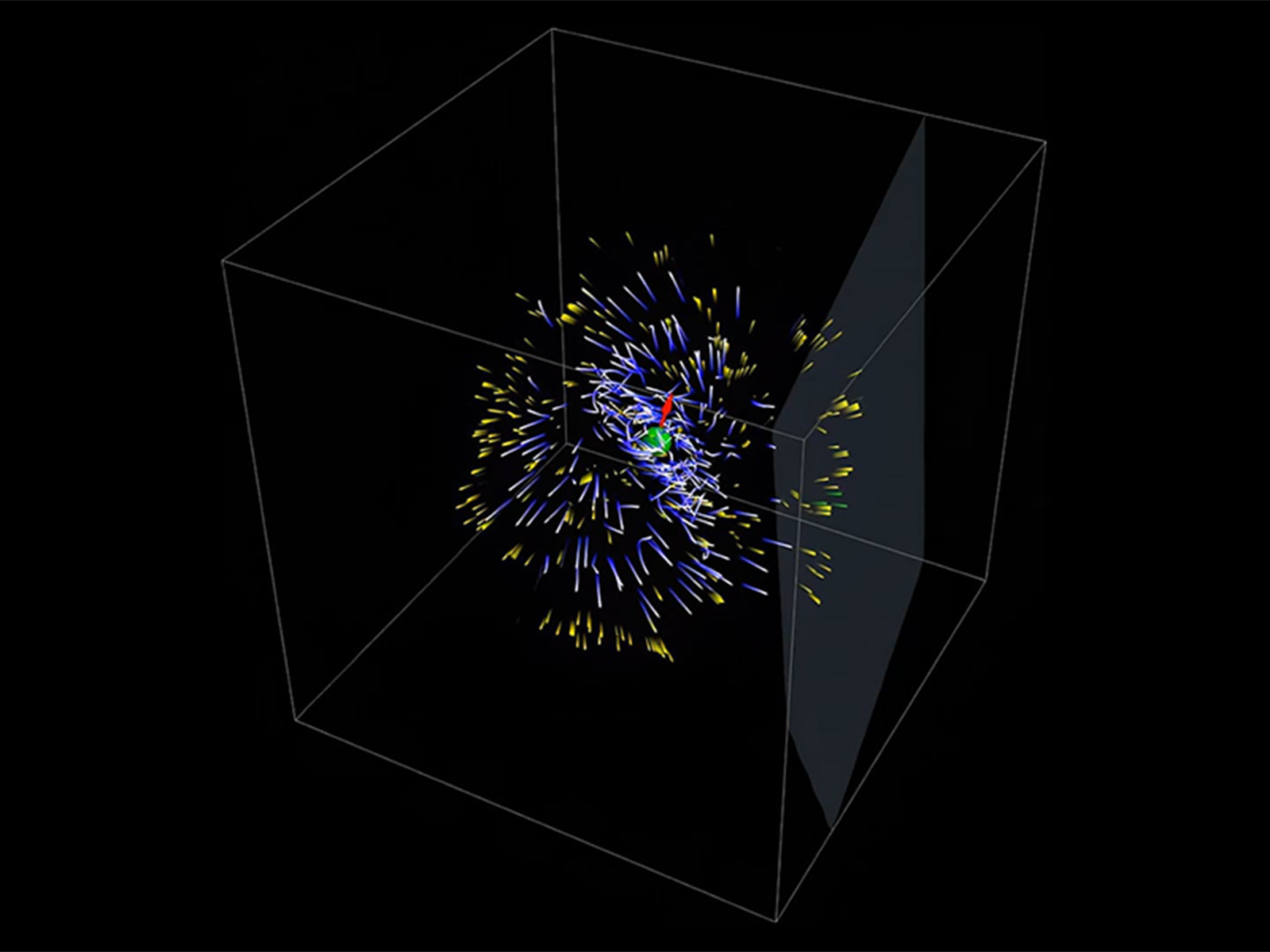
Researchers at NASA’s Goddard Space Flight Center use the agency’s supercomputers to explore the fascinating world of neutron stars—some of the densest objects in the universe—by using cutting-edge simulations and advanced machine learning techniques. The scientists run magnetohydrodynamic (MHD) and particle-in-cell (PIC) simulations to study the magnetic environments, or magnetospheres, of single and binary neutron stars. By examining their emission patterns, they aim to understand the high-energy radiation detected by NASA’s Fermi Gamma-ray Space Telescope. In addition to these simulations, the researchers apply deep neural networks to quickly infer crucial properties of neutron stars, such as their magnetic field structure, mass, and radius, from data obtained by Fermi and by NASA’s Neutron star Interior Composition Explorer (NICER), an X-ray observatory aboard the International Space Station. This will help astrophysicists better understand the extreme conditions inside neutron stars and provide new insights into their equation of state—a fundamental aspect of astrophysics that describes the state of matter under a given set of physical conditions. The project represents an exciting blend of simulation, observation, and artificial intelligence to unravel the mysteries of these extraordinary cosmic objects.
NASA's supercomputing resources enabled large-scale MHD and particle-in-cell simulations, alongside advanced machine learning models. These tools, supported by NASA's High-End Computing Program, provided comprehensive insights from Fermi and NICER missions, revolutionizing neutron star parameter inference.
Constantinos Kalapotharakos,
NASA Goddard Space Flight Center
Quick Facts
- The researchers used NASA's Aitken, Pleiades, Electra, and Cabeus supercomputers to run 3D magnetohydrodynamic and particle-in-cell simulations of single and double pulsar magnetospheres, along with ray tracing in general relativistic metric, Markov chain Monte Carlo (MCMC), and MultiNest codes. Machine learning algorithms revolutionized neutron star parameter inference.
- The simulations explained gamma-ray pulsars observed by the Fermi satellite and uncovered hidden correlations. Machine learning sped up neutron star parameter inference, revealing multipolar magnetic fields in millisecond pulsars, with better constraints on the equation of state from NICER and Fermi data.
- This work advances the understanding of pulsar emissions and guides similar studies in black hole environments. It also plays a pivotal role in shaping future space missions and mission concepts, such as AMEGO-X, GammaTPC, STROBE-X, and HEX-P. Additionally, it offers key insights into magnetic fields and dense matter properties.
- The team plans to enhance their codes for more self-consistent simulations and incorporate additional data in neutron star parameter inference. Additionally, they will expand their machine learning tools for use in other fields like exoplanet microlensing and Laser Interferometer Space Antenna gravitational wave data analysis.
Researchers
- Constantinos Kalapotharakos, NASA Goddard Space Flight Center Please enable Javascript to see email address.
- Greg Olmschenk, NASA Goddard Space Flight Center Please enable Javascript to see email address.
More Information
- Fermi Gamma-Ray Pulsars: Understanding the High-energy Emission from Dissipative Magnetospheres
- Three-dimensional Kinetic Pulsar Magnetosphere Models: Connecting to Gamma-Ray Observations
- The Multipolar Magnetic Field of the Millisecond Pulsar PSR J0030+0451
- The Gamma-Ray Pulsar Phenomenology in View of 3D Kinetic Global Magnetosphere Models
