Predicting Orion Supersonic Ascent Abort Vibrations to Keep Astronauts Safe
Overview
NASA’s Artemis Program aims to transport humans to interplanetary destinations such as the Moon—and eventually Mars—and return them safely back to Earth via the Orion crew module. The safest spacecraft ever built, NASA’s Orion will carry the first woman and next man to land on the Moon by 2024, and enable sustained presence on and around the Moon by 2028. An integral part of ensuring safe spaceflight is Orion’s Launch Abort System, or LAS. This state-of-the-art crew escape system is attached to the top of the spacecraft and can propel the crew module away from the rocket within milliseconds should a life-threatening event arise during launch. The LAS is then jettisoned once the spacecraft has safely reached low-Earth orbit.
"The success of these simulations opens the door to more analysis that can help reduce uncertainty for scenarios that are difficult or too expensive to test, further helping to reduce risk and ensure the safety of astronauts when using the Orion Launch Abort System."
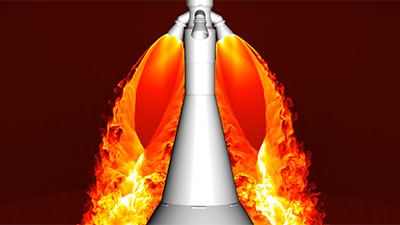
In order to propel the crew module away to safety, the LAS uses an abort motor that produces four large high-speed exhaust plumes that flow along the sides of Orion, generating extremely strong acoustic vibrations. These vibrations need to be carefully analyzed to ensure the safety of the astronauts inside. To better understand the effects of altitude and velocity on the strength of the vibrations generated by the plumes on the surface of the LAS, we produced a detailed, turbulence-resolving simulation of the Ascent Abort Test 2 (AA-2) conducted in July 2019. During the AA-2 flight test, a booster provided by Northrop Grumman launched from Cape Canaveral Air Force Station in Florida, carrying a fully functional LAS and a 22,000-pound Orion test vehicle to an altitude of 31,000 feet and Mach 1.17 (just over 1,000 miles per hour), at which point the abort motors were triggered and the LAS accelerated Orion away from the booster.
Project Details
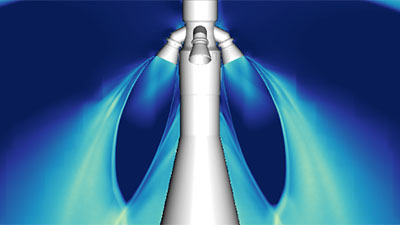
The Launch, Ascent, and Vehicle Aerodynamics (LAVA) team at NASA’s Ames Research Center has closely collaborated with the Orion Loads and Dynamics team at Johnson Space Center since 2017 to help characterize the vibrations imparted by the LAS abort motor plumes onto the LAS structure. During this time, the team has run multiple simulations for various launch abort scenarios using the cutting-edge LAVA computational fluid dynamics (CFD) software. To investigate the effect of altitude and velocity when abort is triggered on the unsteady loads measured on the LAS surface, and to validate the LAVA predictions with flight test data, we performed detailed turbulence-resolving simulations of the AA-2 flight test’s early burn.
Results and Impact
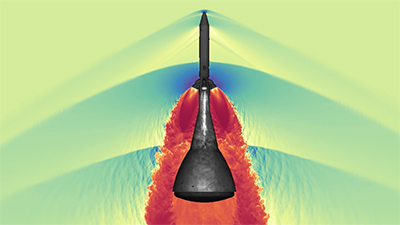
The scale-resolving simulation of the AA-2 flight test was unprecedented in terms of the length of time simulated—1.3 seconds—at this level of detail. Along with earlier ground-breaking CFD analyses our team has performed for the LAS, this work continues to demonstrate a growing new capability for NASA. It is the first turbulence-resolving simulation of an ascent abort scenario with enough fidelity and time integration to accurately predict the acoustic vibrations and their spatial correlation on the surface of the LAS across a wide range of frequencies (12.5 Hz to 2,500 Hz) when compared to the flight test data—and it was completed with modest resources in a short-enough turnaround time to affect engineering decisions. Results have significantly contributed to a better understanding of the effects of altitude and velocity on the acoustic environment. The success of these simulations also opens the door to more analysis that can help reduce uncertainty for abort scenarios that are difficult or too expensive to test, further helping to reduce risk and ensure the safety of astronauts when using the LAS.
Why HPC Matters
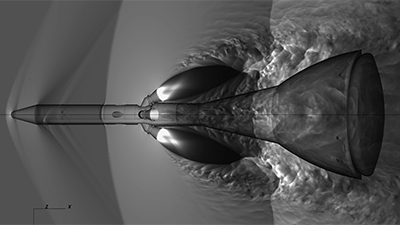
The AA-2 simulation was performed with an adapted Cartesian mesh with 721 million cells and completed nearly 588,200 time steps corresponding to 1.3 seconds of real time. It made full use of 100 Intel Skylake nodes, corresponding to 4,000 cores total, via hybrid MPI-OpenMP parallelism on NASA’s Electra supercomputer for 29 days, generating nearly 200 terabytes of data. The NASA Advanced Supercomputing Division’s visualization experts provided renderings of statistics computed on the volume database of nearly 5,000 snapshots to give an in-depth look at the fluid dynamics causing high sound pressure levels in certain areas.
Related Links
- Computational Framework for Launch, Ascent, and Vehicle Aerodynamics (LAVA)
- Orion Ascent Abort Test 2 (AA-2) Fact Sheet
francois.cadieux@nasa.gov Michael F. Barad, NASA Ames Research Center
michael.f.barad@nasa.gov James C. Jensen, NASA Ames Research Center
james.c.jensen@nasa.gov Cetin Kiris, NASA Ames Research Center
cetin.c.kiris@nasa.gov