Drug Repurposing for COVID‑19 with 3D-Aware Machine Learning
Overview
Novel therapeutics against pathogens like SARS‑CoV‑2, the virus responsible for the COVID‑19 global pandemic, are in urgent need. Leads can be found by training machine learning (ML) models on experimental data and using the models to predict drug activity. These ML models typically use a 2D representation of molecules based on the connectivity of their atoms. However, a drug is not a 2D object, but exists as an ensemble of interconverting 3D structures (conformers). Our work investigates whether ML predictions can be improved using a conformer ensemble representation of molecules. Using NASA high-performance computing (HPC) resources to generate over 33 million conformers for 400,000 molecules, we found that 3D information significantly improves model performance, and that some of the improvement can be obtained using only one conformer from each molecule’s ensemble.
"This project would not have been possible without NASA’s high-performance computing resources, which allowed us to generate these structures for a time-sensitive project in a matter of weeks."
Project Details
The relevance of conformer information to chemical property prediction is a longstanding question. Most existing models use either a 2D graph representation of molecules or a single low-energy 3D structure. The barrier to answering this question is the absence of high-quality conformers, as generating conformers ranked by energy is computationally complex. An efficient algorithm is offered by the newly developed Conformer-Rotamer Ensemble Sampling Tool (CREST) software, which offers a balance of accuracy and computational cost.
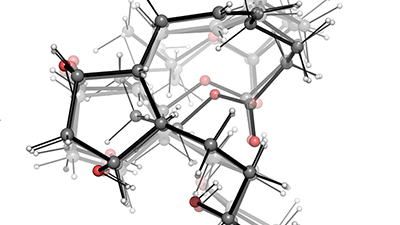
We created a dataset of 304,466 drug-like molecules and 133,318 combinatorially generated molecules, and used CREST to generate conformers for each species, leading to over 33 million conformers (an average of about 100 per molecule). We then trained a model on 278,793 molecules for inhibition of SARS‑CoV 3CL, a protease in SARS‑CoV, the virus that causes SARS (severe acute respiratory syndrome); CoV 3CL is similar to the associated protease in the new virus, SARS‑CoV‑2. The model, called CP3D, represents each molecule as a weighted average over conformer fingerprints, or unique identifiers. For comparison, we trained a 2D model called ChemProp and a CP3D model on the single conformer of lowest energy. We then used the trained models to generate fingerprints for 837 molecules that have been tested for SARS‑CoV‑2 3CL inhibition, and a new network was trained to predict CoV‑2 3CL inhibition from these fixed fingerprints.
Results and Impact
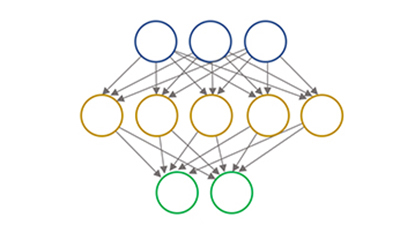
Using the SARS‑CoV model, we analyzed predictive performance using the receiver operating characteristic (ROC) area under the curve (AUC), as well as the precision-recall curve (PRC) AUC. When comparing the results of the CP3D and ChemProp models, we found that 3D information slightly improves the ROC and significantly improves the PRC. CP3D trained on a single conformer also significantly improves the PRC, but does not improve the ROC. Fingerprints were then generated from the SARS‑CoV neural networks, and new models were trained on these fingerprints to predict SARS‑CoV‑2 inhibition. We also compared these to a 2D ChemProp model trained from scratch. Our results show that the 3D model has comparable PRC performance to the 2D model, but has a significantly better ROC score. Only some of the ROC improvement can be recovered with a single 3D structure. Interestingly, the best PRC score is from CP3D with a single conformer.
Why HPC Matters
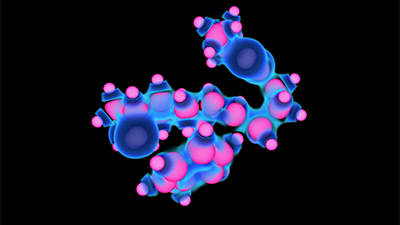
Over 33 million CREST conformers were generated in all, requiring 1.2 million processor-hours running on the Aitken, Electra, and Pleiades supercomputers at the NASA Advanced Supercomputing (NAS) facility at NASA’s Ames Research Center. The CREST runs on the drug dataset took an average of 38 wall minutes using 13 cores (8.2 core-hours) on Intel Xeon Cascade Lake and Skylake nodes. Jobs for the combinatorially-generated small molecules took an average of 2.4 wall minutes on 13 cores (30 core minutes). This project would not have been possible without NASA’s high-performance computing resources, which allowed us to generate these structures for a time-sensitive project in a matter of weeks.
Related Links
- GEOM: Energy-Annotated Molecular Conformations for Property Prediction and Molecular Generation
- CREST: Automated Exploration of the Low-Energy Chemical Space with Fast Quantum Mechanical Methods
simonaxelrod@g.harvard.edu Rafael Gómez-Bombarelli, Massachusetts Institute of Technology
rafagb@mit.edu