CFD Support for Enabling Commercial Supersonic Flight
Overview
NASA’s X-59 Quiet SuperSonic Technology (QueSST) is an advanced low-boom aircraft concept that will be used to emulate and test the noise generated by future supersonic transport designs. The QueSST team will conduct community response testing across a wide variety of environments and locations to build up a database of noise levels and acceptability metrics. This database will then be used by the Federal Aviation Administration (FAA) and International Civil Aviation Organization (ICAO) to set noise level requirements for supersonic overland flight, replacing the blanket ban that is currently in effect.

The most critical feature of the X-59 is that it must be able to fly at supersonic speed without creating an objectionable sonic-boom on the ground. To ensure this design requirement is met, NASA has been working closely with Lockheed Martin to create a large database of computational fluid dynamics (CFD) simulations to verify the aircraft’s supersonic performance. Collaboration across multiple CFD teams at NASA’s Ames and Langley Research Centers has ensured that all of the CFD codes used in this project predict similar loudness values for the X-59. At Ames, researchers used the NASA-developed Cart3D and Launch Ascent and Vehicle Aerodynamics (LAVA) flow solvers to rapidly perform CFD analyses of new designs for the X-59. Both codes are also being used to develop a flight planning tool that will predict how the control surfaces of the aircraft should be manipulated to achieve target loudness levels, which will require running hundreds or thousands of large scale CFD simulations over the next few years.
"The thousands of CFD simulations required to perform mission planning for the X-59 make HPC an indispensable part of this program. Without high-performance parallel computing, supersonic database generation for the X-59 would not be possible."
Project Details
Both Cart3D and LAVA have been used to run CFD on various design iterations of the X-59. The main difference between the two solvers is that Cart3D solves the Euler equations on a Cartesian mesh while LAVA solves the steady Reynolds-Averaged Navier-Stokes (RANS) equations on an unstructured polyhedral mesh. Despite these differences, both codes have been shown to produce very similar predictions for the ground level noise of the X-59. Since no experimental data of the X-59 has been obtained yet, it has been crucial to verify CFD solutions across as many solvers as possible to build confidence in the predictions. In this respect, the comparisons between Cart3D, LAVA, and other NASA solvers has been excellent.
The confidence in the CFD that was established during the design process for the X-59 will be used as a starting point in the development of a large supersonic performance database. The overall goal of this database is to feed a flight planning tool that will train pilots how to fly the aircraft and hit a target noise level on the day of a flight test. The database will need to cover all possible combinations of control surface settings and flight conditions that may be encountered during the test campaign. Due to recent improvements that have significantly sped up the LAVA solver, it was chosen as the main code for this database. Other NASA CFD codes, including Cart3D, will still be run to spot check the LAVA results.
Results and Impact
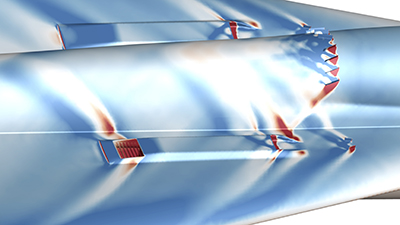
Cart3D and LAVA have been successfully used to verify the supersonic performance of the X-59 during its design, and will again be used to predict the flight performance of the vehicle during the test campaign. During the design phase, these analysis tools, combined with NASA’s high-performance computing (HPC) resources, helped engineers to identify significant flaws in the the vehicle’s design that had the potential to threaten mission success. In one instance, this resulted in a short turnaround redesign of the flight vehicle’s nose. The supersonic performance data for pilot training will also be used by the flight test program to provide a large variety of high-quality data for the FAA and ICAO to help determine the future of civilian supersonic flight.
Why HPC Matters
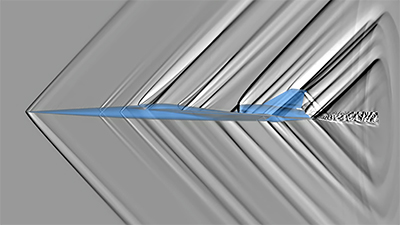
The thousands of CFD simulations required to perform mission planning for the X-59 make HPC an indispensable part of this program. Without high-performance parallel computing, supersonic database generation for the X-59 would not be possible. All X-59 simulations completed by the Ames team have been performed on the Pleiades supercomputer at the NASA Advanced Supercomputing (NAS) facility. A typical LAVA run on Pleiades requires 1,500 Intel Ivy Bridge cores with one to two hours of wall-clock time, and a typical Cart3D boom analysis requires about 500 cores and six hours of wall-clock time.
James Jensen, NASA Ames Research Centerjames.c.jensen@nasa.gov Michael Aftosmis, NASA Ames Research Center
michael.aftosmis@nasa.gov Marian Nemec, NASA Ames Research Center
marian.nemec@nasa.gov Cetin Kiris, NASA Ames Research Center
cetin.kiris@nasa.gov