SARS-CoV-2 Spike Protein: Unlocking the Pick That Picks Our Cells
Overview
SARS-CoV-2, the novel coronavirus that causes COVID-19, has swept across the planet, infecting over 30 million people and killing more than 900,000. Understanding how key proteins of the virus work is crucial to developing effective treatments, vaccines, and eventually a cure. This study investigates both the energetics and dynamics that occur within the spike protein (S), which plays a key role in binding to human epithelial cells and enabling the virus to infect the body. When the protein’s energetics and dynamics—which work together to maintain the viral protein's stability—are sufficiently understood, molecules can be engineered to disrupt the protein's function.
"The SARS-CoV-2 spike protein is composed of over 51,000 atoms; consequently, simulating its molecular dynamics is extremely computationally intensive. Meeting this challenge therefore requires serious computational firepower. Without NASA's HPC resources and personnel, this research could not have taken place."
Project Details
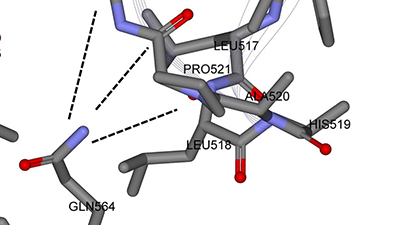
In this project, we sought to identify pairs of amino acids in the S protein that interact with each other at the atomic scale, using a process called energy mapping. Specifically, we looked for amino acids that participate in key intra- and inter-protein energetic interactions, which are involved with maintaining the protein’s structural stability; and fluctuations, which are associated with binding the protein to receptor protein targets on the host epithelial cells. We then probed the dynamics of the S protein to confirm the roles of the amino acids that were identified by the energy mappings.
To perform this study, we employed a variety of software tools for carrying out the energy mappings and molecular dynamics, including our own in-house programs and scripts.
Results and Impact
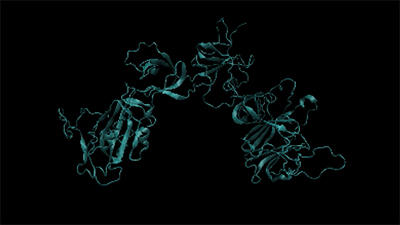
The S protein is trimeric—it is composed of three identical subunits, known as protomers, that each contain a molecular “latch” that keeps each protomer in a closed or “down” conformation when engaged. If not engaged, the protomer is said to be in the “up” state. These specific conformations play an important role in binding to epithelial cells during the cellular infection process.
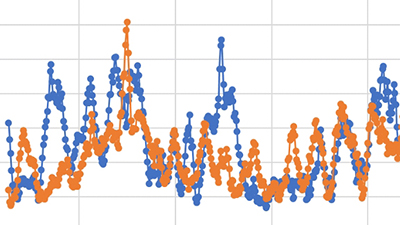
We identified the amino acids that appear to be involved in this “latch” within a given trimer protomer subunit. The attractive interactions of the latch determine whether a protomer is in the up state—in which it can bind to epithelial cells—or in the down state, in which it does not appear capable of binding. The amino acids that make up the latch of a given protomer were also seen in interactions with the two neighboring protomers that make up the complete protein—implying the importance of these latch amino acids in the stability of the complete trimeric spike protein. These insights offer potential drug target candidates for drug design efforts, such as peptide-based inhibitors that could destabilize the S protein or keep the protomers in the down state, thus preventing binding to host cell proteins.
Why HPC Matters
This study was made possible by NASA's high-performance computing (HPC) resources. We used our custom scripts to set up simulations on the Pleiades supercomputer, and ran the simulations on Pleiades using the NAMD molecular dynamics software. NAS staff were instrumental in optimizing NAMD to reduce the wall-clock time for obtaining results. In all, 580,608 node-hours were used to run 32 batches of individual simulation jobs across 36 nodes for three weeks.
What's Next
Future work includes running simulations of systematic mutations to the molecular latch in order to characterize its role in trimer stability in greater detail. From these results, we also aim to engineer peptide-based inhibitors and test, via simulation, how they affect the fluctuations of the spike protein. If possible, additional work will also entail simulations of the spike protein in the presence of its primary host cell ligand, ACE2, with and without any inhibitor candidates. These simulations will ultimately culminate with in vitro tests to determine efficacy of the inhibitors, and possibly inform modifications to original designs, if needed.
Related Links
- Static All-Atom Energetic Mappings of the SARS‑CoV‑2 Spike Protein with Potential Latch Identification of the Down State Protomer
- VCU Researcher Harnessing Supercomputers in the Race Against COVID-19
obastida@umn.edu Michael Peters, Virginia Commonwealth University
mpeters@vcu.edu