Predicted Expansion of the South Atlantic Anomaly in the Next Five Years
Overview
Earth’s magnetic field, also called the geomagnetic field, changes in both time and space. Such changes mostly originate from the Earth’s dynamic fluid outer core. Monitoring, interpreting, and predicting geomagnetic variations are critical for understanding the dynamics of Earth’s deep interior and interactions between the fluid core and the rest of the Earth systems, as well as societal implications.

A collaborative team of researchers from the Geodesy and Geophysics Lab at NASA’s Goddard Space Flight Center and the University of Maryland, Baltimore County have been working on the geomagnetic data assimilation (GDAS) project, in which space-borne and ground-based magnetic measurements are assimilated with core dynamics models via an ensemble Kalman-filter (EnKF) algorithm, with the goal to better estimate the dynamic core state and predict geomagnetic variations.
One of our recent geomagnetic predictions is the continuous westward expansion of the South Atlantic Anomaly (SAA), an area at the Earth’s surface where the geomagnetic field intensity is exceptionally low and stretches from southern Africa, across the southern Atlantic and South America, to the eastern Pacific. The SAA provides unique opportunities for probing the nature of the Earth’s deep interior. It is also a geomagnetic hazard to low-Earth orbit space missions, and is therefore, important to monitor and understand for fundamental science research and societal applications.
"NASA high-performance computing resources are vital for the success of our project."
Project Details
The GDAS project goals are to: 1) understand the responses of the geodynamo model to the assimilation of geomagnetic observations; 2) estimate the dynamic state in the Earth’s core via assimilated geodynamo solutions; 3) investigate interactions between the fluid core and the solid Earth; and 4) make forecasts of geomagnetic secular variation (SV) on sub-decadal timescales. In addition to fundamental scientific research, the team’s assimilation results contribute to the International Geomagnetic Reference Field (IGRF), which is widely used for broad scientific research and applications.

The main tool used in the GDAS project is the Geomagnetic Ensemble Modeling System (GEMS). This system includes a numerical core dynamics model, MoSST_SYS, for simulating the geodynamo in the Earth’s core; an ensemble Kalman-filter system, EnKF_SYS, for assimilating geomagnetic observations with model forecasts; and a shell-based driver, GDAS_SYS, to manage the entire assimilation process. The systems works by generating an analysis at a given “analysis time” by EnKF_SYS, which will then be used as the initial state for MoSST_SYS to make forecasts until the next analysis time.
The core dynamics model utilizes a hybrid finite difference/pseudo-spectral scheme in space, with the state variables including the magnetic field, the fluid velocity field, and the temperature anomaly. Time variations of the state variables are governed by the magnetohydrodynamic and thermal equations, and are solved with proper initial and boundary conditions. The magnetic observations used in GEMS are the geomagnetic gauss coefficients provided by independent global geomagnetic field models derived from observations over the past four centuries.
Results and Impact
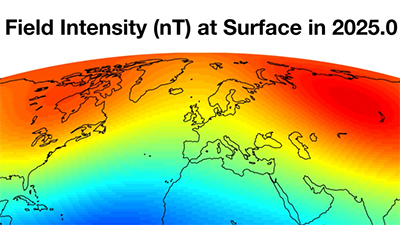
The team produced two animations of the geomagnetic intensity variation from 2010 to 2025, one on the Earth’s mean surface, and the other on the core-mantle boundary (CMB) that is nearly 3,000 kilometers below the surface. Results for the period 2010–2019 are from NASA’s comprehensive CM6 geomagnetic field model. Results for 2020–2025 are derived from forecasts, and were submitted as a candidate SV model to IGRF in 2020. In particular, the SAA is the region enclosed by the outmost contour (30,000 nano Tesla in magnitude) at the Earth’s mean surface. This region has expanded and slowly moved westward through 2010–2019. The team predicts that such expansion will continue in 2020–2025.
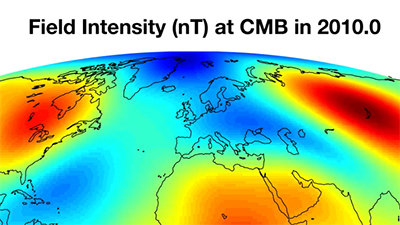
In addition, the field intensity of the SAA will continue to decrease, and a second minimum will reappear near the end of the forecast period. The SAA at the Earth’s surface is correlated with the more complicated migration and seperation of three minima (valleys) on the core-mantle boundary beneath the SAA.
Why HPC Matters
This project requires petaflop-level computation (estimated based on 100x100x100 resolution for a 512‑ensemble assimilation) and NASA’s high-performance computing resources are critical to its success. Over the project period, a substantial amount of the computation was done on the Pleiades supercomputer at the NASA Advanced Supercomputing (NAS) facility at Ames Reseach Center, including the generation of over 10,000 free-running geodynamo simulation results that are used to create initial ensembles for the GDAS project, and assimilation with 3,000-year archeomagnetic field models. Simulations for a single ensemble member utilized up to 128 processors on Pleiades. Assimilation runs are parallelized such that up to 128 ensemble member runs were executed in parallel.
What's Next
One challenge in geodynamo simulation and geomagnetic data assimilation is to reduce model errors (including model biases) by using dynamo parameter values closer to those appropriate for the Earth’s core. This will require higher resolution, and correspondingly, more efficient parallelization. It is expected that more “Earth-like” parameters will help improve estimation of the core dynamic state with GDAS, which will in turn improve our understanding of the Earth’s deep interior and the interactions between its core and the rest of the Earth systems. These improvements will also lead to more accurate secular variation forecasts over longer periods.
Related Links
Weijia Kuang, NASA Goddard Space Flight Centerweijia.kuang-1@nasa.gov Terence J. Sabaka, NASA Goddard Space Flight Center
terence.j.sabaka@nasa.gov Andrew Tangborn, University of Maryland, Baltimore County
tangborn@umbc.edu Ce Yi, NASA Goddard Space Flight Center
ce.yi@nasa.gov