Generating Aerodynamic Databases for NASA’s X-57 Maxwell Aircraft
Overview
NASA’s X-57 Maxwell is an electric aircraft concept designed to achieve a 5x reduction in energy consumption when compared to traditional gas-powered turboprop propulsion. A collaboration between NASA’s Ames Research Center, Armstrong Flight Research Center, and Langley Research Center has demonstrated the ability of computational fluid dynamics (CFD) solvers to accurately predict the complex aerodynamic characteristics of the X-57, and provides confidence in the aerodynamic databases developed for the agency’s flight simulator.

In order to construct these databases, thousands of CFD simulations have been conducted for multiple aircraft configurations, flight conditions, and propulsion settings. In addition, multiple time-dependent CFD computations were performed to assess the dynamic stability of the aircraft under forced roll, pitch, and yaw oscillation. The recent refactorization of the NASA-developed Launch Ascent and Vehicle Aerodynamics (LAVA) flow solver has enabled about a 10x reduction in high-performance computing resources for each X-57 simulation, resulting in a total of 2,500 flight conditions simulated to date.
"Without high-performance parallel computing resources, aerodynamic database generation for the X-57 would not be possible. All database simulations for this work were performed on the Pleiades supercomputer at the NASA Advanced Supercomputing facility at Ames."
Project Details
All LAVA CFD simulations of the X-57 aircraft were performed by solving the steady and unsteady Reynolds-Averaged Navier-Stokes (RANS) equations using a structured curvilinear mesh paradigm. Initial simulations at the beginning of this study served as a validation of CFD predictions, where results were compared with experimental data to help determine the appropriate mesh resolution, numerical scheme, and turbulence model to be used during database generation. Additionally, CFD solutions from multiple solvers were compared to further verify that predictions were consistent among multiple codes.
Using the lessons learned from these preliminary simulations, database generation for the X-57 aircraft began for the many flight conditions and aircraft configurations across the flight envelope. The X-57 utilizes electrically powered distributed propulsion technology, with 12 high-lift propellers distributed across the wing to maximize lift during takeoff and landing. Therefore, modeling propulsive effects in a computationally feasible way helps quantify the effects of these propellers for a variety of power settings. The integrated aerodynamic loads and moments computed for these powered simulations are necessary to quantify stability characteristics, which are then used to develop the flight simulator model.
Results and Impact
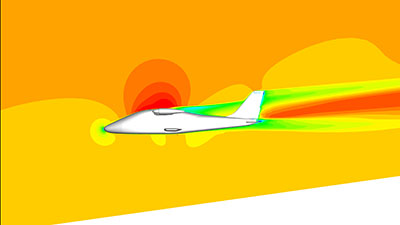
The validation studies, conducted before database generation began, demonstrated that CFD solvers could predict aerodynamic loads and moments to within 5% across the all of the codes, and within 8% of the experimental data. All aerodynamic database results computed to date are also consistent across the solvers and any minor variations quantify uncertainty that is incorporated in the final model. Many key lessons learned during this analysis will be valuable for future mission-critical NASA projects, including procedures for verification and validation that were established to ensure subsequent database simulations would be optimal in terms of accuracy and computational efficiency.
This work found that tools for rapid pre-processing and post-processing of large quantities of CFD data will also be incredibly useful for future NASA programs that require database generation. Additionally, the successful application of the refactored LAVA flow solver to the X-57 problem has demonstrated that the latest version of the software can reduce required resources by an order of magnitude relative to the previous solver, greatly accelerating the turnaround time for database completion.
Why HPC Matters
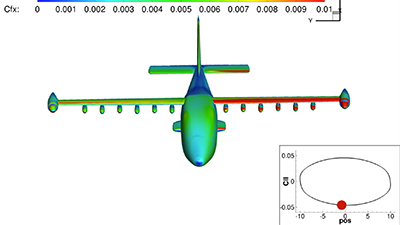
Without high-performance parallel computing resources, aerodynamic database generation for the X-57 would not be possible. All database simulations for this work were performed on the Pleiades supercomputer at the NASA Advanced Supercomputing (NAS) facility at Ames. With the refactored LAVA flow solver, simulations can now be run on 800 Intel Ivy Bridge cores within 2–4 hours, which previously required 1,200 Ivy Bridge cores for 16–24 hours. To date, nearly 40 million core hours on NAS computing resources have been utilized for this project.
Jared Duensing, NASA Ames Research Centerjared.c.duensing@nasa.gov Cetin Kiris, NASA Ames Research Center
cetin.c.kiris@nasa.gov