Developing Aerodynamic Databases for Artemis’ Booster Separation Event
Overview
NASA’s Artemis Program will land the first woman and next man on the lunar surface by 2024. Crews on Artemis missions will be launched in an Orion crew vehicle atop NASA's Space Launch System (SLS), the most powerful rocket ever constructed. Each of the possible configurations of the SLS has two solid rocket boosters (SRBs), which were developed on technology used in the agency’s Space Shuttle Program. About two minutes after liftoff, these SRBs separate from the center core of the SLS using 16 small rockets called booster separation motors. For the safety of the crew and success of the mission, it is critical for NASA engineers to understand the possibility of the SRBs striking the center core or each other during the separation event. The conditions during this phase of flight are difficult, if not impossible, to model in an experimental setting; and as such, detailed aerodynamic databases are constructed using NASA-developed computational fluid dynamics (CFD) tools.
Project Details
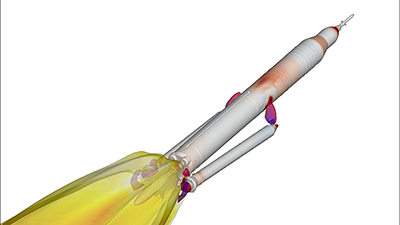
Simulations made using the NASA’s FUN3D and OVERFLOW codes are being used to construct the booster separation databases for future Artemis missions. A total of 22 different engine rocket plumes are accounted for in the CFD calculations, and the aerodynamic data itself is a function of 13 independent variables: six describing position (three for translation and three for rotation); four describing free-stream conditions (angles of attack/sideslip, Mach number, and air density); and three describing thrust conditions (core, booster, and booster separation motors). Simulating these variables in a large number of permutations requires thousands of data points in order to provide full coverage of the database, creating a challenging balance of resources to produce the best data possible.
Results and Impact
"Ultimately, the results of these simulations will be critical in reducing the risk to the crew of Artemis II, the mission’s first crewed flight test, during booster separation."
These databases will be used by the Guidance, Navigation, and Control (GNC) group at NASA’s Marshall Space Flight Center to model the booster separation event for Artemis missions. The GNC team will incorporate the aerodynamic data into their dynamic simulations, which will be used to ensure that the boosters can separate successfully without recontacting the core under all possible flight conditions. Ultimately, the results of those simulations will be critical in reducing the risk to the crew of Artemis II, the mission’s first crewed flight test, during booster separation.
Why HPC Matters
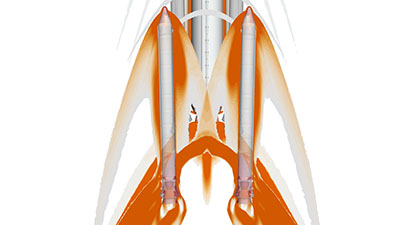
All CFD simulations to develop the database were run in different stages on the Pleiades and Electra supercomputers at the NASA Advanced Supercomputing (NAS) facility, with each case using approximately 2,500 core hours. The nominal database required 5,780 FUN3D simulations, while various supporting simulations (core stage engine failures, interpolation check cases, code to code verification, etc.) required an additional 13,000 simulations.
Jamie Meeroff, NASA Ames Research Centerjamie.g.meeroff@nasa.gov Stuart Rogers, NASA Ames Research Center
stuart.e.rogers@nasa.gov Aaron Burkhead, NASA Ames Research Center
aaron.c.burkhead@nasa.gov Daniel G. Schauerhamer, NASA Ames Research Center
daniel.g.schauerhamer@nasa.gov