High-Fidelity Multiphase Simulations of the KSC Launch Environment
Overview
The Launch Ascent and Vehicle Aerodynamics (LAVA) team within the the NASA Advanced Supercomputing (NAS) Division’s Computational Aerosciences Branch at Ames Research Center is supporting Kennedy Space Center (KSC), the agency’s Space Launch System (SLS) program, and commercial partners by providing high-fidelity simulation data for the SLS at Launch Complex 39B, and for other KSC launch complexes. These computational fluid dynamics (CFD) simulations examine the ignition overpressure (IOP) and duct overpressure (DOP) waves that result from the ramp-up of liquid and solid rocket engines. The strong IOP and DOP waves interact with the launch vehicle and have the potential to endanger a mission.
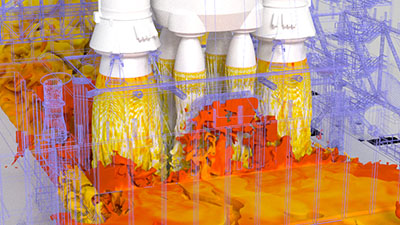
For Launch Complex 39B, the CFD simulations have been a critical component guiding design decisions for significant modifications to the trench, mobile launcher, and tower. Utilizing LAVA’s Cartesian Navier-Stokes solver with its immersed boundary method, we simulate rocket launch startup sequences including complex geometry for both the SLS and commercial vehicles, the launch pad before and after trench modifications, and the neighboring launch tower. LAVA's high-order accurate numerical methods propagate the IOP and DOP waves accurately within these complex domains.
"Computational fluid dynamics data are being used to guide project engineers in evaluating real-time, mission-critical design decisions as the main flame deflector and mobile launcher redesign/build project progresses."
Project Details
To accomplish the next level of flow physics fidelity needed for the launch pad simulations it is critical to include a multiphase capability in the flow solvers. To achieve this, we are extending the capabilities of our in‑house LAVA code to enable simulation of multiphase launch environments. The effort specifically targets simulations of NASA's water-based Ignition Over-pressure Sound Suppression (IOP/SS) system, which delivers over 400,000 gallons of water per minute into targeted locations on the launch site. This system is necessary to protect launch vehicles and their payloads from the powerful acoustic environment created during launch.
We are also incorporating novel numerical methods into the LAVA framework for solving equations of multiphase flow that includes both liquids and gasses. These robust and high-order methods accurately resolve the complex flow features while still remaining stable for extreme problems involving shocks and material interfaces. The development of this capability has partially been supported by KSC’s Exploration Ground Systems; our team is responsible for delivering validation study results that demonstrate the effectiveness of our solver. Validation of this new tool would give Ames a novel capability that is in high demand to inform mission-critical design decisions.
Results and Impact
Over the past decade, the LAVA team has made major contributions to KSC’s redesign of the main flame deflector (MFD) and mobile launcher (ML), using high-fidelity rapid turnaround analysis. For example, during late stages of the rebuild, the KSC team realized that the gaps between the MFD and the trench wall, and the gaps between the steel plates of the MFD itself, could allow hot plume gases and strong acoustic waves to affect structures under the MFD, posing launch safety and maintenance concerns. Experts from the LAVA team were called in to apply high-resolution CFD to help identify thermal, pressure, and flow environments on and around the geometrically complex MFD. Current work includes updating the analysis with the latest SLS engine conditions, and updating the pad with the latest built geometry.
The LAVA team continuously improves and updates NASA’s launch environment simulation capability by routinely enhancing the numerical methods, including accuracy, robustness, and time-to-solution on NAS’s latest systems. As a result, CFD data are being used to guide project engineers in evaluating real-time, mission-critical design decisions as the MFD and ML redesign/build project progresses. Results allow engineers to confidently continue the project and will help NASA reduce the mission risk by averting issues and potentially saving significant amounts of time and money. This collaboration also represents a great opportunity to advance Ames’s key expertise in the launch acoustics area, and to further improve the NAS Division’s in-house software.
Why HPC Matters
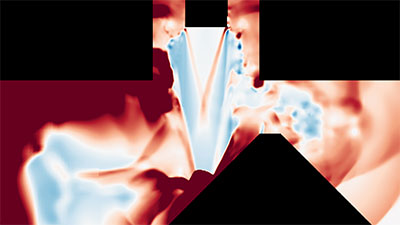
The high-resolution simulations of the launch environment required approximately five weeks of simulation time on the Electra supercomputer, using up to 4,000 Intel Skylake cores. With the added complexity of modeling the IOP/SS system, the need for powerful computational resources also grows. Because these simulations are time-dependent, they generate hundreds of terabytes of data for each calculation, which are stored on the mass storage system at the NAS facility.
More Information
Michael Barad, NASA Ames Research Centermichael.f.barad@nasa.gov Jordan Angel, NASA Ames Research Center
jordan.b.angel@nasa.gov Emre Sozer, NASA Ames Research Center
emre.sozer@nasa.gov James Jensen, NASA Ames Research Center
james.c.jensen@nasa.gov Cetin Kiris, NASA Ames Research Center
cetin.c.kiris@nasa.gov