CFD Simulations of Complex Multirotor Test Systems in a Wind Tunnel
Overview

NASA recently developed the Multirotor Test Bed (MTB) system as a part of the agency’s Revolutionary Vertical Lift Technology Project with the intention of facilitating wind-tunnel testing for new and existing multirotor aircraft configurations, with a focus on collecting data for unmanned aircraft system (UAS) vehicles. Multirotor UAS flow fields are complex and require high-fidelity Navier-Stokes simulations for accurate representation. In general, the flow field of a conventional helicopter and other multirotor vehicles, whether in forward flight or hover, consists of unsteady aerodynamics with complex three-dimensional wakes dominated by vortices from the rotor blade tips. Using computational fluid dyanmics (CFD), researchers at NASA’s Ames Research Center seek to simulate the MTB and capture rotor blade aerodynamics, blade and rotor performance, and rotor-body interactions in order to improve understanding and performance of multirotor systems.
"High-performance computing resources are necessary for large simulation efforts on this scale. This is even true for low-order methods where multiple simulations could be run efficiently and expediently."
Project Details
The MTB was designed to allow researchers and engineers to adjust the vertical, lateral, and longitudinal placement of each rotor, as well as the rotor tilt and the pitch of the whole aircraft assembly. Validation using experimental data for lower-order modeling and a full rotor unsteady simulation was performed using the high-performance computing resources at the NASA Advanced Supercomputing (NAS) facility at NASA Ames. For these simulations, the team attempted a new computational framework on geometric details using an auto-meshing algorithm.
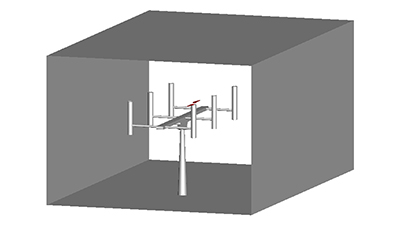
To reduce the complexity of simulating unsteady flows of the rotating blades with moving overset grids, the team made use of an option in the NASA-developed OVERFLOW CFD flow solver to model rotors and propellers as infinitely thin disks, which are represented by the momentum source terms in the governing Navier-Stokes equations. Both full rotor and disk models were loosely coupled with the CAMRAD II comprehensive rotorcraft analysis software and tested on various rotor systems.
Results and Impact
High-fidelity CFD simulations are necessary for representing the complex flow physics of multirotor vehicles in detail. Comparison to physical experiments and validation were performed for both the full rotor and disk model. The wind tunnel geometry was included in the model, allowing rotor-rotor interactions and interactions with the other components of the tunnel to be simulated, to ensure parity with experimental data. The geometry of the MTB system was represented by Boundary Representation solids, which were created using the SolidWorks CAD software.
Why HPC Matters
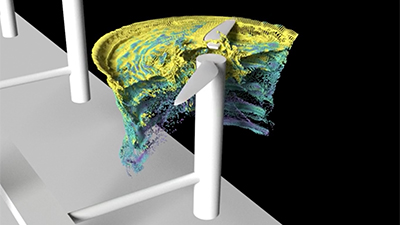
High-performance computing resources are necessary for large simulation efforts on this scale. This is even true for low-order methods where multiple simulations could be run efficiently and expediently. The unsteady MTB simulations required a large amount of computational and storage resources to manage the large dataset. Additionally, researchers needed the ability to assimilate various tools to enhance the capability of the whole analysis process. For this work, simulations were carried out using the Pleiades, Electra, and Aitken supercomputers at the NAS facility.
What's Next
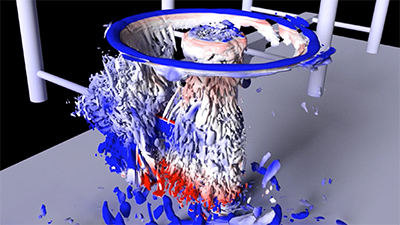
Experts within the NAS Division are developing an automatic overset surface and volume mesh generation tool that will reduce the time needed to perform the MTB simulations. This auto-mesh process would take approximately two minutes to produce surface grids of the MTB geometry on a laptop, down from the more than two weeks a manual approach would require.
Related Links
- The Multirotor Test Bed – A New NASA Test Capability for Advanced VTOL Rotorcraft Configurations (PDF 1.9 MB)
jasim.u.ahmad@nasa.gov William M. Chan, NASA Ames Research Center
william.m.chan@nasa.gov Sarah A. Conley, NASA Ames Research Center
sarah.a.conley@nasa.gov Carl R. Russel, NASA Ames Research Center
carl.r.russel@nasa.gov