
Designing Aircraft Engines to Burn Lean and Clean
Overview
Due to the high temperatures inside aircraft engine combustors, nitrogen and oxygen present in the air moving through the combustors can combine to form nitric oxide (NO) and nitrogen dioxide (NO2)—referred to collectively as NOx. Over the past 30 years, efforts to minimize ozone and smog formation by reducing NOx emissions near airports have been largely successful. Currently, new efforts are underway to minimize NOx emissions during the climb and cruise phases of flight. In one concept for reducing NOx emissions, known as Lean Direct Injection (LDI), a single fuel injector is replaced by many small fuel injectors to provide rapid mixing of air with liquid sprays within a short distance. Burning lean (using less fuel) results in lower combustor temperatures and reduced NOx emissions. The Aeronautical Sciences (AS) project of the NASA Aeronautics Mission Research Directorate is improving the capability of computational fluid dynamics (CFD) models to accurately predict emissions for advanced low-emissions combustion concepts operating on a variety of fuels.
Project Details
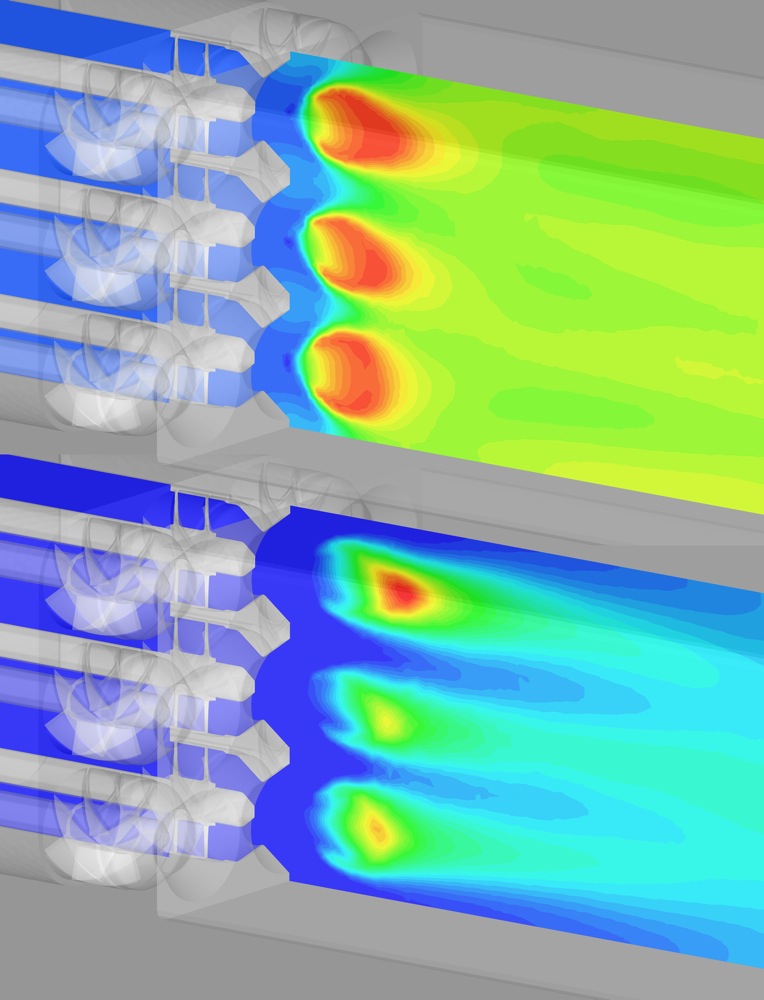
In the combustion technical discipline of the AS project, we are working to improve the capabilities of the National Combustion Code (NCC) to analyze chemically reacting flows with liquid fuel injection. New capabilities being developed include using a time-filtered Navier-Stokes approach, turbulence/chemistry interactions, and polyhedral meshing. Our simulations use Reynolds-Averaged Navier-Stokes (RANS) equations with laminar chemistry. We simulated an LDI combustor concept using nine fuel injectors, arranged in a 3-by-3 matrix injector pattern, for two air swirler configurations (helical axial swirlers using 45- and 60-degree blade angles) and three lean fuel-air equivalence ratios (0.43, 0.39, and 0.37 for a 45-degree blade angle, and 0.55, 0.43, and 0.24 for a 60-degree blade angle). NCC simulations were compared against experimental data for pressure drop and NOx emissions at the combustor exit. Meshes included flow upstream of the air swirler passages and the entire test rig section downstream of the injectors and main combustion section.
Results and Impact
Our simulations provided validation of pressure drop and NOx emissions against baseline (2005) LDI combustor concepts, and resulted in the development of best practices for RANS simulations of LDI combustor concepts. The knowledge obtained is now being used to support the design of several advanced combustor concepts under the Environmentally Responsible Aviation (ERA) project, and to provide guidance to the AS project on areas for improvement in NCC development.
Role of High-End Computing Resources
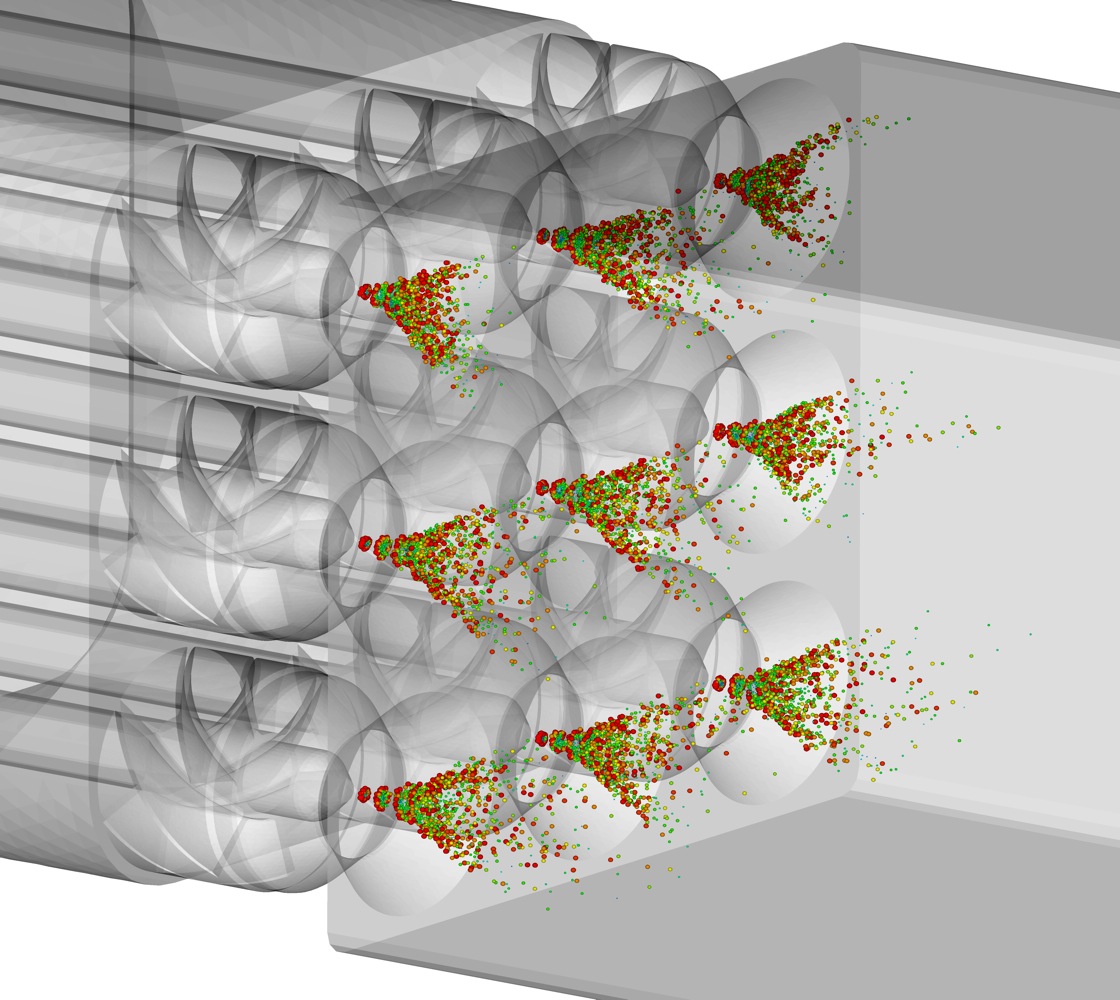
The RANS simulations required approximately 1 million cells per fuel injector, or about 9.5 million cells for the 9-point injector results shown in the images. LDI combustor concepts with up to 27 injectors have also been simulated. All 9-point LDI simulations were performed on NASA's Pleiades supercomputer using 576 Intel Xeon Westmere processors. For the 18-step chemistry and the several thousand spray particles used in these simulations, each case required about 60 hours of wall-clock time to converge. We are now performing time-accurate simulations that capture large-scale turbulent structures—requiring more computer resources by several orders of magnitude.
Jeffrey Moder, NASA Glenn Research Centerjeffrey.p.moder@nasa.gov Kumud Ajmani, NASA Glenn Research Center
kumud.ajmani-1@nasa.gov