
Innovating the Future of the Passenger Airplane
Overview
NASA is investigating innovative new ways of improving passenger airplanes. Higher fuel efficiency and less noise are two major goals of this effort. One proposed idea—the D8 airplane—takes its inspiration from the submarine. The D8 design uses a doublewide fuselage configuration made by joining two traditional fuselages placed side-by-side. The wider fuselage provides higher lift and two aisles for boarding passengers. This reduces the amount of lift required from the wing, making it possible to design a smaller, lighter wing. The D8's engines are mounted on the top rear of the fuselage, which enables the fuselage and tail assembly to act as a diffuser and nacelle, eliminating the need for an additional nacelle to house the engine components. The design also includes a boundary-layer ingesting fan that should provide additional efficiency as it does for a submarine propeller.
Project Details
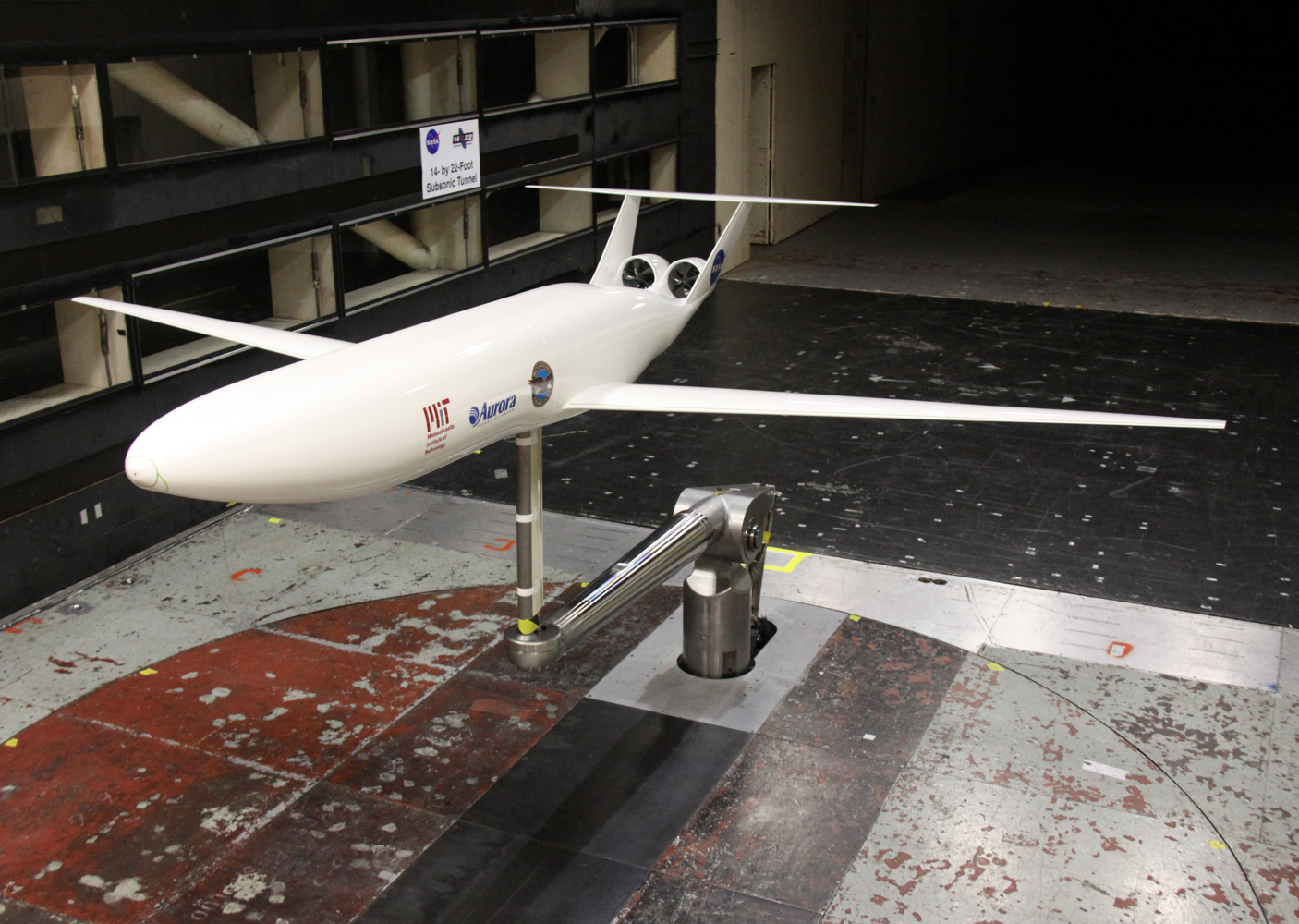
A 1:11 scale model of the D8 is being tested in the 14-by-22-foot wind tunnel at Langley Research Center to ascertain whether the concept actually uses less power to fly compared to a conventional design. In conjunction with these tests, computational fluid dynamics (CFD) simulations are being performed to determine the effect of the boundary-layer ingesting fan on the airplane's performance. CFD simulations of both the full-scale airplane and the wind tunnel model are being conducted. An unpowered model of the airplane is used to validate the simulations. Subsequently, the power required to fly the aircraft is computed for a podded nacelle configuration, which has the engines placed on pods on the side of the fuselage like a business jet, and the boundary-layer ingesting configuration with the engines placed on the top rear of the fuselage. The required power is then compared to determine which method is more efficient.
Results and Impact
The computational results are expected to verify the wind tunnel experiment's conclusion that the D8's integrated nacelle design is more fuel-efficient than the traditional podded nacelles. If proven, this could mean that future aircraft may use this NASA-fostered technology to save fuel on commercial aircraft. This fuel savings may translate to lower air travel costs for passengers. The computational results are also expected to shed additional light on the reasons behind the better fuel efficiency by examining the airflow behavior in the vicinity of the engines.
Role of High-End Computing Resources
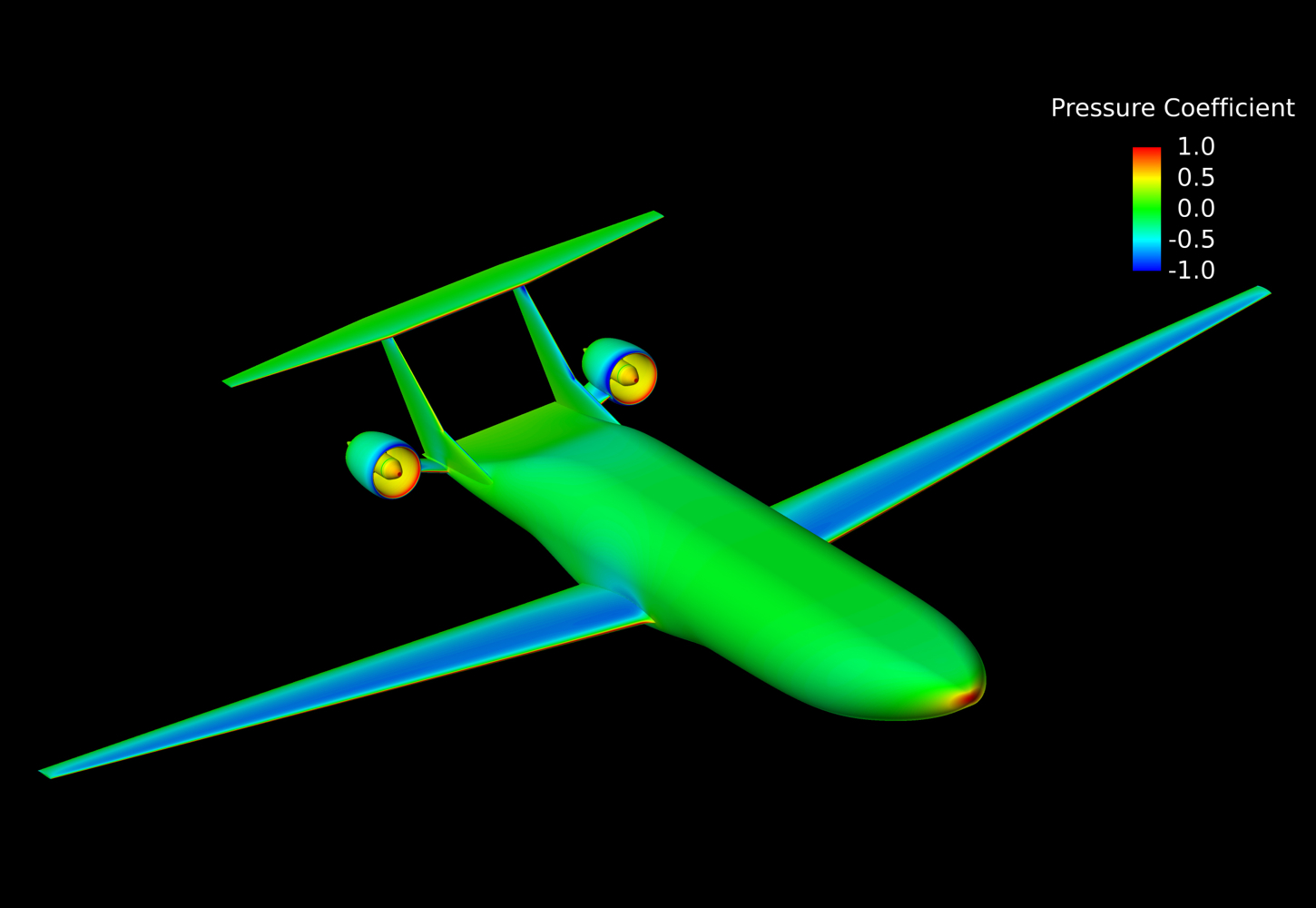
CFD simulations of the aircraft in flight require accurate modeling of both the aircraft and the airspace in its vicinity. To accomplish this, a computational model of the full aircraft would require approximately 250 million grid cells. Computing a single analysis run for a model of this resolution would take approximately 30,000 processor-hours on the Pleiades supercomputer at NASA Ames Research Center. Our simulations use an assumption of symmetry, which makes it possible to compute flow on only one side of the airplane and reduces the computing requirements by half. The results allow us to compare computational data with wind tunnel tests to validate the solution accuracy and determine if the boundary-layer ingesting nacelle is indeed more fuel efficient. The fast NASA networks also allow a geographically separated team from two NASA centers and the Massachusetts Institute of Technology (MIT) to collaborate efficiently.
Michael Barad, NASA Ames Research Centermichael.f.barad@nasa.gov Shishir Pandya, NASA Ames Research Center
shishir.pandya@nasa.gov