
Advancing Rotorcraft Simulation Using Computational Fluid Dynamics
Overview

Rotorcraft such as helicopters and tiltrotors provide many civil and military services due to their ability to take off and land vertically without a runway. Performing accurate aerodynamic analyses of these vehicles is very challenging. Vortices form at rotor blade tips and interact with other blade vortices and vehicle components, resulting in very complex flow fields. Physics-based computational fluid dynamics (CFD) simulation methods based on the Navier-Stokes equations can provide more accurate analyses of rotorcraft aeromechanics than other simplified models. Rotorcraft analyses require a multidisciplinary approach that combines aerodynamics, blade flexibility, and blade motions for trimmed flight. This is accomplished by loosely coupling the OVERFLOW CFD code, which provides nonlinear viscous aerodynamics, with the CAMRAD II helicopter comprehensive analysis code, which provides computational structural dynamics and trim algorithms.
Project Details
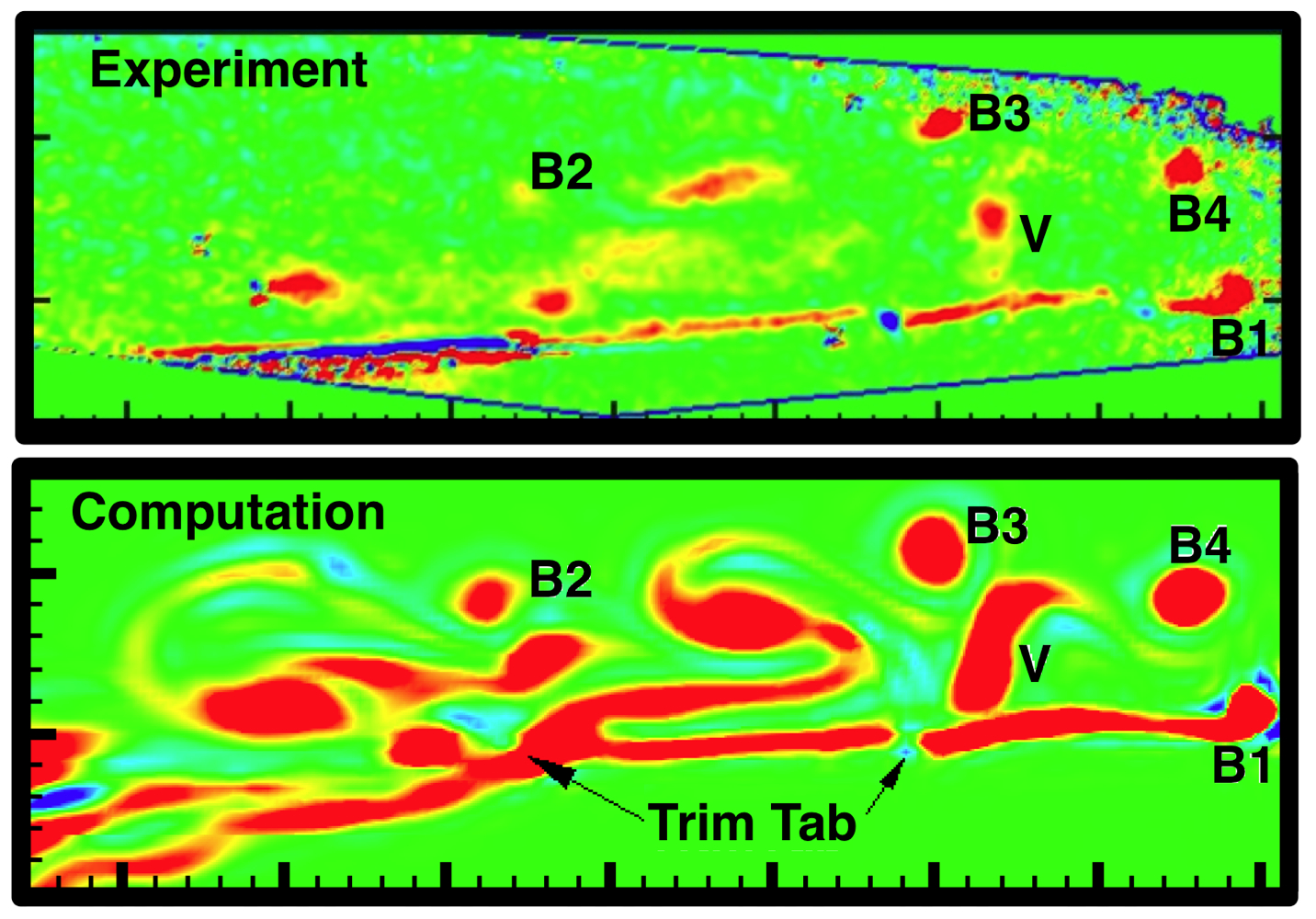
One of the goals of the Rotary Wing Project within NASA's Fundamental Aeronautics Program is to develop advanced CFD methods with improved simulation accuracy. We accomplish this by developing new code capabilities, such as high-order spatial and temporal accuracy, adaptive mesh refinement (AMR), and improved turbulence models using detached eddy simulation (DES). We assess the accuracy of our simulations by comparing computed results with wind tunnel and flight test measurements. Two other goals are to utilize these new capabilities to advance our understanding of rotor aeromechanics and improve the performance of new rotorcraft concepts.
Results and Impact
Using advanced simulation methods, NASA's Rotary Wing Project has achieved significant improvements in rotorcraft modeling capabilities. Key accomplishments include:
- Improved prediction accuracy for the figure of merit (the chief hover performance parameter) from 2 percent error to 0.2 percent error using fifth-order spatial accuracy and DES turbulence modeling.
- A 50 percent accuracy improvement (compared to 2007 state-of-the-art models) in predicting the normal force and pitching moment of a Blackhawk helicopter rotor in forward flight.
- Increased prediction accuracy for vortex core sizes from 60 percent error to 4 percent error using AMR.
- Computed vortex core strengths and locations compare very well with experimental particle image velocimetry measurements.
Role of High-End Computing Resources
Our project's multidisciplinary flow simulations required 5 - 24 hours to compute each rotor revolution and a total of 1 - 2 weeks to run each case using 1,500 - 4,600 cores on NASA's Pleiades supercomputer. Grid sizes varied from 60 - 750 million grid points, and up to 100 terabytes of disk space were needed to render movies of the unsteady flow simulations.
Neal Chaderjian, NASA Ames Research Centerneal.chaderjian@nasa.gov Jasim Ahmad, NASA Ames Research Center
jasim.u.ahmad@nasa.gov