
Formation of Massive Stars from Giant, Turbulent Molecular Clouds
Overview
The formation of high-mass stars—with masses 10 - 100 times greater than our Sun—remains one of the most significant unsolved problems in astrophysics. These stars dominate energy injection into the interstellar medium and eventually explode as supernovae, producing most of the heavy elements in the universe. Ionizing radiation feedback from massive stars destroys the molecular clouds in which they are born and shapes the evolution of galaxies. Many low-mass stars are born in clusters containing massive stars, and Hubble Space Telescope observations show that stellar accretion disks around both types of stars are destroyed by the ionizing radiation from the massive stars. Extragalactic astronomers use observations of the ionized regions produced by these stars as a prime tool for determining star formation rates and abundances in galaxies. Although massive stars are central to the key phenomena that shape the universe, the processes involved in their formation remain elusive. To investigate these processes, we perform large-scale simulations of massive stars forming from the collapse of giant, turbulent molecular clouds.
Project Details
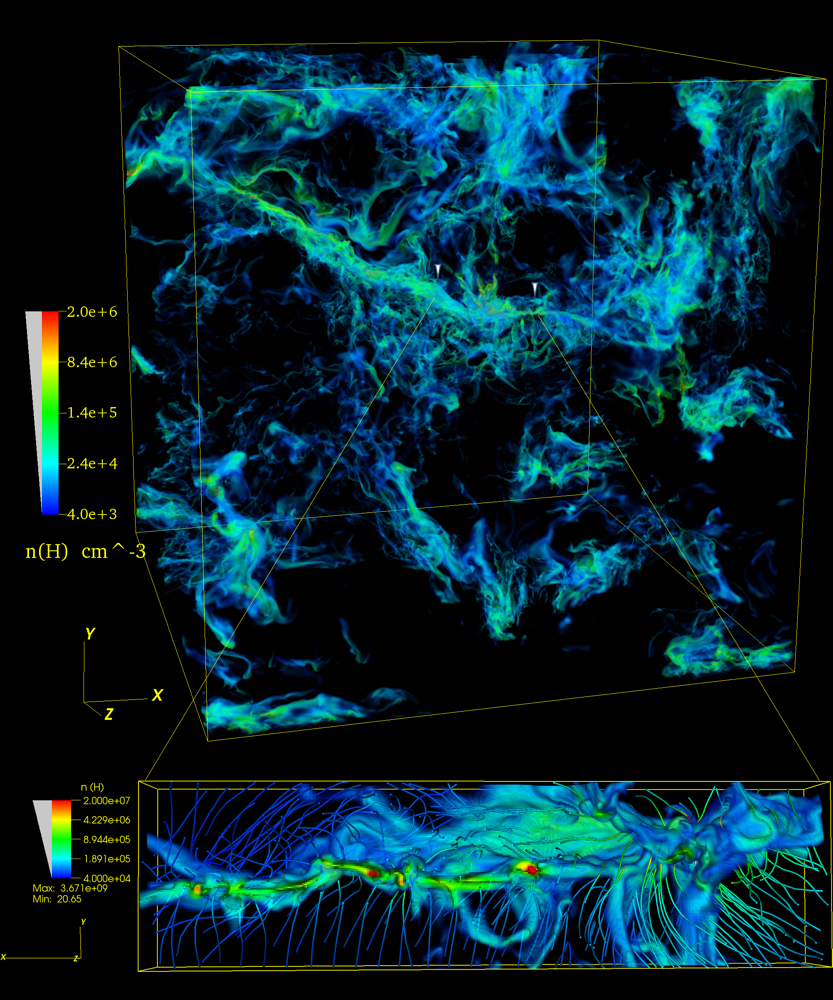
Using our state-of-the-art 3D astrophysical adaptive mesh refinement (AMR) code, ORION, we developed large-scale radiation-magnetohydrodynamics simulations that follow the gravitational collapse of a massive, highly turbulent, magnetized molecular cloud from over 5 parsecs down to 0.00005 of a parsec. Within the cloud, the collapse is simulated down to the formation of multiple turbulent clumps, which further collapse into star-forming cores. Using AMR, these magnetized turbulent cores are then further evolved to the formation of massive stars. The huge dynamic range of the AMR simulations is effectively equivalent to 1015 volumetric cells. These simulations include, for the first time, magnetic fields, radiation transport, turbulence, and highly energetic protostellar outflows.
Results and Impact

Our work supports NASA's goals to understand the origins of stars and galaxies in our universe. Our simulations show how massive, magnetized, infrared dark turbulent clouds collapse gravitationally to form turbulent filaments, which fragment into star-forming cores. These simulations are the first to include feedback from magnetic fields, radiation, and outflows, and to be evolved far enough to show the fragmentation properties of the bulk of the gas in the core. Results show that the coupled effects of magnetic fields and radiative feedback strongly suppress core fragmentation, leading to the production of single massive star systems rather than small stellar clusters.
Role of High-End Computing Resources
Our simulations were performed on NASA's Pleiades supercomputer at the NASA Advanced Supercomputing facility. Each simulation used 1,000 - 4,000 processors, for a total of 1 million processor-hours over several months of computation, and produced several terabytes of data. Simulations of this enormous range of scale would not be possible without NASA's vast computational resources.
Richard Klein, Lawrence Livermore National Laboratory, University of California, Berkeleyrklein@astron.berkeley.edu