
HECC—Continuing NASA's 30-Year Legacy of Supercomputing Innovation
Overview
NASA's High-End Computing Capability (HECC) Project provides an agency-wide compute environment focused on enabling science and engineering discovery across all technical mission organizations. The HECC team has engineered a high-performance computing (HPC) solution that meets the competing demands of capacity, capability, and time-critical computing simultaneously—providing our users the hardware and services needed to achieve their science, research, and engineering goals.

Project Details
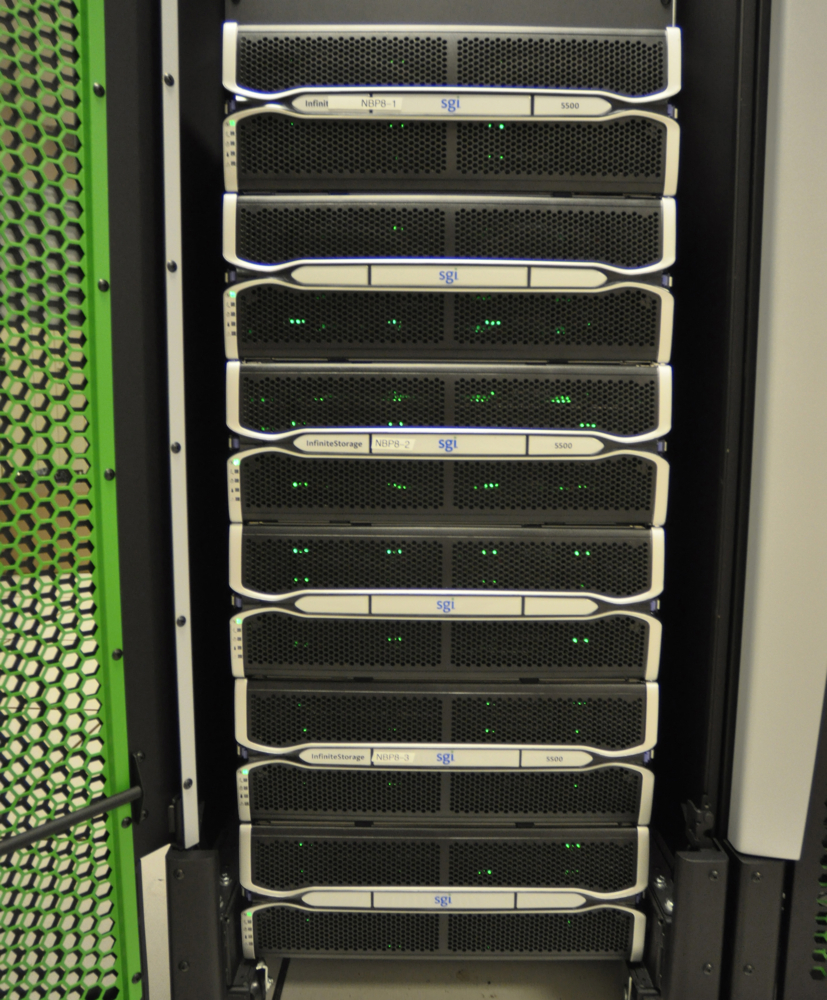
Based at the NASA Advanced Supercomputing (NAS) facility at Ames Research Center, HECC meets the agency's HPC requirements through a customer-focused team of professionals providing world-class services to a broad array of technical users. This year, the HECC team made several large procurements that improved the theoretical peak performance of Pleiades, NASA's flagship supercomputer, from 1.7 to 2.87 petaflops, and more than doubled the NAS facility's online storage capacity from 9 to 20 petabytes.
We also deployed two test systems incorporating the Intel Xeon Phi coprocessor, based on the company's Many Integrated Core (MIC) architecture, to assess the systems' viability to meet the increasing computational demands of our user community. In addition, we enhanced our website and began a series of web-based seminars designed to improve users' efficiency on the systems.
The team remains driven to provide the best HPC environment possible to our users, through advances in hardware and improved service delivery.
Results and Impact
HECC supports over 900 users in 40 states. These engineers and researchers run extremely sophisticated codes in their quest to solve some of the world's most complex problems—from designing safer aircraft to investigating the formation of the universe. To enable this work, HECC must provide a stable, reliable environment where users can run jobs ranging from one node to tens of thousands of nodes.
This year, the results of our work include:
- A 62% increase in Pleiades' overall peak performance.
- Over 100% growth in Lustre storage, with improved performance on random access files.
- Ensured continuous system availability with the installation of four Rotary Uninterruptible Power Supply units.
Role of High-End Computing Resources
The HECC Project provides world-class high-end computing, storage, and associated services to enable scientists and engineers supporting NASA missions to broadly and productively employ large-scale modeling, simulation, and analysis to achieve successful mission outcomes.
William Thigpen, NASA Ames Research Centerwilliam.w.thigpen@nasa.gov