
Improving Predictions of Sea Level Rise with the Ice Sheet System Model
Overview
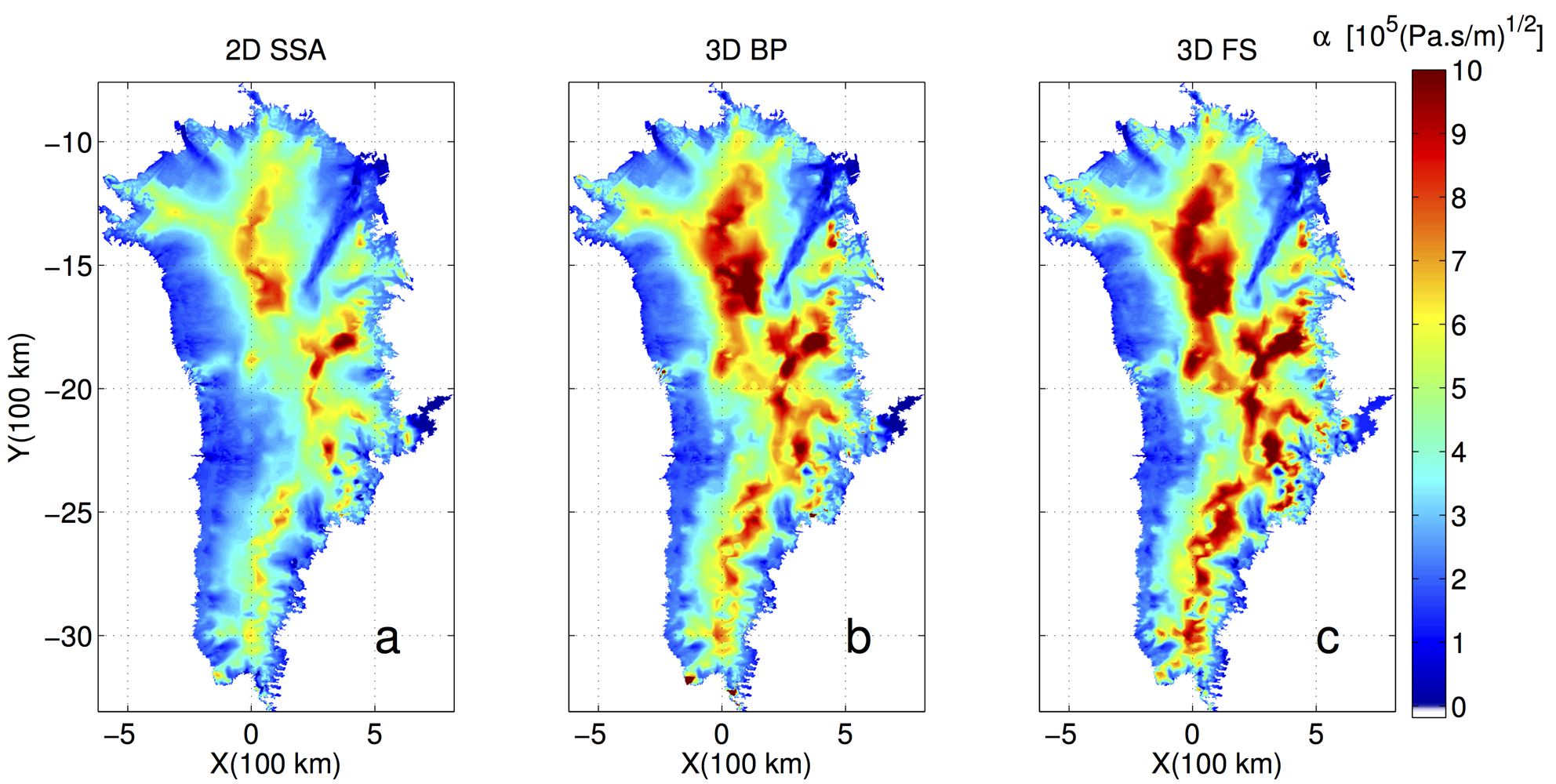
Melting polar ice sheets (Antarctica and Greenland) are one of the main contributors to sea level rise. NASA has launched airborne and satellite missions such as IceBridge, IceSat, and GRACE to monitor these ice sheets in both time and space. The enormous amount of data retrieved from these missions has driven development of state-of-the-art ice-sheet models to integrate these data for improved predictions of sea level rise. In collaboration with the California Institute of Technology and the Universities of California at Irvine and Los Angeles, we have made important progress in modeling the evolution of polar ice caps using the Ice Sheet System Model (ISSM).
Project Details
ISSM is a finite-element, large-scale, high-resolution, multi-model, and multi-scale framework developed at the Jet Propulsion Laboratory (JPL) to simulate the evolution of polar ice sheets over the next 20 - 100 years. Due to the challenging nature of this endeavor, ISSM relies heavily on data assimilation techniques including adjoint-based inversions; optimizations to try to match observations and simulations; a wide array of model physics; and advanced parallel and automatic differentiation methods. Integration of these complex technologies within one homogeneous C++ code allows for high-fidelity, continental-scale simulations of Antarctica and Greenland. The framework can be deployed on any architecture, in particular high-performance clusters such as NASA's Pleiades supercomputer, or even on the cloud (e.g., Amazon's EC2).
Results and Impact
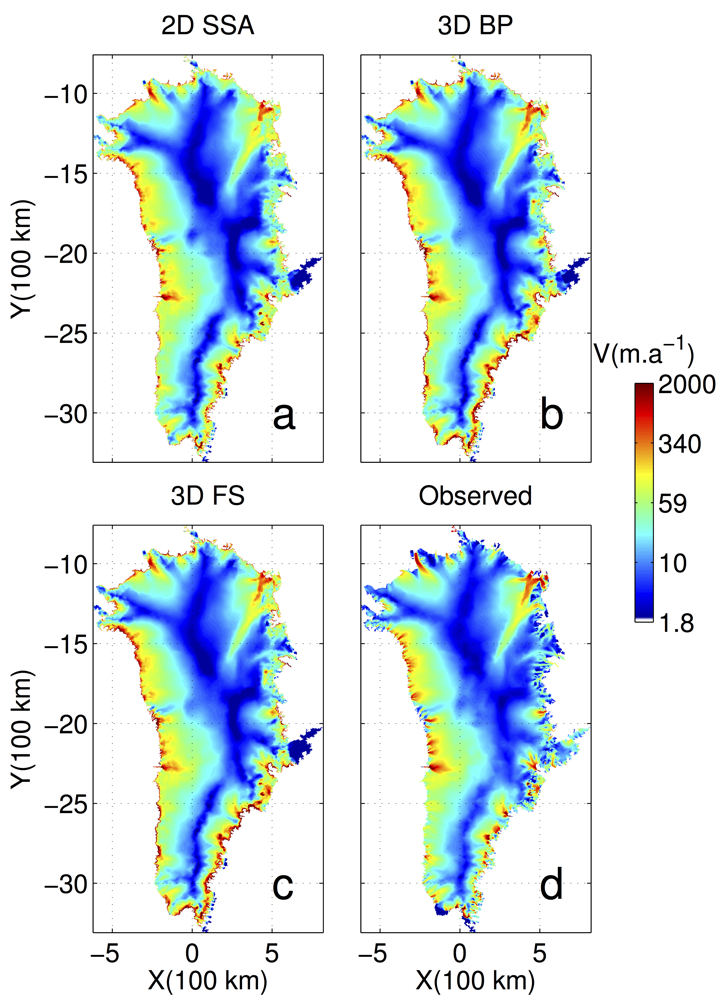
ISSM simulations have resulted in unique science pertaining to the stability of polar ice sheets in a changing climate, including: understanding the role of bedrock topography in model spin-ups; assessing the sensitivity of polar ice sheets to boundary conditions such as geothermal heat flux, surface temperature, and surface forcing; and improving model predictions using adjoint-based inversions to infer basal friction at the ice/bed interface. These results have led to quantifiable improvements in model projections, which have led to a better understanding of how polar ice sheets will contribute to sea level rise in the near future.
Role of High-End Computing Resources
A standard ice flow model of Antarctica requires approximation of 200,000 elements in 2D, and 20 times more elements in 3D. For full Navier-Stokes models, this translates into 4 billion degrees of freedom, which is computationally prohibitive. To address this issue, we developed simplified formulations in which ice flow physics is reduced in complexity, resulting in simulations of approximately 5 million degrees of freedom. Each simulation can be run easily on Pleiades for uncertainty analyses, using approximately 1,000 processors for 5 days per run.
Eric Larour, NASA Jet Propulsion Laboratoryeric.larour@jpl.nasa.gov